


BUILDING PERMIT DRAWINGS FOR FOURPLEX
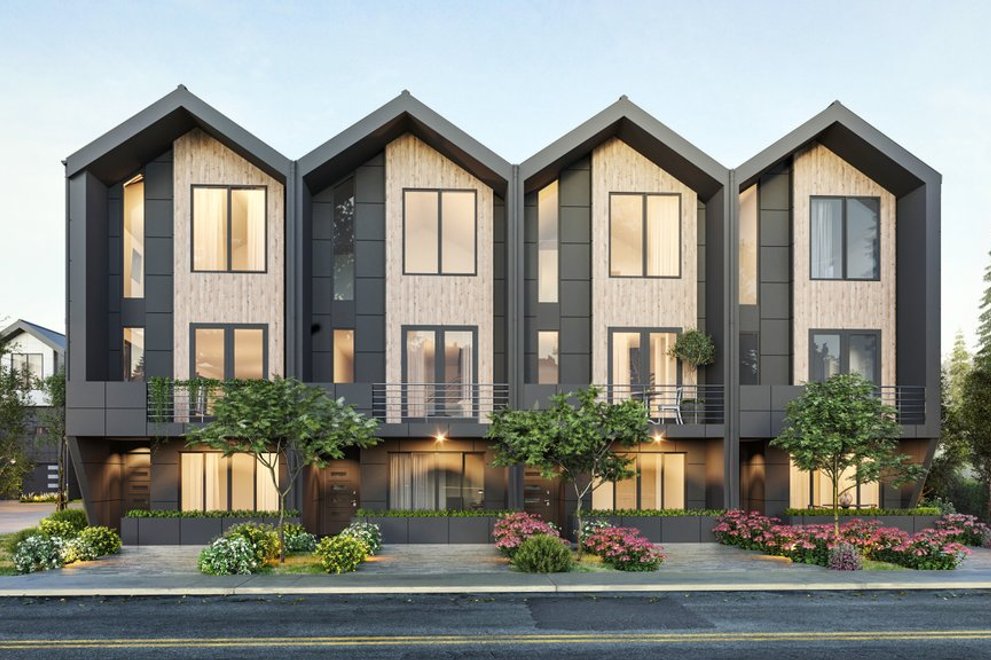
Ontario is facing significant housing challenges, and increasing supply is becoming a strategic priority for all levels of government.
A fourplex is a residential building with four units, with at least one dwelling unit located entirely or partially above another. An existing house can also be converted into a fourplex or an addition to an existing house can be built to have a fourplex that is divided horizontally and/or vertically into four separate dwelling units, each with an entrance that is either independent or through a common vestibule. Four attached dwelling units built side-by-side would generally be considered as townhouses.
Fourplexes expand the range of low-rise housing forms and tenures, and make efficient use of existing infrastructure and services. Fourplexes increase the supply of rental housing and support the achievement of complete communities to accommodate a diverse range of household sizes and incomes. Fourplexes are considered a form of residential infill intensification that is compatible in built form and scale to surrounding development.
More fourplexes will make living in Toronto, Mississauga, and Kitchener far more affordable. Typical conversion of a detached home into a fourplex involves building an addition in the rear yard and dividing the building into four two-bedroom dwelling units, one on the main floor, two on the second floor, and one in the basement.
The important fact is that a fourplex will always generate exceptional rent revenue, positive cash flow, and a significant increase in the market value, though constructing a fourplex is cash-heavy upfront and requires significant capital. Most of the property owners build rental fourplexes to have rental income or to reside alongside the extended family or tenants.
The municipality requires drawings of the proposal to have a fourplex so the City can determine if the proposed fourplex is safe and complies with the municipal Zoning By-law, the Ontario Building Code, and any other applicable law. A site plan application process is NOT required for residential buildings with four to 10 total dwelling units that do not contain other uses within the building or on the property.
Municipalities can still choose to allow fourplexes in their built-up residential neighbourhoods. Some municipalities in Ontario already have zoning by-laws to allow more density, but building multi-unit dwellings across the province is limited and prevented by a lack of water and sewer infrastructure in rural residential neighbourhoods.
Individual ownership of dwelling units in a fourplex would only be possible by registering a condominium corporation, an expensive, cumbersome process that’s not usually applied to a fourplex.
Building Permit Requirements for a Fourplex in Toronto
FOURPLEXES IN TORONTO
With a growing population, Toronto, which is Canada’s largest city, now embraces fourplexes to significantly increase the housing supply. In the City of Toronto, building a fourplex is permitted on residential lots zoned R, RD, RS, RM, or RT.
Maximum Permitted Height of a Fourplex in Toronto The height of a fourplex is the distance between the established grade and the elevation of the highest point of the fourplex. Fourplexes are subject to maximum height limits in metres. Fourplexes are exempt from zoning by-laws shown on the Height Overlay limiting the maximum number of storeys. If the Height Overlay on the Interactive Zoning By-Law Map shows a permitted height of less than 10m, the maximum height of a fourplex is 10m. If the Height Overlay is 10m or more, that height limit applies. If there is no maximum height shown on the Height Overlay, height limits for fourplexes are primarily contained in the following zoning Chapter 10 clauses within each zone: R Zone: 10.10.40.10 RD Zone: 10.20.40.10 RS Zone: 10.40.40.10 RT Zone: 10.60.40.10 RM Zone: 10.80.40.10
Maximum Permitted Lot Coverage for a Fourplex in Toronto
Ontario Regulation 462/24 — Requirements and standards — parcels of urban residential land
- (1) The following requirements and standards are established with respect to parcels of urban residential land on which additional residential units are located:
- Up to 45% of the surface of the parcel is permitted to be covered by buildings and structures.
- Subject to any maximum height and minimum setback requirements in a by-law passed under section 34 of the Act applicable to buildings and structures on the parcel, there is no limit to the floor space index of the parcel.
Where this Regulation applies, a permitted maximum lot coverage of 45% is applied to all buildings and structures on the lot, including both the multiplex and garden suite/laneway suite. Where the City of Toronto’s zoning regulations permit a maximum lot coverage greater than 45%, this would prevail over the lot coverage requirements of Ontario Regulation 462/24. If the numerical value on the Lot Coverage Overlay Map is less than 45% and the lot contains a detached houseplex, the maximum lot coverage for all buildings and structures on the lot is 45%.
The permitted maximum lot coverage in Ontario Regulation 462/24 would not apply to areas of the City of Toronto where there is currently no permitted maximum lot coverage regulations.
Lot Coverage means the percentage of the lot area covered by all buildings, structures, or parts thereof, at or above average grade or established grade, exclusive of overhanging eaves of 0.45 m or less, and outdoor swimming pools, but inclusive of pergolas and decks greater than 10m² and higher than 0.61 m above established grade. For lots having two or more zones, lot coverage shall be deemed to apply to only that portion of the lot that is located within each specified zone.
In the Residential Zone category, any part of a building or structure that is permitted to encroach into a required minimum building setback in Clause 10.5.40.60 is not included in the calculation of lot coverage. In the Residential Zone category, any part of a platform without main walls, such as a deck, porch, balcony, or similar structure that does not encroach into a required minimum building setback, and any roof, canopy, awning, or similar structure above the platform, is not included in the calculation of lot coverage, if it is attached to or less than 0.3 m from a building; and the lot area covered by these structures is no more than 5% of the lot area.
Maximum Permitted Floor Space Index (FSI) for a Fourplex in Toronto Maximum floor space index regulations, as indicated by a “d” with a number value in the zone label, do NOT apply to fourplexes. If there is a Chapter 900 exception that applies to the fourplex, indicated by an (x) followed by a number in the zone label, any maximum floor space index specified in this exception may still apply to a fourplex.
Floor Space Index (FSI) means the ratio of the gross floor area of all buildings and structures to the lot area. Gross Floor Area means the sum of the areas of each storey of a fourplex above or below established grade, measured from the exterior of outside walls of the fourplex including floor area occupied by interior walls but excluding any part of the fourplex used for mechanical floor area, stairwells, elevators, motor vehicle parking, bicycle parking, storage lockers, below-grade storage, any enclosed area used for the collection or storage of disposable or recyclable waste generated within the fourplex, common facilities for the use of the residents of the fourplex, and amenity area.
Minimum Required Setbacks for a Fourplex in Toronto Fourplexes are now subject to the same building setbacks as other residential building types in each zone. The minimum required setbacks that apply to a fourplex depend on the zone in which the fourplex is located. Setback regulations are primarily contained in the following Chapter 10 clauses: R Zone: 10.10.40.70 RD Zone: 10.20.40.70 RS Zone: 10.40.40.70 RT Zone: 10.60.40.70 RM Zone: 10.80.40.70
Fourplex with a Garden Suite or Laneway Suite in Toronto It is possible to have an accessory dwelling unit, like a garden suite or laneway suite, on the same property as a fourplex, if certain regulations are met.
Parking Requirements for a Fourplex in Toronto Fourplexes are not required to provide parking spaces on the property. If the property owner chooses to provide parking spaces, they must comply with the standards set out in the Zoning By-Law, including regulations in Chapter 10, Chapter 200, and any applicable Chapter 900 exception: R Zone: 900.2 RD Zone: 900.3 RS Zone: 900.4 RT Zone: 900.5 RM Zone: 900.6
Development Charges Payable for a Fourplex in Toronto In most cases, fourplexes are exempt from development charges and cash-in-lieu of parkland dedication. Exemptions for development charges for fourplexes are found in 415-6 A.(2) of the Municipal Code. Exemptions for cash-in-lieu of parkland dedication for fourplexes are found in 415-30 (16) of the Municipal Code. Even though development charges are waived by the City of Toronto, the School Boards still require education charges for the conversion to have a fourplex.
Multiple Front Entrance for a Fourplex in Toronto Fourplexes may have multiple front entrances. The multiplex zoning by-law amendment (By-law 474-2023) also deleted the restrictions on front entrances for secondary suites.
Balconies/Decks on a Fourplex in Toronto Two balconies or decks are permitted per unit: one on the front and one on the rear of the fourplex. Balconies and decks must be located on the second storey or above and cannot project beyond the maximum limits specified in the Zoning By-law. Fourplexes on a corner lot may also locate balconies on the side wall facing a street.
Refuse Storage Area At-grade, well-ventilated, refuse storage area (3 m x 1 m by 1.5 m in height) on private property for each of the dwellings, configured in such a manner as to allow for the bins to be transferred to curbside for City collection. Storage is permitted in the garage, but it must be shown with the dimensions above. Screening at the front of the unit is also acceptable when used with the dimensions above.
Tree Protection By-law applicable to Fourplex Project in Toronto Any activity that can cause a tree of 30cm or more in diameter to be injured or removed, on private property, is prohibited unless authorized with a permit under the Tree Protection By-law.
Fourplex with a Laneway Suite Several investors and builders are now looking for lots with a laneway garage at the rear in the City of Toronto to build a fourplex with a laneway suite.
Zoning Review for a Fourplex To determine whether a proposed fourplex complies with the Zoning By-law, a Zoning Review must be applied for to obtain a Zoning Applicable Law Certificate.
Minor Variance Application to the Committee of Adjustment If required, an application can be made to the City of Toronto Committee of Adjustment to request a minor variance to the Zoning By-law.
In early 2023, the City of Toronto voted to allow duplexes, triplexes, fourplexes, and, on lots big enough for laneway and garden suites, five-plexes, across the city. As municipalities struggle with an ongoing housing crisis, Committees of Adjustment axe proposals to have fourplexes that are not in compliance with the zoning by-laws and require minor variance approvals through Committee of Adjustment meetings. Minor Variance Approvals for fourplexes at Committee of Adjustment meetings are an ongoing challenge of adding density to residential neighbourhoods, despite the new zoning by-laws that are supposed to make fourplexes easier to build. The Committee of Adjustment provides opportunities for the neighbours to object to the height and size of the proposal, concerns about parking, and adding tenants to the street. Several fourplex proposals were rejected at the Committee of Adjustment meetings after outcry from neighbours. Even when appealed, the Local Appeal Body elected not to overturn the decision of the Committee of Adjustment. Decisions to deny proposals to have fourplexes were made by the Committee of Adjustment and not by municipal staff or council. The main reason for the Committee of Adjustment to refuse a minor variance application for a fourplex is the committee’s conclusion that, taken as a whole, the variances are not minor, and the proposed fourplex is not in keeping with the character of the neighbourhood.
When proposals to have fourplexes are not in compliance with the zoning by-laws, they require minor variance approvals through Committee of Adjustment meetings which provide the neighbours a forum to air their concerns and objections — objecting to the changes to the character of the neighbourhood, the size and height of the fourplex, concerns about renters, traffic and street parking, garbage pickup, and feeling that the variances are not actually minor and a possible decline in the value of their properties.
City of Toronto’s Staff are currently studying opportunities to enable detached residential buildings of up to six units and four storeys citywide.
Building Permit Requirements for a Fourplex in Mississauga
FOURPLEXES IN MISSISSAUGA
The City of Mississauga has approved a motion to allow residents to build fourplexes on low-rise residential lots.
The City of Mississauga’s new by-laws:
- Permit fourplexes “as of right” which means applicants can apply for a building permit without additional zoning permissions if they meet by-law regulations.
- Support purpose-built fourplexes or the conversion of an existing property to accommodate fourplexes.
- Allow a variety of fourplex configurations up to three storeys in height including a partially above-grade basement unit.
- Support the creation of rental units in neighbourhoods.
The City of Mississauga has developed purpose-built fourplex regulations for the majority of lots that permit detached dwellings in the City of Mississauga. As a result, purpose-built fourplex regulations are based on the R5 zone, which is the smallest standard base zone for detached dwellings, with a minimum lot area and lot frontage of 295m² (3,175ft²) and 9.75 m (32 ft), respectively.
Purpose-Built Fourplex Regulations in Mississauga
In Mississauga, a new fourplex is permitted only in the following zones: Rl to Rll, Rl5, R16, RMI, RM2 and RM7.
Maximum Height: 10.6 m (34.8 ft.) to the peak of a sloped roof; 8.1 m (24.6 ft.) to the top of a flat roof Minimum Front Yard: 6.0 m (19.7 ft.) Minimum Interior Side Yard: 1.2 m (3.9 ft.) Minimum Rear Yard: 7.5 m (24.6 ft.) Minimum Exterior Side Yard: 4.5 m (14.8 ft.) Maximum Lot Coverage: Additional 10% above the base zone, but only for the purpose of a fourplex Maximum Dwelling Depth: 20 m (65.6 ft.) Required Parking Spaces: 2 (No additional requirement)
In Mississauga, an additional residential unit can’t be built on a lot that has a fourplex. Different regulations apply in Mississauga based on whether the fourplex is converted from the existing home or a new build.
Fourplex conversions are low-rise residential buildings that have been remodelled to accommodate four separate units. In this case, all four units must fit within the building footprint of the home that existed as of December 6, 2023. Additions can’t be built to accommodate four units — the enlargement of a detached dwelling legally existing on December 6, 2023, for the purposes of conversion to a fourplex shall not be permitted.
A purpose-built fourplex is a new residential building that’s designed and built to accommodate four separate apartments. These fourplexes are subject to the City of Mississauga’s new zoning regulations, which provide more flexibility than the conversion of an existing home, which includes additional height, reduced setbacks, and increased lot coverage.
In Mississauga, the Average Grade means with reference to a detached fourplex, the average of eight grade elevations, six of which are taken along the side lot lines of a lot and two of which are taken at the centreline of the street on which the lot has frontage. The first two grade elevations shall be taken at the points of intersection of the front lot line and each side lot line. The second two grade elevations shall be taken along each side property line at the minimum front yard setback requirement of the zone in which the fourplex is located. The third two grade elevations shall be taken along each side property line at a distance of 15 m back from where the second two grade elevations were measured. The last two grade elevations shall be taken at the points of intersection of the street centerline and the projections of the side lot lines.
In Mississauga, the height of a fourplex means the vertical distance between the average grade and:
- the highest point of the roof surface of a flat roof, including a parapet;
- the mean height level between the eaves and ridge of a sloped roof; or
- the mean height level between the eaves and the highest point of the flat roof where there is a flat roof on top of a sloped roof.
The permitted maximum height for purpose-built fourplexes in Mississauga would facilitate three storey buildings with a sloped roof and two-storey buildings with a flat roof, while allowing for flexibility for a partially above-grade basement unit. This added flexibility in height is important as bedrooms and living spaces in basement units require minimum window sizes under the Ontario Building Code.
In an R5 zone in Mississauga, the proposed yards outlined above would facilitate a minimum required floor area of 105m² (1,130ft²) per storey, including any internal stairs.
The required minimum side yard setbacks would facilitate windows on both side walls of the fourplex without major restrictions in the Ontario Building Code. With a three storey building and a basement unit, each unit would be able to comfortably accommodate a three-bedroom, family-sized unit. For larger lots, maximum permitted dwelling depth of 20m (65.6ft) limits potentially oversized fourplexes.
A purpose-built fourplex necessitates more flexibility with lot coverage, and therefore, an additional 10% is permitted for a fourplex (e.g. 50% whereas the base zone permits 40%).
On larger, wider lots, required parking may be accommodated in the rear yard, with access from the side yard, which is common with many existing fourplexes in the City of Mississauga. This approach would allow the front yard space to be used as an amenity area. On the other hand, smaller narrower lots will be required to accommodate the required parking in the front yard or in an attached garage, resulting in the rear yard being used as amenity area.
In order to maintain amenity space on the property, and to make fourplexes feasible across Mississauga, no additional parking spaces are required by the City of Mississauga for fourplexes. On lots that are large enough to have extensive rear yards, and wide enough to accommodate a driveway in an interior side yard, a maximum of four parking spaces are permitted in the rear yard. The City of Mississauga’s zoning by-law is already permissive to allow for hard surface in the rear yard, provided that 0.61 m (2 ft.) is maintained along the lot lines for drainage.
Building Permit Requirements to have a Fourplex in Guelph
Guelph is one of the fastest-growing communities in Canada, and residents can now build up to four housing units on a property in Guelph.
The City of Guelph now allows the building of fourplexes on a property — a type of development known as gentle density to provide more housing options while maintaining the small-town charm of Guelph neighbourhoods.
The City of Guelph approved Official Plan and Zoning bylaw amendments that will allow for more diverse and affordable options for housing, including fourplexes, in low-rise neighbourhoods to improve housing supply and affordability. By allowing more diverse housing options, including fourplexes, the City of Guelph helps more residents find a place to call home — from first-time homebuyers to those looking for another income stream, multi-generational families, and retirees looking to age in place.
Providing more housing on one property also helps provide “missing middle” housing, such as fourplexes, tiny homes, duplex-style garden suites and more.
Other benefits of gentle density include:
- Providing more housing without urban sprawl
- Making services more efficient and cost-effective
- Offering more living spaces closer to schools, parks, and community amenities
Encouraging gentle density is one of eight commitments included in the Housing Accelerator Fund (HAF) action plan to fast-track the creation of new homes. The City of Guelph also approved the Housing Affordability Strategy — another commitment in the Housing Accelerator Fund (HAF) action plan. This represents significant progress on the Housing Accelerator Fund (HAF) action plan and the City’s work to reduce housing barriers and improve housing supply.
City of Guelph’s Zoning Provisions for Fourplex
For single detached dwellings, a total of four dwelling units is permitted on a lot. This includes the primary dwelling unit together with:
i. Up to three additional dwelling units located within the same building as the primary dwelling unit, or ii. Up to two additional dwelling units located within the same building as the primary dwelling unit and one additional dwelling unit in a separate building on the same lot, or iii. One additional dwelling unit located in the same building as the primary dwelling unit and up to two additional dwelling units in a separate building on the same lot.
Additional dwelling units are permitted with semi-detached, duplex, townhouse on-street, or townhouse rear access on-street dwellings to a maximum of 3 dwelling units on a lot.
A 1.2 m wide unobstructed pedestrian access shall be provided to the entrance of the additional dwelling unit, unless access to the additional dwelling unit is provided directly from a street or lane. A gate may be constructed within the pedestrian access, but no encroachments are permitted within the 1.2 m width, including exterior stairs, window wells, air conditioners, etc.
A primary dwelling unit means the largest dwelling unit on the lot where one or more additional dwelling units exist. Residential floor area includes basements with floor to ceiling heights of at least 1.95 m but does not include stairs, landings, cold rooms, garages, carports, and mechanical rooms.
An additional dwelling unit within a primary dwelling unit shall have a residential floor area that is less than the primary dwelling unit.
Exterior stairs to storeys above the first storey are prohibited in the front yard, exterior side yard and in the required interior side yard.
Requirements for Additional dwelling unit(s) within separate building(s) on the same lot:
- Each additional dwelling unit shall not exceed 80m² of residential floor area.
- Two additional dwelling units are permitted in one building with a maximum floorplate of 90m².
- Additional dwelling unit(s) shall not occupy more than 30% of the yard, including all accessory buildings or structures.
- The maximum building height is 6.1 m.
- A minimum 1.2 m interior side yard setback is required for the primary dwelling unit in the yard closest to the unobstructed pedestrian access, unless access to the additional dwelling unit is provided directly from a street or lane.
- An additional dwelling unit in a separate building on a lot may occupy a yard other than a front yard or required exterior side yard.
- An additional dwelling unit in a separate building on a lot may occupy the front yard of a through lot directly abutting a lane.
- An additional dwelling unit in a separate building on a lot shall have a minimum interior side yard and rear yard setback consistent with the required minimum interior side yard setback for the primary dwelling unit in the applicable zone to a minimum of 1.2 m.
- The second storey of an additional dwelling unit shall have a minimum 3 m interior side yard and rear yard setback where a second storey window faces a lot line.
- Any second storey balcony, entrance, or exterior stair to the second storey must be setback a minimum of 3 m from a lot line.
- Rooftop amenity area above the second storey is not permitted.
- A minimum distance of 3 m shall be provided between the primary building and additional dwelling unit(s) in a separate building.
An attached garage for single detached dwellings, semidetached dwellings and townhouses shall have a minimum floor area of 20m².
Parking Space Dimensions
Residential interior parking space (within a garage or carport): 3 m width x 6 m length Residential exterior parking space: 2.5 m width x 5.5 m length Apartment building (over 3 units), mixed-use building, stacked townhouse, triplex, fourplex, and nonresidential uses: 2.75 m width x 5.5 m length Interior or exterior parallel parking space: 2.6 m width x 6.5 m length Interior or exterior stacked (tandem) parking space: Interior or exterior parking space dimensions, with length multiplied by 2
If no legal off-street parking space can be provided for the primary dwelling unit, no parking spaces are required for the additional dwelling units.
Apartment buildings, mixed-use buildings, triplexes, and fourplexes with less than 20 dwelling units are not required to provide visitor parking spaces.
Required Parking Spaces in all zones except downtown zones
1 ADU = No space required 2 ADUs = 1 space 3 ADUs = 2 spaces Triplex = 2 spaces Fourplex = 3 spaces
No parking space is required in downtown zones for apartment building, duplex, single detached, semi-detached, townhouse-on-street, townhouse-rear access on-street, triplex, fourplex, or additional dwelling unit.
An accessible parking space is required for fourplexes and multi-unit buildings with four or more dwelling units if an accessible building or accessible dwelling unit is required by the Ontario Building Code.
A minimum of 20% of the total required parking spaces for multi-unit buildings with 3 or more dwelling units and mixed-use buildings on lots identified with a (PA) suffix shall be provided as electric vehicle parking spaces.
Maximum Permitted Residential Driveway Width
RL.1: Single detached/duplex dwelling (up to 4 units) – 6.5 m; Semi-detached dwelling – 60% of the lot frontage or 5 m, whichever is less. RL.2: Single detached dwelling – 50% of the lot frontage or 5 m, whichever is greater; Duplex dwelling, multi-unit building (up to 4 units) – 5 m; Semi-detached dwelling – 60% of the lot frontage or 5 m, whichever is less. RL.3, RL.4, RM.5, RM.6, D.1, D.2: Single detached, semi-detached, and duplex dwelling – 50% of lot frontage or 5 m, whichever is less; Townhouses – 65% of lot frontage or 5 m, whichever is less.
RL.1 and RL.2 – Lot Requirements for multi-unit buildings (4 units)
A minimum setback of 0.5m between the residential driveway and the nearest lot line must be maintained as landscaped open space in the form of natural vegetation, such as grass, flowers, trees and shrubbery. For multi-unit buildings with 3 or more units, 35% of lot area is required to be landscaped open space. Maximum Permitted Building Height: 3 storeys Principal Entrance: A principal entrance shall be provided that faces the front lot line or exterior side lot line. Maximum permitted elevation of principal entrance: 1.2 m measured from grade at the front face of the building.
Building Permit Requirements to have a Fourplex in Burlington
The City of Burlington’s draft New Residential Zoning Bylaw describes where triplexes, fourplexes and low-rise apartment buildings may be allowed in Burlington’s neighbourhood areas.
If a lot fronts onto a major street like Plains Road, New Street, Lakeshore Road or Guelph Line and is outside of the proposed Low-Rise Neighbourhood 7 zone, building a triplex or a fourplex will be permitted. If a lot fronts a major street and is also within the proposed Low-Rise Neighbourhood 8 zone, building a low-rise apartment building will be permitted.
Proposed Zoning Provisions that apply to Triplex dwellings in the Low-Rise Neighbourhood Zones:
Minimum Lot Area: 390m² Minimum Lot Frontage: 13m Maximum Lot Coverage: 45% Minimum Front Yard Setback: 6m Minimum Rear Yard Setback: 7.5m Minimum Interior Side Yard Setback: 1.2m Minimum Exterior Side Yard Setback: 4.5m Minimum Front Yard Soft Landscaped Open Space: 30% Maximum Building Height: 2 storeys to 10m in a LN1-6 Zone; 3 storeys to 14m in LN8 Zone
Proposed Zoning Provisions that apply to Fourplex dwellings in the Low-Rise Neighbourhood Zones:
Minimum Lot Area: 450m² Minimum Lot Frontage: 15m Maximum Lot Coverage: 45% Minimum Front Yard Setback: 6m Minimum Rear Yard Setback: 7.5m Minimum Interior Side Yard Setback: 1.2m Minimum Exterior Side Yard Setback: 4.5m Minimum Front Yard Soft Landscaped Open Space: 30% Maximum Building Height: 2 storeys to 10m in a LN1-6 Zone; 3.5 storeys to 15m in LN8 Zone
Where a detached private garage is in the rear yard, the minimum interior side yard setback leading to the rear yard private garage shall be 3m. The minimum outdoor common amenity space requirement will comprise at least one contiguous outdoor area of a minimum of 30m² at grade. The maximum height of the main entrance to a Triplex and Fourplex shall be 1.5m above grade.
Building Permit Requirements to have a Fourplex in St. Catharines
The City of St. Catharines permits the development of duplexes, triplexes, and fourplexes in R1 Low Density Residential – Suburban Neighbourhood; R2 Low Density Residential – Traditional Neighbourhood; R3 Medium Density Residential; R4 High Density Residential; Medium Density Mixed Use; M2 Medium/High Density Mixed Use; and M3 High Density Mixed Use; following a change to the city’s zoning bylaw to increase housing options. Homeowners can now add two accessory dwelling units in the City of St. Catharines.
Detached Additional Dwelling Units require a minimum 1.2-m setback at the rear lot or side lot lines for a wall with doors or windows.
Only one fourplex dwelling is permitted on one lot.
PARKING A fourplex shall provide four parking spaces and tandem parking is not permitted. A fourplex is exempt from providing accessible parking.
Zoning Provisions for Fourplex
R1: Minimum Required Lot Area: 1,260m² Maximum Permitted Lot Area: 1,860m² Minimum Required Lot Frontage: 16.5m Minimum Required Front Yard Setback: 6m to dwelling / 7m to garage Minimum Required Rear Yard Setback: 7.5m Minimum Required Interior Side Yard Setback: 1.2m / 2m Minimum Required Exterior Side Yard Setback: 4m to dwelling / 6m to garage Maximum Permitted Front Yard Setback: 12m to dwelling Maximum Permitted Exterior Side Yard Setback: 8m to dwelling Maximum Permitted Height: 10m Minimum Required Landscape Open Space: 35% Maximum Permitted Total Lot Coverage: 45%
R2: Minimum Required Lot Area: 1,120m² Maximum Permitted Lot Area: 1,860m² Minimum Required Lot Frontage: 12m Minimum Required Front Yard Setback: 3m to dwelling / 6m to garage Minimum Required Rear Yard Setback: 6m Minimum Required Interior Side Yard Setback: 1.2m Minimum Required Exterior Side Yard Setback: 3m to dwelling / 6m to garage Maximum Permitted Front Yard Setback: 8m Maximum Permitted Exterior Side Yard Setback: 6m Maximum Permitted Height: 10m Minimum Required Landscape Open Space: 35% Maximum Permitted Total Lot Coverage: 45%
R3: Minimum Required Lot Area: 560m² Maximum Permitted Lot Area: 1,400m² Minimum Required Lot Frontage: 12m Minimum Required Front Yard Setback: 3m to dwelling / 6m to garage Minimum Required Rear Yard Setback: 6m Minimum Required Interior Side Yard Setback: 1.2m Minimum Required Exterior Side Yard Setback: 3m to dwelling / 6m to garage Maximum Permitted Height: 11m Minimum Required Landscape Open Space: 35% Maximum Permitted Total Lot Coverage: 45%
R4: Minimum Required Lot Frontage: 12m Minimum Required Front Yard Setback: 3m to dwelling / 6m to garage Minimum Required Rear Yard Setback: 6m Minimum Required Interior Side Yard Setback: 1.2m Minimum Required Exterior Side Yard Setback: 3m to dwelling / 6m to garage Maximum Permitted Height: 11m Minimum Required Landscape Open Space: 25% Minimum Required Density Per Hectare: 85 Units
City of Kitchener Permits to Have Fourplexes
The City of Kitchener approved new Official Plan and Zoning By-law Amendments to have fourplexes on residential lots in Kitchener where zoning permits single detached, semi-detached or street townhouse dwelling units located in existing buildings; additions to new buildings; or new buildings either as the main building or in the backyard.
More than 95% of lots in the City of Kitchener are occupied by single detached, semi-detached or street-facing townhouses; most of these over 55,000 lots have only one residential dwelling unit.
The application process for a Fourplex in Kitchener has two parts:
- Zoning confirmation
- Building permit