

Quick Answer: A general contractor in Mississauga manages your permits, trades, schedule and budget from the first drawing to the final inspection. Before you hire one, confirm the company holds a City of Mississauga building renovator licence, carries at least $2 million in construction liability insurance, and puts the full written estimate inside the contract.
Do you need a general contractor in Mississauga?
A general contractor in Mississauga takes responsibility for the whole job: drawings, permits, trade coordination, materials, city inspections and the final walkthrough. Serving Mississauga and the surrounding Peel Region, most firms work on houses, additions and commercial fit-outs. Homeowners usually hire one once a project crosses three or more trades.
Small jobs rarely need one. Re-shingling a roof, replacing a window with the same size, or building a deck under 0.61 metres high does not even require a permit under the City of Mississauga’s list of projects that need a building permit. Move a wall, finish a basement or add square footage, though, and you are suddenly managing framers, electricians, plumbers, HVAC installers, a designer and an inspector on the same calendar.
That coordination is the product you are buying. General contracting is scheduling, sequencing and accountability, which is why the fee exists in the first place and why some firms bundle it with design-build services across homes, additions and commercial work.
What should you check before hiring building contractors in Mississauga?
Before you sign with a general contractor in Mississauga, four checks matter more than star ratings: a valid City trade business licence, proof of construction liability insurance, Workplace Safety and Insurance Board coverage for everyone on site, and a written contract that includes your estimate. Ontario law already requires that last one on almost every residential job.
Licences local contractors must hold in Mississauga
Mississauga licenses building renovators directly, and the bar is higher than most homeowners expect. Applicants must pass a written exam set by the City with a minimum grade of 70%, submit a criminal record search completed within the previous 30 days, provide a letter of employment showing at least two years of practical experience, and file a certificate of insurance for a minimum of $2 million in construction liability. Plumbing, heating, paving and drain contractors go through the same trade licensing stream, and every licence has to be renewed each year.
Ask for the licence number, then ask to see a record of completed projects at similar scale. A firm that hesitates on either has told you something useful.
New builds follow a separate provincial regime. Anyone who builds or sells a new home in Ontario must hold a Home Construction Regulatory Authority licence and enrol the home with Tarion, but renovations and upgrades to an existing house typically do not make it a new home, so that requirement usually does not apply to remodel work. Building from the ground up? Check the HCRA licence in the public Ontario Builder Directory before you sign.
What your contract with remodel contractors must include
Under Ontario’s Consumer Protection Act, any home renovation contract worth more than $50 has to be in writing. If your written estimate forms part of that contract, the final price cannot exceed it by more than 10% unless you have agreed to new work and signed a change. Sign in your own home and you also get a 10 calendar-day cooling-off period.
The province recommends keeping deposits to no more than 10% and never paying the balance before the work is finished. Your contract should also spell out:
- a detailed description of the work and the materials being used
- start and completion dates, plus a payment schedule tied to them
- every sub-trade being contracted out and who pays them
- who handles cleanup, and what the workmanship warranty covers
How long do permits take for home additions and commercial construction in Mississauga?
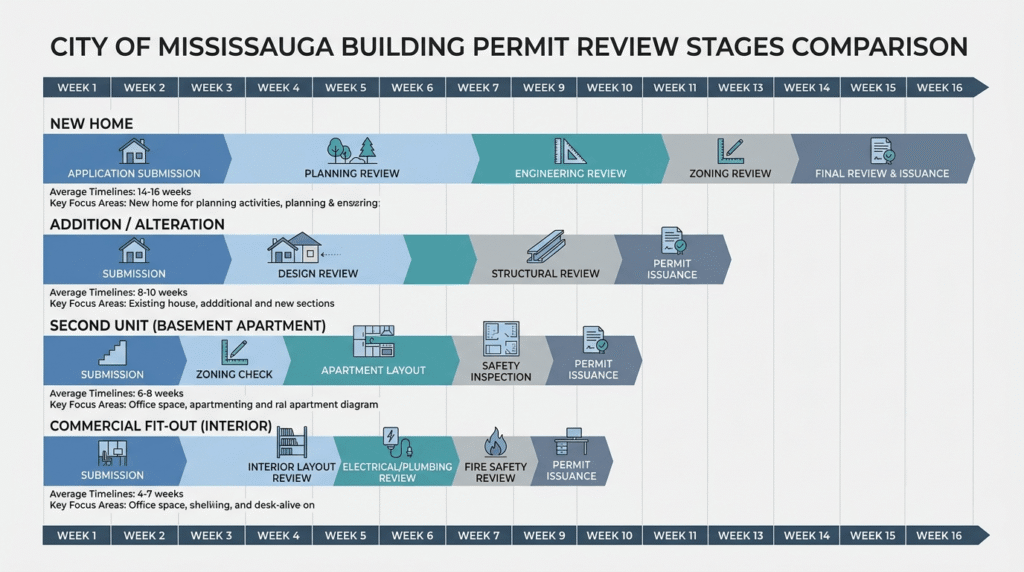
The City prescreens most applications in 7 to 10 business days. A first detailed review then takes 10 business days for residential applications, 15 for second units and 20 for non-residential work. Real elapsed time runs longer, because reviews rarely clear on the first pass.
| Project type | First review | Average time to permit |
|---|---|---|
| New detached or semi-detached home | 10 business days | 13 weeks |
| Alteration or addition to a house | 10 business days | 7 weeks |
| Second unit or basement apartment | 15 business days | 10 weeks |
| New non-residential building | 20 business days | 12 weeks |
| Non-residential alteration or fit-out | 20 business days | 9 weeks |
Every resubmission cycle can add two or more weeks, and resubmissions fall outside those legislated review windows. Permit fees and time frames start at $244 for residential properties and $386 for non-residential ones, plus a $50 non-refundable administration fee when you submit through the ePlans portal. Development charges may apply on top.
Schedules slip for predictable reasons. Zoning relief through the Committee of Adjustment, conservation authority sign-off near a creek or valley, heritage review, or a tree removal permit each run on their own clock. A contractor who has filed in Mississauga before flags these in week one instead of month four, which is also the moment to settle whether you are renovating or rebuilding.
How to hire a construction company in Mississauga: six steps
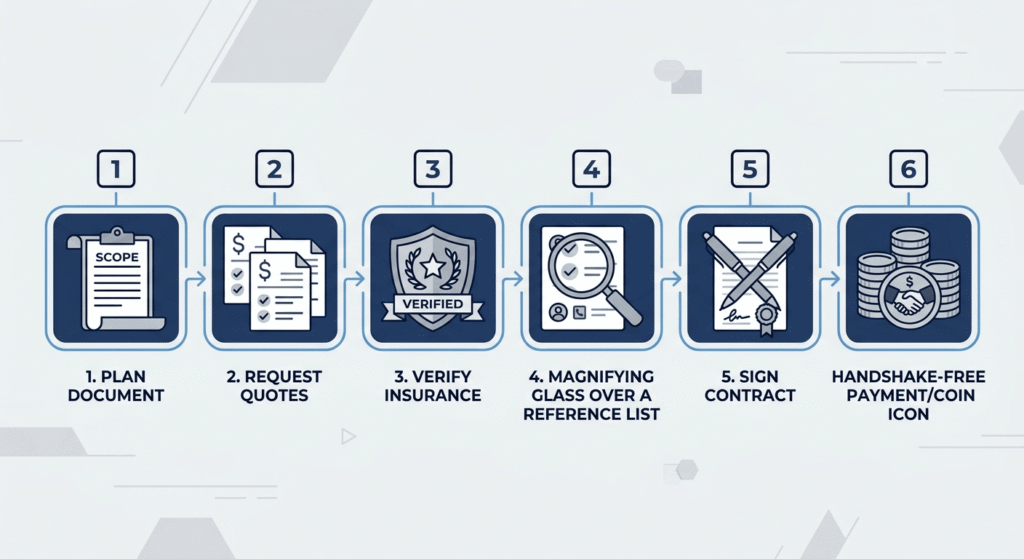
Good outcomes come from the boring part of the process. Write down what you want before you call anyone, then compare quotes from every general contractor in Mississauga on identical scope. Consumer Protection Ontario recommends at least three written estimates, and never accepting a price from a contractor who has not seen the space.
- Write a scope list. Every change made mid-project costs money.
- Get three written estimates for the same scope, each itemized by product and service.
- Verify the trade business licence, the $2 million insurance certificate and WSIB coverage.
- Check references from jobs finished one to three years ago, not just last month, then search the Consumer Beware List for complaints or charges.
- Attach the estimate to the contract along with dates, payment milestones and sub-trade details.
- Keep the deposit at 10% or less and hold the final payment until inspections pass.
Ask each house contractor how they handle change orders, and how pre-construction planning works before demolition starts. The answers tell you more about your next six months than any portfolio will.
Frequently Asked Questions
1. How much does a general contractor in Mississauga charge?
Fees vary by scope, and no public authority publishes a standard rate. What is fixed is the ceiling: if a written estimate forms part of your contract, Ontario law prevents the contractor from charging more than 10% above it without your signed approval. Permits are separate, starting at $244 residential.
2. Do I need a building permit for a home addition in Mississauga?
Yes. Additions always require a permit, and so do several jobs people assume are exempt:
- finishing a basement or adding a second unit
- decks higher than 0.61 metres
- new or enlarged window and door openings
- re-cladding with a different material, such as siding to brick
3. Does a general contractor in Mississauga have to be licensed?
Yes, for renovation work inside city limits. Mississauga requires building renovators to hold an annual trade business operating licence, backed by a City exam, an insurance certificate and a criminal record search. Ontario has no separate provincial licence for renovators, though new home builders must be licensed by the HCRA.
4. How long does it take to get a building permit in Mississauga?
Roughly 7 weeks on average for an alteration or addition to a house, 10 weeks for a second unit and 13 weeks for a new detached home. Incomplete applications fall outside the legislated review windows entirely, so drawing quality directly controls your start date.
5. Should I pay a deposit before work starts?
Keep it small. Consumer Protection Ontario recommends deposits of no more than 10% of the contract price and warns against paying in full before the job is done. Avoid cash deals, and if you do pay cash, get a detailed signed receipt every time.
Conclusion
Hiring a general contractor in Mississauga comes down to verification, not persuasion. Check the trade licence, read the permit timelines honestly, and get every promise into a written contract before the first crew arrives. The firms that welcome those questions are usually the ones still answering the phone a year after your final inspection.