

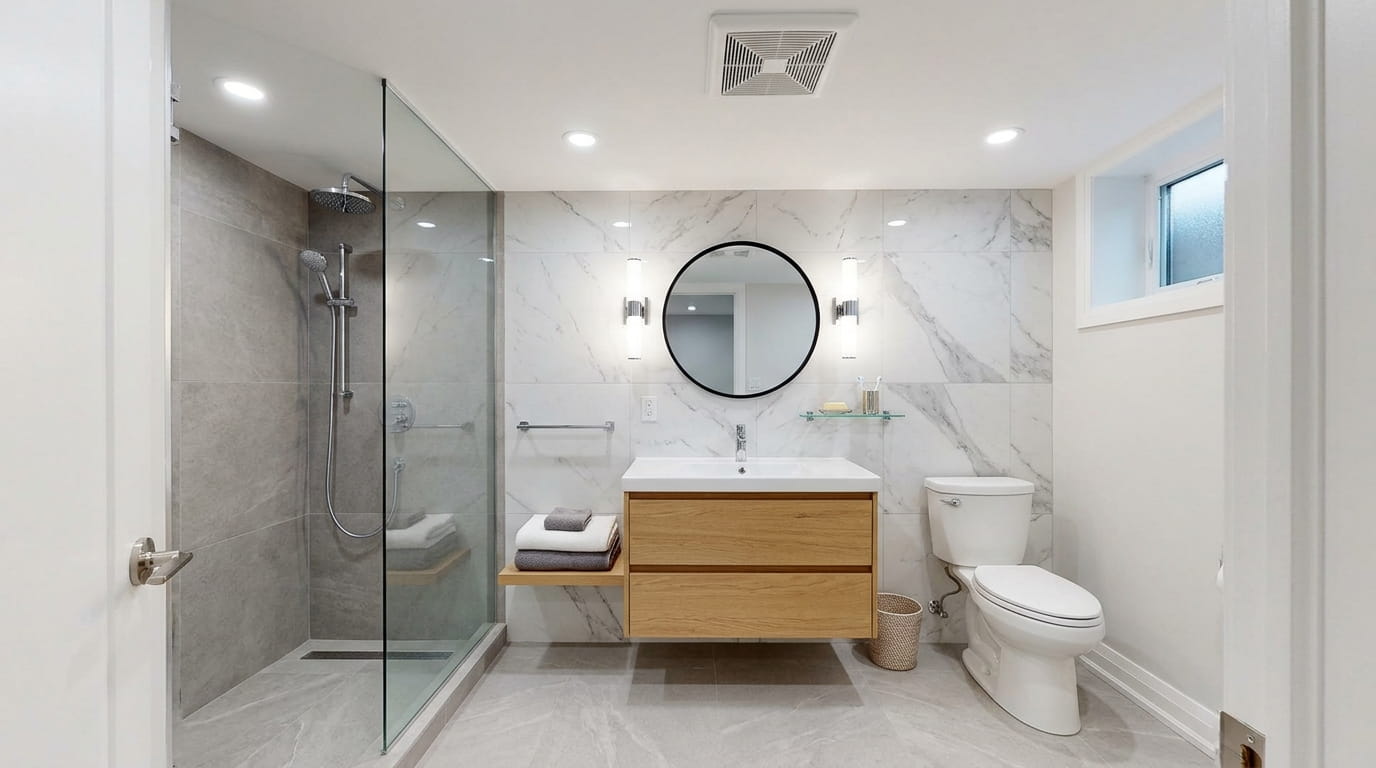
Quick Answer: Adding a bathroom to a basement in Ontario costs about $15,000 to $22,000 for a finished 3-piece and $20,000 to $35,000 for a 4-piece in 2026. What sits under your concrete slab decides where you land, especially whether drain stubs exist and whether your fixtures sit below the sewer line.
Adding a Bathroom to a Basement in Ontario: Cost and Plumbing
Adding a bathroom to a basement is one of the most useful upgrades an Ontario homeowner can make. It turns a rec room into a real guest space and makes a future basement rental workable. It’s also the line item that surprises people most.
Why? Because the price gets set under the concrete, not in the showroom. This guide covers 2026 costs, the plumbing you’ll need, and the permits and rebates that apply in Toronto, Mississauga, Ottawa and across Ontario.
What Is Adding a Bathroom to a Basement?
Adding a bathroom to a basement means installing new drain, vent and water lines below grade, then finishing the room with fixtures, ventilation and moisture-resistant surfaces. Because basement floors often sit near or below the main sewer line, the job usually involves cutting the slab and sometimes pumping waste upward to reach the drain.
Every project in the province follows Ontario’s Building Code. The 2024 edition took effect on January 1, 2025, and the new regulation adopts the National Building Code of Canada 2020, except where Ontario’s own amendments change it. You can read the current version on the province’s Ontario Building Code page. Plumbing falls under Part 7 of the Code, which every Ontario municipality enforces. ontario
How Much Does a Basement Bathroom Cost in Ontario?
A finished basement bathroom in Ontario costs roughly $15,000 to $22,000 for a 3-piece, $20,000 to $35,000 for a 4-piece, and $8,000 to $15,000 for a powder room in 2026. Plumbing rough-in alone runs from about $5,000 to nearly $12,000 before HST, depending on what’s already in the floor.
Those finished-room figures come from GTA contractor pricing and include walls, tile, fixtures and the exhaust fan. Toronto runs higher than smaller markets. HomeStars puts a Toronto basement bathroom addition at $15,000 to $35,000 for 2026.
Basement Bathroom Plumbing: Three Real Scenarios
| Scenario | What’s under the floor | Plumbing cost (before HST) |
|---|---|---|
| Stubs in the slab, gravity drain | Capped drain pipes already in place | About $5,000 |
| No stubs, gravity drain | Slab cut, trenched and patched | About $9,000 |
| No stubs, fixtures below the sewer | Slab cut plus a sewage ejector pump | About $11,950 |
Those totals come from an October 2026 Ontario estimate that bundles a $4,500 three-piece rough-in, about $4,000 to break and patch the slab, an ejector with battery backup where needed, and roughly $500 in permits and inspections. That’s nearly $7,000 between the best and worst case for the same bathroom.
What Else Pushes the Price Up
Your choice of bathroom fixtures matters, but less than most people expect. Upgrading from a 3-piece to a 4-piece with a tub typically adds $3,000 to $5,000, and a heated floor adds $1,200 to $2,000. Long drain runs across finished floors, low ceiling heights around ductwork, and upstairs walls opened for venting add more.
If the bathroom is one part of a larger lower-level project, it often makes sense to plan it alongside our home renovations, additions and garden suites work so trades are scheduled once.
What Plumbing Does a Basement Bathroom Need?
A basement bathroom needs drains tied into the main building drain, a vent connected to the plumbing stack, and hot and cold supply lines. Many homes also need a sewage ejector pump and a backwater valve. A licensed plumber confirms the drain depth first, since that single measurement drives most of the cost.
Rough-In Stubs and the Concrete Slab
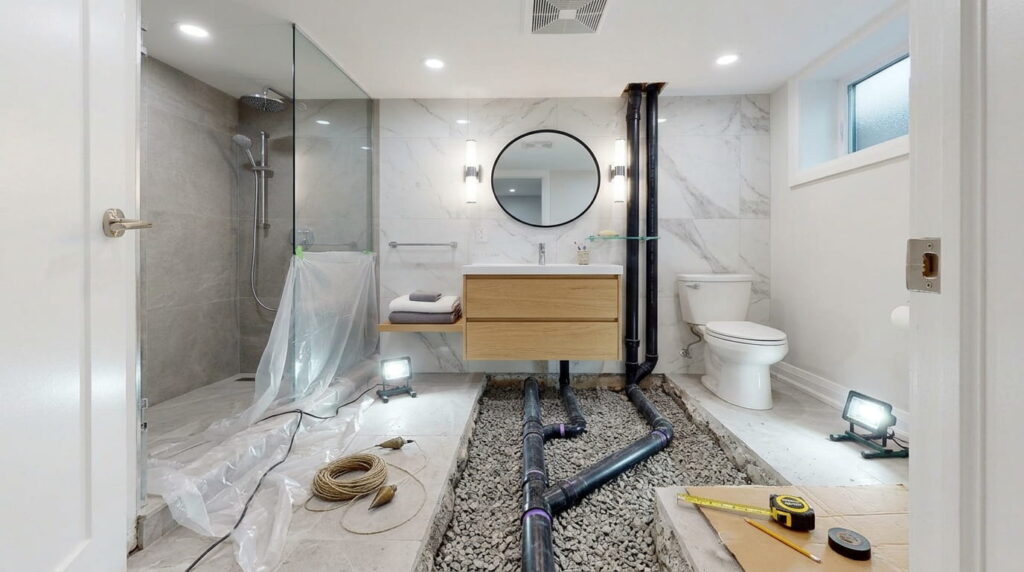
Start by looking for capped pipes. Many newer houses were built with capped drain pipes rising out of the basement slab near a wall, often with a vent roughed in close by. If you have them, the most expensive work is already done.
No stubs? The plumber cuts a trench from the new toilet, shower and sink to the main drain, ties in, backfills and patches the concrete, which adds $1,500 to $8,000 depending on the length of the run.
Sewage Ejector Pump or Upflush Toilet?
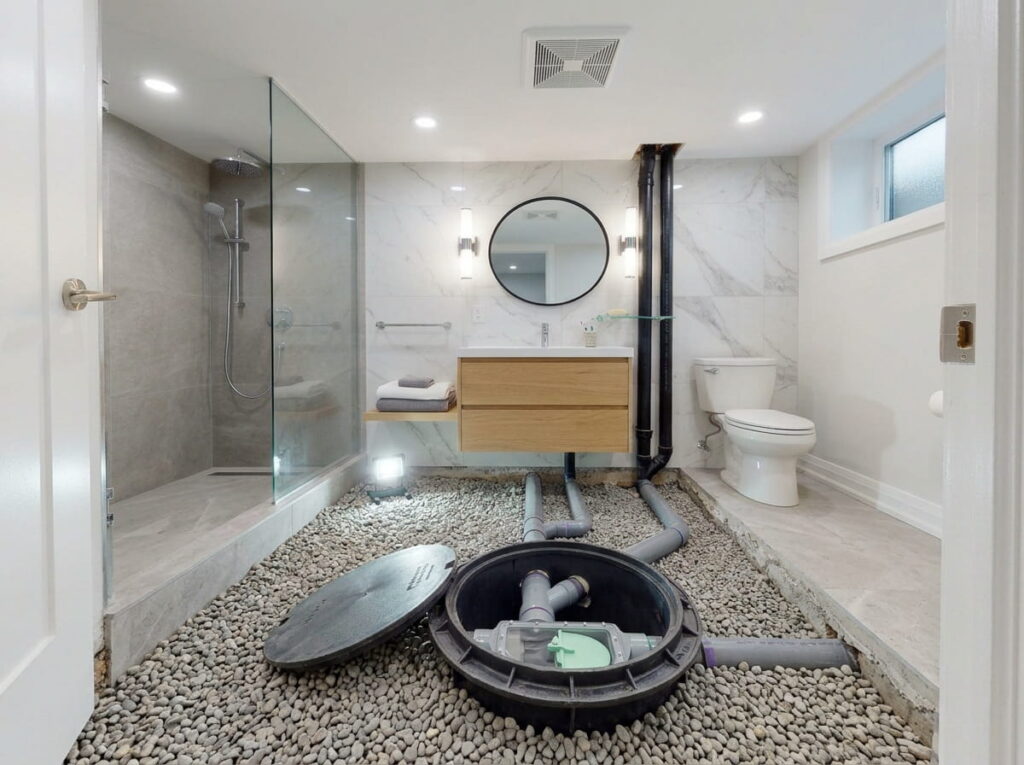
When new fixtures sit lower than the pipe leaving the house, gravity won’t carry the waste, so a sealed pit with a pump lifts it to the drain for an extra $1,500 to $3,500. One caution: the City of Toronto notes the Ontario Building Code may not allow ejector pumps when the plumbing system sits higher than the public sewer.toronto
For a powder room, an upflush toilet can be the sensible call. These macerating systems cost $1,500 to $3,000 and need no trench, but they’re louder than a standard toilet and their motor will eventually need repair.
Venting to the Plumbing Stack
Every fixture needs a vent as well as a drain. Without one, a fixture gurgles, siphons its trap dry and lets sewer gas into the room. In a basement, the plumber ties new vents into the existing stack or runs a new one up through the house, which can mean opening a wall upstairs. New showers also need a pressure-balanced or thermostatic valve, and the Code caps outlet temperature at 49°C.
Why a Backwater Valve Belongs in the Plan
A new bathroom adds another low point where sewage can back up during a storm. A backwater valve closes the sewer line during heavy rain to keep water out, and while it’s closed you shouldn’t use any toilets, sinks or appliances that drain. toronto
Toronto homeowners get real help here. As of May 1, 2026, the City’s Basement Flooding Protection Subsidy Program offers up to $6,650 per property, including up to 80 per cent of a backwater valve’s cost to a maximum of $1,600 per device, for up to two devices. Sewage ejector pumps are not covered by that program. In Ottawa, the Residential Protective Plumbing program rebates 100 per cent of the building permit fee along with set amounts for backwater valves. Basement Flooding Protection Subsidy Program +2
Permits and Who Can Do the Work
Adding fixtures or new drains requires a permit, and buried drains must be inspected before the slab is patched, with rough-in piping water-tested before the walls close. Plumber is a compulsory trade in Ontario, so check your contractor on the Skilled Trades Ontario public register. Our planning and financial guidance walks through budgeting for permit timelines like these.
Frequently Asked Questions
1. Do I need a permit to add a bathroom to a basement in Ontario?
Yes. New fixtures and new drains need a plumbing permit, and the work is inspected before it’s covered. Permits and inspections for a basement bathroom run about $300 to $800. In Toronto, a backwater valve also needs its own permit to qualify for the city subsidy.
2. How do I know if my basement already has rough-in plumbing?
Look for capped drain pipes coming up through the slab, usually near a wall, plus a capped vent pipe nearby. Your house plans or original builder may also show them. Finding stubs can save you roughly $4,000 in slab work.
3. Do I need a sewage ejector pump for a basement bathroom?
You only need one if the new fixtures sit lower than the drain leaving your house. A plumber locates the building drain and measures its depth before quoting. If an ejector is needed, budget $1,500 to $3,500 plus a battery backup.
4. Is an upflush toilet a good choice for a bathroom for basement use?
For a powder room where cutting the slab doesn’t make sense, often yes. The system costs $1,500 to $3,000 installed. It’s noisier than a gravity toilet and has a motor that will need service at some point. Full bathrooms usually justify proper gravity or ejector drains.
5. What rebates can lower the cost of a basement bathroom in Ontario?
Rebates target flood protection, not the bathroom itself:
- Toronto: up to $1,600 per backwater valve, two devices maximum
- Toronto: up to $500 toward a home plumbing assessment
- Ottawa: full building permit fee rebate for protective plumbing
- Ottawa: set rebates for sanitary and storm backwater valves
Conclusion
Adding a bathroom to a basement in Ontario comes down to what’s under your slab. Stubs and a gravity drain keep plumbing near $5,000, while a broken slab and an ejector push it toward $12,000 before finishes. Confirm your drain depth early, pull the permit, and fold a backwater valve into the plan while the floor is open.
Ready to discuss your project?
Book a free consultation with Leedway Group to discuss your property and project.