

Quick Answer Box: Commercial construction costs in Ontario run roughly $150 to $700 per square foot in 2026, depending on building type and finish level. Warehouse shells sit at the bottom of that band. Finished offices and retail land in the middle, restaurants and medical clinics at the top. Statistics Canada puts non-residential cost growth at 3.5% year over year.
Planning a commercial project? Leedway Group delivers office, clinic, restaurant, retail and warehouse projects under one design-build contract. See our commercial design-build service.
What are commercial construction costs in Ontario?
Commercial construction costs in Ontario are the total price of building or fitting out a non-residential space, expressed per square foot of floor area. The number covers materials, labour, equipment, site overhead and contractor profit. It leaves out land, design work and municipal charges, which sit in a separate part of the budget.
That exclusion catches owners off guard more than anything else in a proforma. Statistics Canada draws the same line: the contractor’s price it tracks in the building construction price index deliberately excludes land, land assembly, building design and land development costs. So when a contractor quotes you $280 a square foot, that’s the hard cost of the building. Everything else is still coming.
Leedway Group delivers commercial design-build projects from Mississauga across the Greater Toronto Area and the wider Greater Golden Horseshoe, so the figures below reflect southern Ontario pricing.
How much does commercial construction cost per square foot in Ontario in 2026?
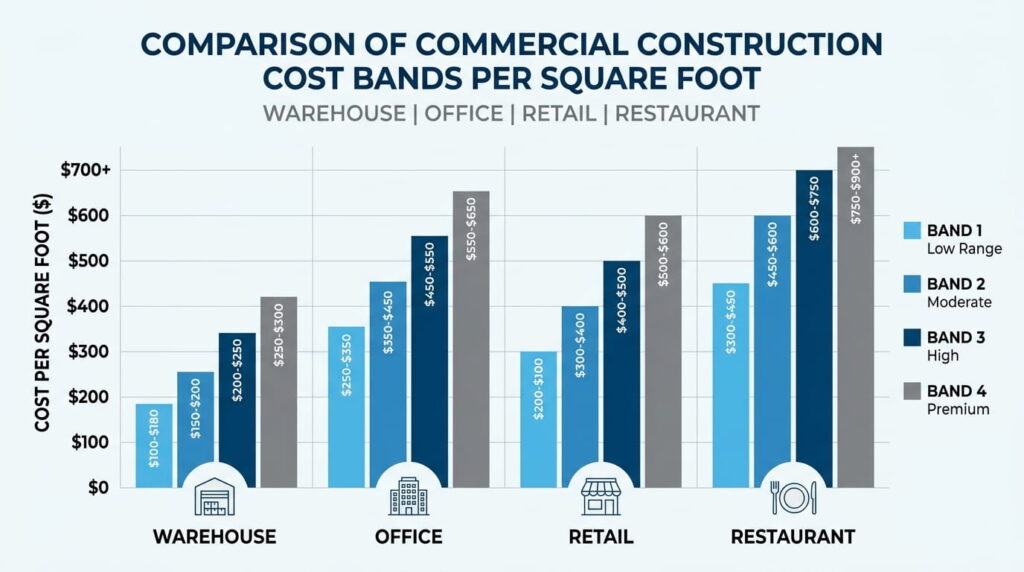
Ontario contractor guides published for 2026 put commercial builds between roughly $150 and $700 per square foot. A pre-engineered warehouse shell anchors the low end. Finished office space and retail fit-outs cluster in the $250 to $450 band, while restaurants and clinics with heavy mechanical loads push past $700 on premium sites.
Construction rates per square foot by building type
Published construction rates per square foot disagree wildly, and the reason is scope. Guides quoting $100 are usually pricing an interior renovation inside an existing envelope. Guides quoting $700 are pricing a turnkey restaurant with a commercial kitchen. Same province, different work.
| Building type | 2026 range per sq ft | Usually includes | Toronto permit rate per m2 |
|---|---|---|---|
| Warehouse or industrial shell | $150 to $250 | Structure, slab, envelope, basic services | $12.37 |
| Office shell | $200 to $300 | Core, envelope, base mechanical | $19.56 |
| Finished office or medical clinic | $250 to $450 | Partitions, finishes, full mechanical | $24.46 |
| Retail store, finished | $250 to $400 | Storefront, HVAC, interior fit-out | $20.77 |
| Restaurant, finished | $400 to $700 plus | Kitchen, grease venting, heavy plumbing | $30.94 |
Those permit rates come straight from the City of Toronto 2026 fee schedule, and they belong beside your build cost from day one. Delivery method moves the total as well, which is why the gap between design-build and a general contractor shows up in the final number.
Material costs are moving unevenly
Material costs are not rising as one block, and that changes which building type stings most. In the second quarter of 2026, non-residential structural steel framing rose 2.2% and metal fabrications 2.0%, while finishes moved just 0.5%. Steel-framed warehouses are inflating faster than fit-out heavy interiors.
Blame the tariffs. Retaliatory duties on steel arrived in March 2025 and expanded again with a 25% tariff on steel derivative products effective December 26, 2025. Fuel prices did the rest, lifting earthwork 2.2% through equipment and haulage.
Labour costs in a tight trades market
Labour costs stayed the sharpest pressure point through 2026. Builders across Canada told Statistics Canada that skilled trades shortages were their primary market challenge in the first quarter, and the second quarter piled seasonal demand onto the same constrained workforce.
Geography helps a little. Non-residential costs in London climbed 2.1% in the second quarter, while Ottawa dipped 0.3% in the first. Building an hour outside the GTA rarely delivers the savings owners expect once trade travel time enters the schedule.
What else belongs in a commercial construction budget?
A commercial construction budget has a second layer the per square foot price ignores. Soft costs, meaning permits, development charges, design and engineering fees, insurance, financing and project management, typically account for 15% to 30% of total development cost. Complex institutional work climbs higher.
Building permits and municipal fees
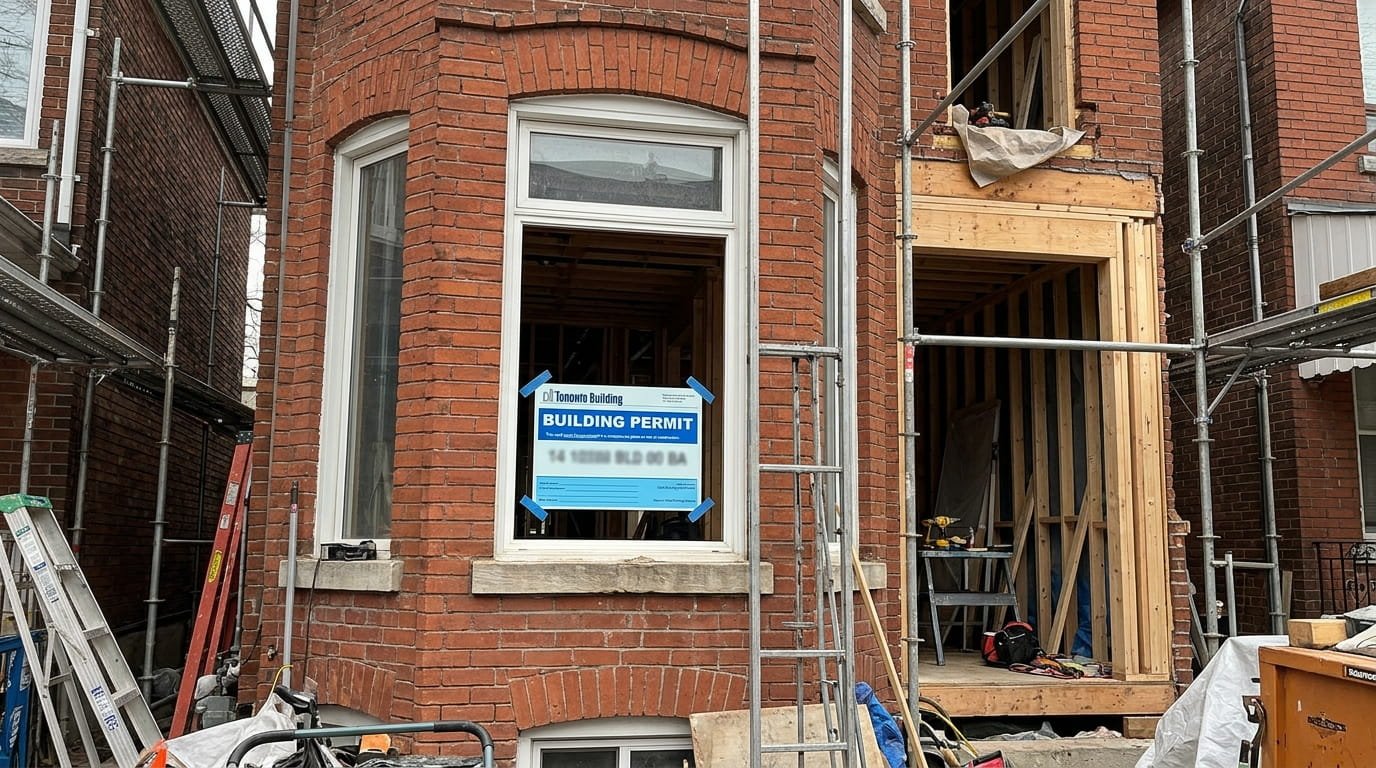
Building permits in Ontario are priced by municipality, not by the province. Toronto calculates its fee as a service index multiplied by floor area, with a 2026 minimum fee of $214.79 and an examination rate of $92.79 per hour.
Run the math on a 10,000 square foot finished office. That is 929 square metres at $24.46, so roughly $22,700, plus a zoning certificate at 25% of the permit fee. Call it $28,000 before development charges. Across Ontario, commercial permit totals commonly run $3,000 to $30,000 or more, so check permit costs by Ontario municipality before you commit to a site.
Starting work without a permit costs more than waiting. Toronto adds 50% of the permit fee as a penalty, capped at $29,456.99.
Architectural fees and consultants
Architectural fees on commercial work generally run 5% to 10% of construction cost for ground-up buildings, with simple warehouses at the bottom and specialty facilities higher. Structural engineering adds another 1% to 3%.
Ontario’s 2024 Building Code, which adopts the National Building Code of Canada 2020, governs every permit drawing you submit. The province keeps a running list of Building Code amendments, and mid-cycle changes land often enough that your consultants should confirm the current version before schematic design closes.
Plumbing costs and mechanical systems
Plumbing costs scale with fixture count, not floor area, which is why a 3,000 square foot restaurant can carry more plumbing than a 10,000 square foot warehouse. Toronto charges $30.94 per fixture on non-residential buildings, $2.52 per linear metre of interior sanitary and storm piping, and $463.95 for a commercial kitchen exhaust permit.
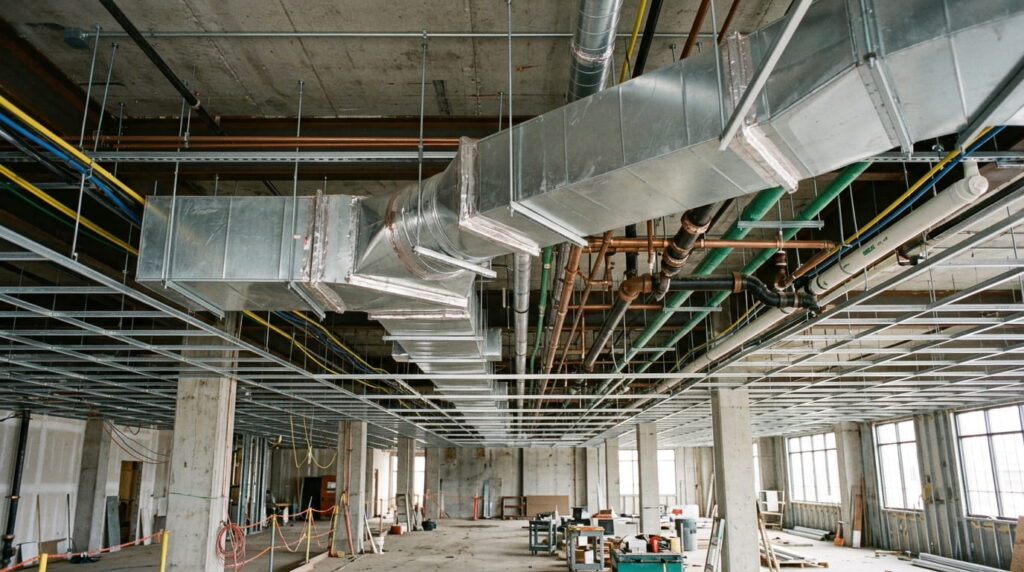
Mechanical work follows the same logic. HVAC permits for offices and retail sit at $1.55 per square metre, while grease interceptors and backflow preventers each carry their own line. Early feasibility and financial planning is where these surface, not during construction.
Frequently Asked Questions
1. How much does it cost to build a 10,000 square foot commercial building in Ontario?
Budget $1.5 million to $4.5 million in 2026, depending on use and finish level. A rough split:
- Warehouse or light industrial shell: $1.5 million to $2.5 million
- Office shell: $2 million to $3 million
- Finished office or medical clinic: $2.5 million to $4.5 million
- Soft costs including permits and design: add 15% to 30%
2. Are commercial construction costs in Ontario still rising in 2026?
Yes, though more slowly than during the pandemic years. Non-residential building construction costs rose 1.4% in the second quarter of 2026 and 3.5% over the previous twelve months across Canada’s 15 largest metro areas, according to Statistics Canada. Steel-related divisions drove most of that increase.
3. Does the price per square foot include permits and architectural fees?
No. A contractor’s per square foot price covers materials, labour, equipment, overhead and profit for the building itself. Permits, development charges, architectural fees, engineering, surveys, insurance and financing are soft costs, and together they typically account for 15% to 30% of total development cost.
4. How much are building permits for a commercial project in Ontario?
Toronto charges $19.56 per square metre for an office shell, $24.46 finished, $20.77 for a finished retail store and $12.37 for a warehouse shell in 2026. Every municipality writes its own fee bylaw, so confirm local rates and add a zoning certificate before budgeting.
5. Is commercial construction cheaper outside the Greater Toronto Area?
Not reliably. London recorded Ontario’s fastest non-residential cost growth in the second quarter of 2026 at 2.1%, while Ottawa saw a small decline earlier in the year. Land prices and development charges usually differ more between municipalities than construction pricing does.
Conclusion
Commercial construction costs in Ontario reward owners who budget in two layers: the contractor’s per square foot price, then the soft costs that price deliberately excludes. Get the second layer wrong and a project that pencilled at $3 million arrives at $3.8 million. Pin down your occupancy classification and permit rates before drawings go out for pricing, and the number you start with stays close to the number you finish with.