

Quick Answer: Commercial construction in Milton typically runs two to four years from land purchase to tenant opening. Approvals dominate the schedule: Ontario non-residential site plan reviews averaged 35 months in the data behind the province’s 2026 reform consultation. Ontario builders quote 10 to 18 months for the build itself.
What Does Commercial Plaza Construction in Milton Involve?
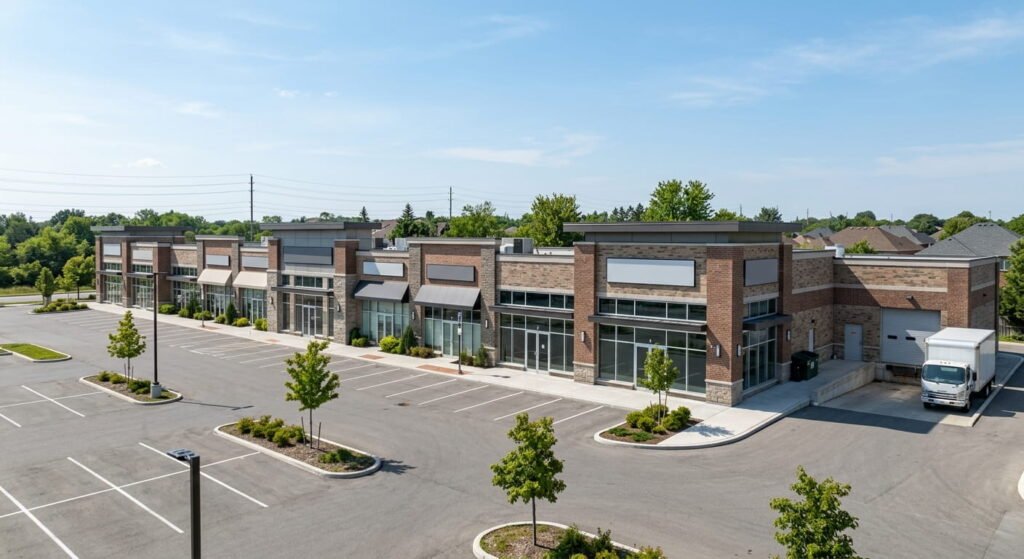
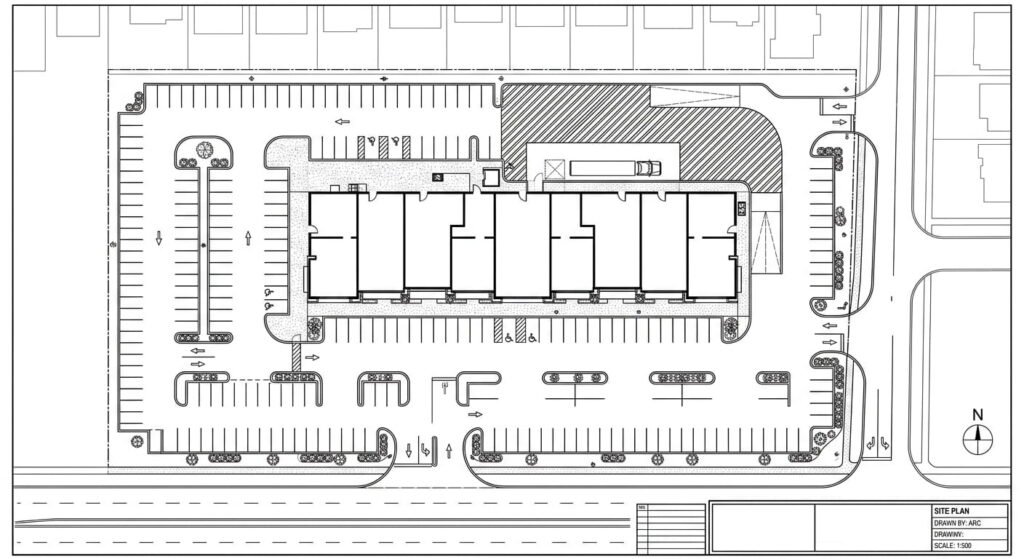
A commercial plaza in Milton is a low-rise retail building, usually single storey, with multiple tenant units, shared parking and a common loading area. Getting one built means clearing three separate gates: zoning conformity, site plan approval under the Planning Act, and a building permit under the Building Code Act.
Leedway Group works across Milton, Oakville, Burlington and the wider Halton area, and one pattern repeats on almost every file. Drawings are rarely what holds a project up. Approvals and servicing are. Commercial construction in Milton rewards developers who front-load the planning work and treat the build as the easy part.
How Long Does Commercial Construction in Milton Actually Take?
Budget two to four years. Pre-consultation, technical studies and site plan approval usually consume more calendar time than the build does. Ontario’s Ministry of Municipal Affairs and Housing reported that non-residential developments averaged 35 months of site plan review, against the 60-day timeline set out in the Planning Act. Environmental Registry of Ontario
| Stage | Typical duration | What controls it |
|---|---|---|
| Pre-consultation and studies | 3 to 6 months | Report scope, consultant availability |
| Zoning bylaw amendment (if required) | 6 to 18 months | Council calendar, tribunal appeals |
| Site plan approval | 12 to 35 months | Number of resubmission cycles |
| Building permit review | 20 business days after a complete application | Completeness, applicable law clearances |
| Construction through occupancy | 10 to 18 months | Weather, lead times, trade sequencing |
Site planning is where schedules quietly break
Resubmissions are the hidden tax. Provincial research found that roughly half of applications require three or more resubmission cycles, each adding two to four weeks, and that comment letters often arrive late and uncoordinated between departments. Environmental Registry of Ontario
The province knows. On March 30, 2026 it opened a consultation on reforming site plan control, floating options that include capping municipalities at three circulations, creating an arbitration panel for files that blow past 60 days, and removing site plan control from the Planning Act altogether. Nothing is law yet, so plan around today’s process. Environmental Registry of Ontario
The build phase is the predictable part
Ontario contractors generally quote 10 to 18 months from pre-construction through occupancy for a low-rise retail plaza. A shell-only delivery lands at the short end. Add tenant fit-outs, a drive-through, or a sprinklered anchor unit and you’re at the long end. Our commercial design-build delivery keeps drawings, permits and trades under one contract precisely because handoffs between separate teams are where months disappear.
Which Approvals Does a Milton Plaza Need Before Construction Starts?
Three, in sequence. Zoning has to permit the use, site plan approval has to be granted, and only then does a building permit get issued. Ontario is explicit that where a site plan control bylaw applies, you may not get a building permit until the plans and drawings have been approved by the municipality. Ontario
Zoning bylaw compliance comes first
Milton splits its rules geographically. Zoning By-law No. 016-2014 applies to the urban areas of Milton, and Zoning By-law No. 144-2003 applies to the rural areas. Changing a use also triggers paperwork: you cannot change the type of use of any land or building within a zone category without a Certificate of Occupancy (Zoning). Milton
If the site is zoned Future Development or the retail use isn’t permitted, you’re filing a rezoning before site plan even starts. That’s the single biggest fork in the schedule. We’ve run that sequence end to end, including a rezoning-to-site-plan file in Niagara.
Building permit review runs on a statutory clock
Milton handles industrial, commercial and institutional files manually. You email the project address, receive a ShareFile link, and staff contact you within two business days to discuss the application. Fees scale with floor area. For mercantile use, a shell with no occupancy is $13.09 per square metre and a partitioned and finished space is $20.14 per square metre, with sprinklers billed separately at $1 per square metre. Full details sit on the Town’s building permits page. milton
The Building Code sets the review window at 20 business days for large buildings once an application is complete. Complete is the operative word. Ontario notes that the municipality must either issue the permit or refuse it with all reasons inside that window, and the Citizen’s Guide to land use planning confirms the clock only starts on a complete file. Ontario
What Drives Construction Costs and Schedule Risk on Milton GTA Projects?
Fees, charges and materials, roughly in that order of surprise. Milton’s 2026 non-residential site plan approval application costs a $15,461 base fee plus $25,508 per hectare to a maximum of 10 hectares, before a single drawing goes to the Region. Milton
Development charges reward tight land development scheduling
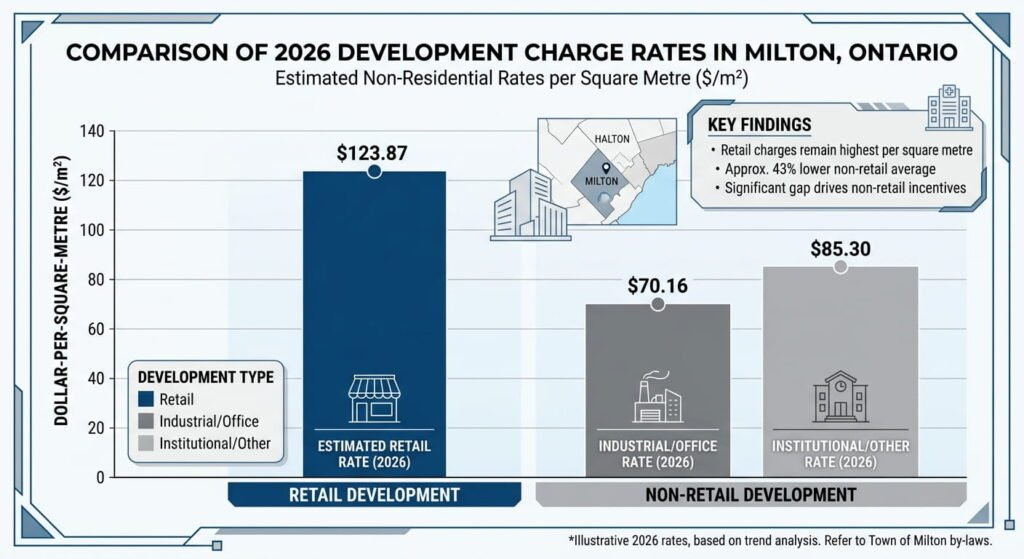
Retail costs roughly double what other non-residential uses cost. As of April 1, 2026, Milton’s town-wide development charge is $123.87 per square metre for retail and $70.16 per square metre for non-retail. On a 3,000 square metre plaza that’s a $161,000 swing based on tenant mix alone.
Four separate charges typically stack on a Milton plaza:
- Town of Milton town-wide development charges
- Area-specific stormwater charges for secondary plan areas such as Boyne or Derry Green
- Halton Region development charges
- Education development charges through the Halton District School Board
Two timing rules matter. Non-residential development charges are generally payable prior to permit issuance, and rates are indexed every April 1 to the Statistics Canada non-residential Building Construction Price Index for Toronto. Slip your permit past March 31 and you pay the new schedule. Our planning and financial guidance walks through how that lands in a pro forma.
Construction materials pricing in 2026
Steel and earthwork are leading the increases. Statistics Canada reported that non-residential building construction costs rose 1.4% in the second quarter of 2026 and 3.5% year over year, with conveying equipment up 2.9%, earthwork and structural steel framing each up 2.2%, and metal fabrications up 2.0%, while finishes rose only 0.5%. Statistics CanadaStatistics Canada
Read that split carefully. Structure and sitework are inflating; interior finishes aren’t. A plaza delayed 18 months in approvals absorbs the expensive half of the basket.
Frequently Asked Questions
1. How long does site plan approval take for a commercial project in Milton?
Plan for 12 to 35 months. The Planning Act sets a 60-day timeline, but provincial data shows non-residential applications across Ontario averaging 35 months. Resubmission cycles drive most of the gap, so a complete first submission is the highest-leverage thing you control.
2. Do I need a zoning bylaw amendment to build a plaza in Milton?
Only if the current zone doesn’t permit your retail uses or your built form. Urban Milton sites fall under Zoning By-law 016-2014. Order a compliance and property information request early, because discovering a rezoning requirement after you close on land adds 6 to 18 months.
3. What does a commercial building permit cost in Milton?
Fees are area-based and vary by use. Common 2026 rates include:
- Mercantile shell, no occupancy: $13.09 per square metre
- Mercantile partitioned and finished: $20.14 per square metre
- Sprinkler systems: $1 per square metre
- Site servicing for sanitary, storm and water: $3.75 per linear metre
- Signs: 1.60% of prescribed value, minimum $264.20
4. When are development charges payable on a Milton commercial build?
Non-residential development charges are generally due before the building permit is issued, not at occupancy. Rates reset every April 1. Town charges are only one layer, since Halton Region and education development charges are billed on top of Milton’s town-wide rate.
5. Can I start site work before site plan approval is granted?
No. Milton requires a separate site alteration permit for grading and earthworks, and the Building Code Act prohibits construction before a permit is issued. Building without one carries fines up to $500,000 for a corporation on a first offence, so early clearing is a costly shortcut.
Conclusion
The build is rarely the risk. Approvals are, and the 35-month provincial average for non-residential site plan review should reset how you model carrying costs on a Milton project. Front-load the studies, confirm zoning before closing, and file a genuinely complete application. Handled that way, commercial construction in Milton stays a two-year story instead of a four-year one.