

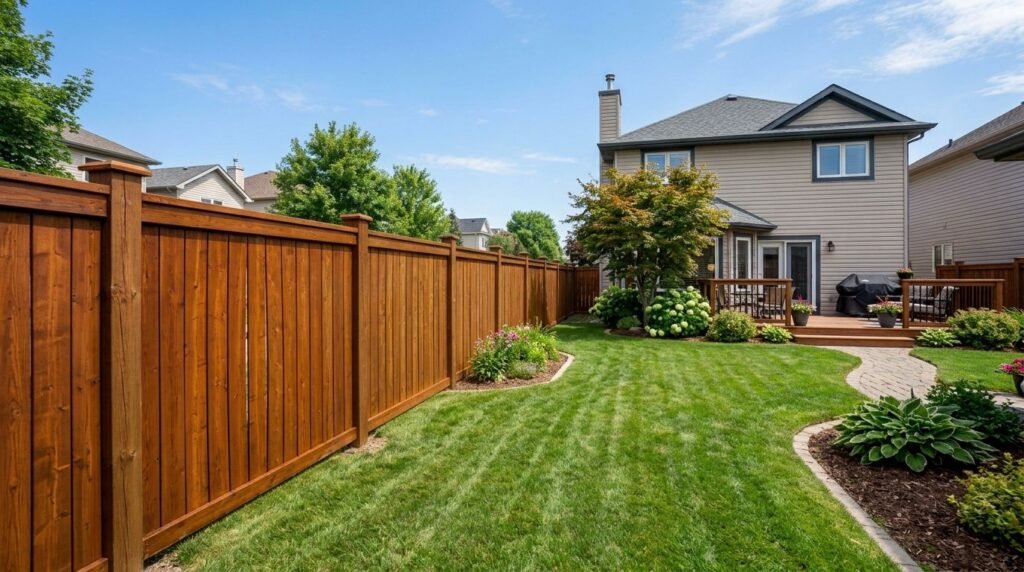
Quick Answer Box: Fence renovation covers repairing, replacing or refinishing an existing fence instead of tearing out the whole line. In Canada, fence renovation runs roughly $25 to $100 per linear foot installed, with partial section repairs from $400 to $1,200. Cost depends on material, post condition, removal, and local by-law limits.
What is fence renovation?
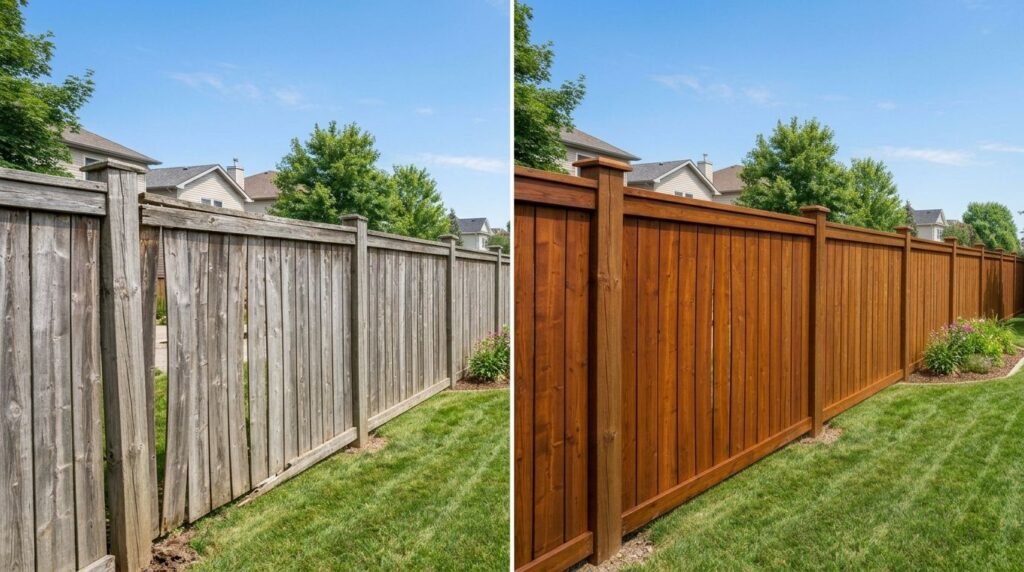
Fence renovation is the work of restoring an existing fence to sound, good-looking condition: resetting or replacing failed posts, swapping damaged boards or panels, rehanging gates, and refinishing the surface. It sits between routine repair and full teardown, and it usually keeps the original fence line and footings that still work.
The distinction matters at quote time. A contractor pricing a full replacement in Ontario adds $3 to $10 per linear foot just to demolish and haul away the old fence. Renovation skips most of that.
That single difference often decides the budget.
How much does fence renovation cost in Canada?
Expect $25 to $100 per linear foot installed for full replacement across Canada, and $400 to $1,200 to rebuild two or three damaged sections. Fence renovation cost tracks four things: the material, how many posts have failed, site access, and whether the old fence has to come out.
Material sets the widest spread. In Ontario in 2026, pressure-treated wood runs $30 to $55 per linear foot installed, cedar $45 to $75, vinyl $45 to $85, and chain link $15 to $40. Lumber prices climbed 12 to 18 percent through 2025 and haven’t come back down.
| Renovation scope | Typical Canadian range | What drives the number |
|---|---|---|
| Replace 2 to 3 damaged sections | $400 to $1,200 | Panel size and material match |
| Reset or replace a single post | $150 to $450 | Footing depth, concrete, access |
| Gate post replacement | $400 to $800 | Oversized footing and hardware |
| Stain or paint an existing fence | $2 to $14 per linear foot | Height, prep, number of coats |
| Full replacement, 150 ft backyard | $3,750 to $12,000 | Material grade and old-fence removal |
Labour is 40 to 60 percent of most fence quotes, which is why access matters more than homeowners expect. A backyard reachable only through a 30-inch side gate means every post, bag of concrete and panel gets carried by hand. Build that into your renovation budget planning.
Is fence repair cheaper than replacement?
Fence repair usually wins on cost until roughly 40 to 50 percent of the fence needs work. Below that line, a section-by-section fix is straightforward: pickets run $15 to $30 each in Metro Vancouver, rails $40 to $80, and a full panel $200 to $500.
Above it, the math flips. Matching old wood to new is the hidden problem nobody quotes for. Cedar weathered by eight seasons won’t match a fresh board, and vinyl colours from a decade ago rarely match current production. The same renovate or rebuild question that applies to houses applies to fence lines.
What does fence post replacement involve?
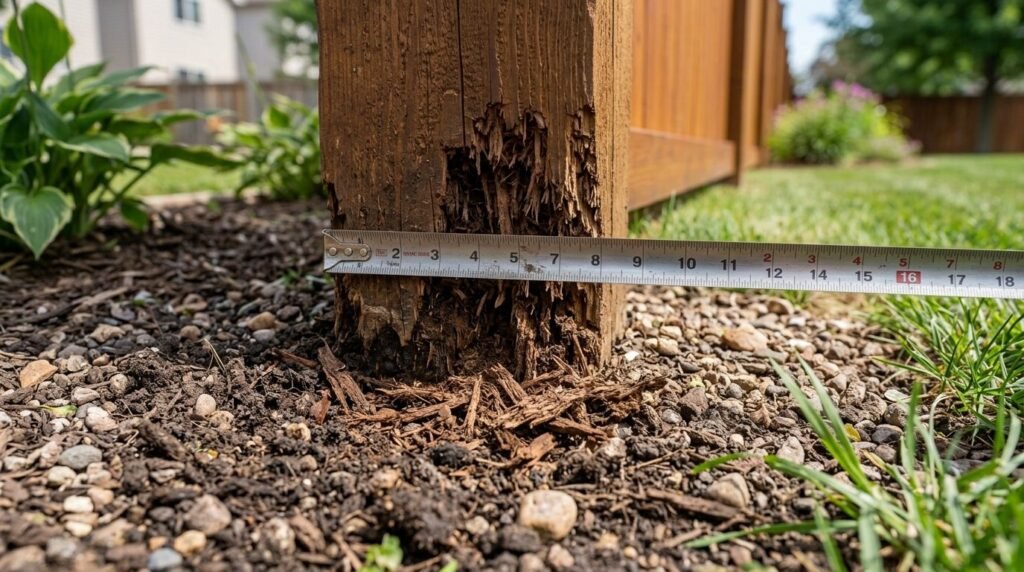
Posts fail first, and they fail underground. Pressure-treated pine in ground contact lasts 15 to 25 years in Canadian soil, cedar 10 to 20, galvanized chain link posts 20 to 30. Fence post replacement with a fresh concrete footing runs $200 to $450 per post, dropping to $100 to $250 on jobs of five or more.
Depth is the whole game. Frost lines across Canada sit between three and five feet, and Toronto’s clay holds moisture against the post base through every freeze-thaw cycle. A post set at 18 inches will heave two to three inches out of the ground within a few winters.
What does a fence renovation involve beyond new boards?
A fence renovation involves more than boards. You need to confirm municipal height limits before anyone digs, settle who pays if the fence sits on a shared boundary, finish the wood so the repair lasts, and time the work around whatever else is happening in the yard.
Do you need a permit to renovate a fence in Canada?
Usually not, if you rebuild in the same place at the same height. Most Canadian municipalities treat like-for-like work as maintenance. Permits get triggered by extra height, by moving the line, or by pool enclosures, and the rules are municipal rather than national.
Toronto’s Municipal Code Chapter 447 caps front-yard fences at 1.2 metres and side or rear fences at 2.0 metres, rising to 2.5 where the yard backs onto a lane or non-residential property. Barbed wire, sheet metal and electric fencing are banned on residential lots. Vancouver holds a 1.2 metre front-yard limit and reviews anything taller through a conditional development permit.
Here’s the part most fence quotes skip. The federal Office of Consumer Affairs states plainly that confirming which permits you need is the homeowner’s job, not the contractor’s, unless your contract says otherwise in writing. If an inspector finds an over-height fence, the order lands on you.
Shared fences add a layer. Ontario’s Line Fences Act lets adjoining owners take a boundary dispute to municipal fence-viewers, with a 2024 appeal fee of $390.29 indexed each January. Toronto opted out in 2018, so its residents settle boundary disagreements themselves, through mediation, or in civil court.
Are fence painting services worth paying for?
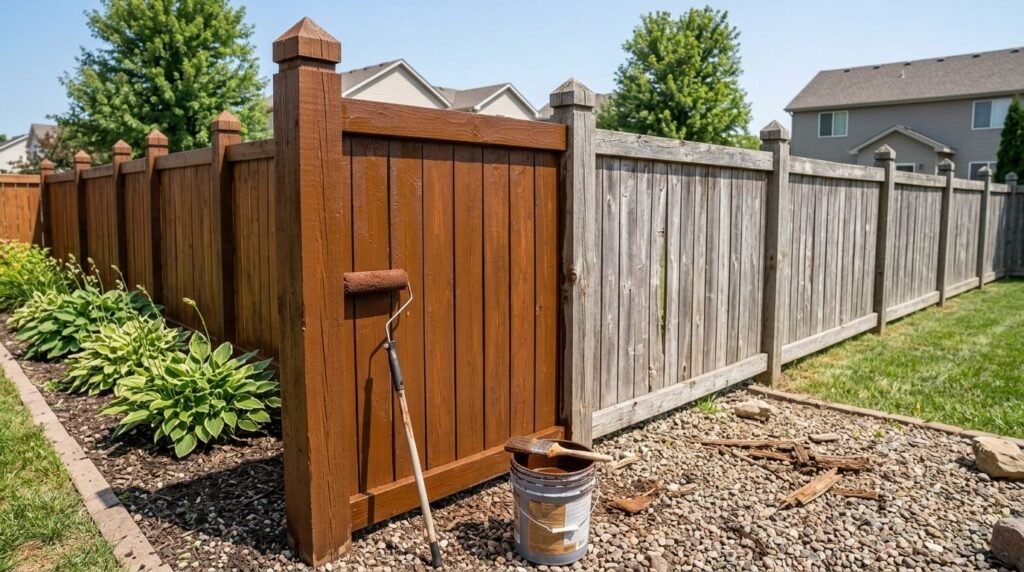
Professional fence painting services run $2 to $14 per linear foot, with most painters holding a $250 to $500 job minimum. DIY materials for the same fence land between $200 and $650, so the gap you’re buying is prep work and labour, not product.
Height drives the bill more than length does. A 150-foot fence at four feet tall is 1,200 square feet of surface once you count both sides. At six feet it’s 1,800. Same property line, 50 percent more work. Sealing bare wood before it greys is cheap long-term home upkeep.
Where does a fence upgrade fit in a bigger exterior project?
Sequencing saves money. If a deck, patio or grading change is coming, a fence upgrade should follow the heavy machinery, not precede it. Excavators find new fence lines, and repairing one twice costs more than waiting.
Fencing recovers 30 to 70 percent of its cost at resale, which puts it mid-pack among exterior home renovation returns. It earns its keep differently though: a leaning, rotted fence reads as deferred maintenance to a buyer’s inspector, and that impression carries past the fence line. Builders who handle renovations and additions often price the fence into the same contract.
Frequently Asked Questions
1. Is it cheaper to repair a fence or replace it?
Repair is cheaper until damage passes roughly 40 to 50 percent of the fence. Rebuilding two or three sections costs $400 to $1,200, while a full 150-foot replacement runs $3,750 to $12,000. Count failed posts first, since posts drive the decision more than boards do.
2. Can you replace fence panels without replacing the posts?
Yes, if the posts still pass three checks:
- No wobble when you push the post at shoulder height
- Solid wood at the soil line, not soft or crumbling
- Plumb, with no lean left over from frost heave
Fail any one of them and the new panels will loosen within a season or two.
3. Who pays for a shared fence between neighbours in Canada?
Cost-sharing rules are provincial and municipal, not federal. Ontario’s Line Fences Act splits boundary fence costs between adjoining owners and provides fence-viewers to arbitrate, but municipalities may opt out, and Toronto did in 2018. Confirm your own municipality’s position before assuming your neighbour owes half.
4. What time of year is best for fence work in Canada?
April through October. Concrete doesn’t cure reliably below 5°C, frozen ground blocks post-hole augers, and most contractors won’t warranty footings poured in winter. Booking in early spring also beats the summer rush, when peak-season demand can add 10 to 20 percent to a quote.
5. Can I cancel a fence contract after signing it?
In Ontario, yes. Any home renovation or repair contract worth $50 or more that you sign in your home carries a 10 calendar-day cooling-off period, with no cancellation fee. If work has already started, you still owe reasonable compensation for labour and materials supplied.
Conclusion
A fence renovation is one of the few exterior projects where doing less is often the better call. Sort the posts from the boards, confirm your municipality’s height rules before anyone digs, and get three written quotes with the removal line spelled out. A tired fence becomes an asset again for a fraction of replacement cost.