
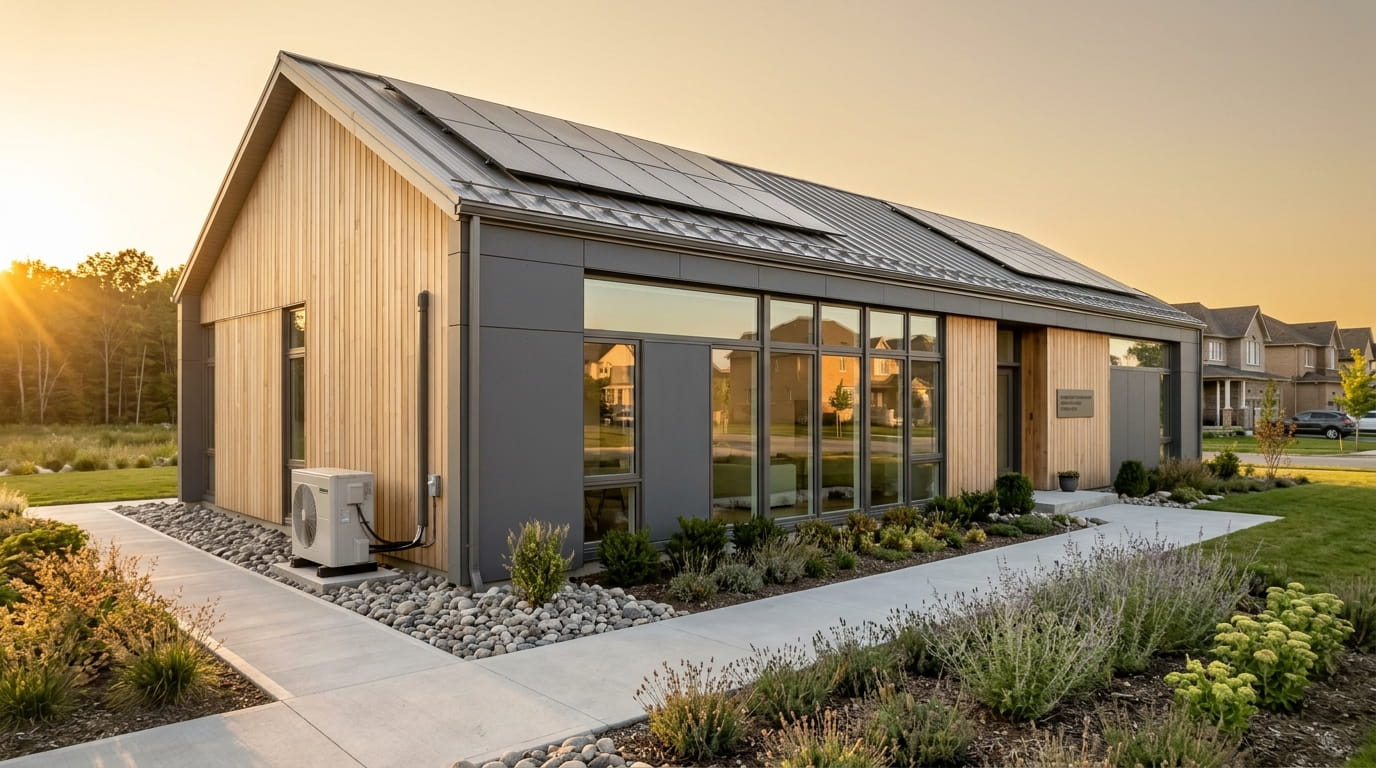
Quick Answer: Net zero homes produce enough energy annually to balance their energy use. In Ontario, achieving this involves an efficient building envelope, carefully selected heating equipment, and renewable generation. Costs depend on the property and design, while renovation rebates may help eligible existing homeowners fund specific upgrades.
What Are Net Zero Homes?
Net zero homes balance the energy they consume over a year with energy generated on-site. That includes heating, cooling, hot water, appliances, and lighting. Natural Resources Canada explains this annual balance in its path to net-zero energy homes guidance. Natural Resources Canada
The annual distinction matters in Ontario. A home can draw electricity from the grid during winter and generate surplus electricity during sunnier months. Achieving net zero doesn’t mean producing everything the house needs every hour.
Net-zero-ready homes have the efficiency features needed for the target, with renewable generation planned for later installation. Leedway Group’s net zero energy homes guide explains this distinction and the systems involved. Leedway Group
How Much Do Net Zero Homes Cost in Ontario?
There is no single reliable price for an Ontario net zero home. The additional investment depends on the starting design, building size, site conditions, and performance target. A new home designed around efficiency also has a different cost structure from an older property undergoing extensive renovation.
Be careful with published national estimates. Natural Resources Canada’s research discusses the additional expense of net zero construction, but those figures describe particular building approaches. They aren’t a current quotation for your Ontario property. Natural Resources Canada
Ask for a baseline construction budget and a separate breakdown of the upgrades required to reach the target. That makes comparisons more useful than a single price per square foot.
Building Envelope and Attic Insulation
The building envelope includes the walls, roof, windows, foundations, and other components separating indoor space from outdoors. Improving its performance reduces heating and cooling demand, which influences equipment sizing and the amount of electricity the home must generate.
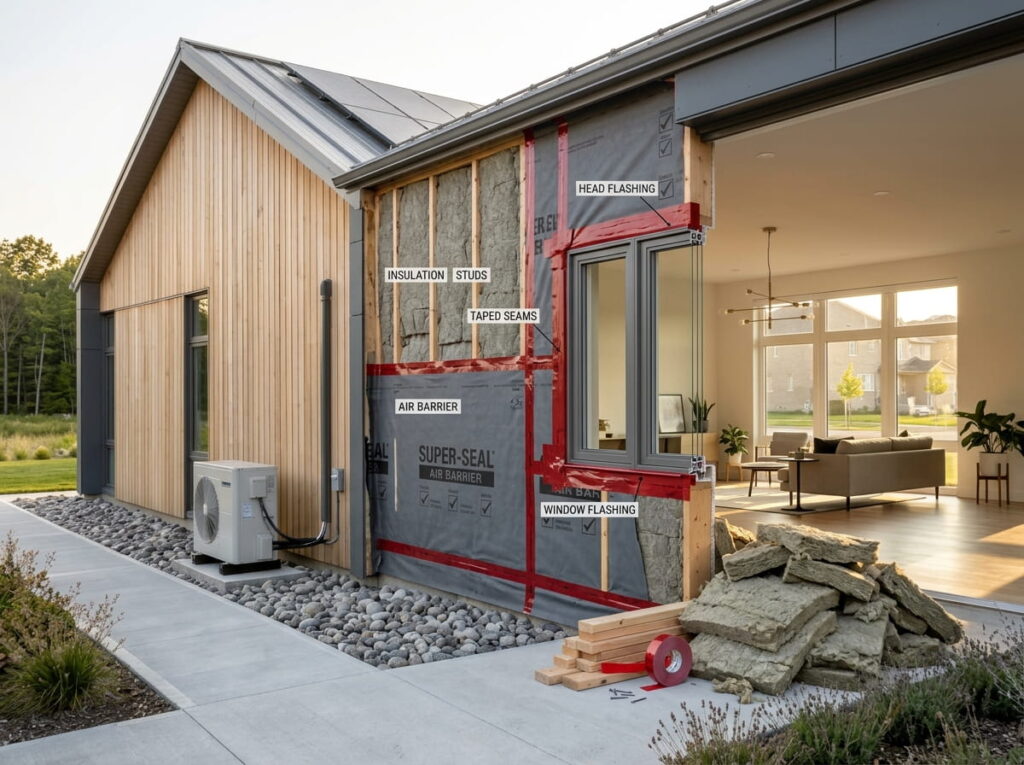
Attic insulation is one part of that work. Air sealing, window installation, and insulation continuity also need attention. Adding insulation without addressing gaps elsewhere can leave avoidable heat loss in the finished home.
For a new build, review these details before drawings are finalized. Leedway Group’s custom home and renovation services provide a starting point for discussing the construction scope alongside your performance goals. Leedway Group
Heat Pump Installation and Geothermal Heating
Heat pump installation costs depend on equipment capacity, distribution systems, electrical work, and installation conditions. Compare complete proposals, including controls and any supplementary heating, rather than equipment prices alone.
Air-source heat pumps transfer heat between outdoor air and the home. Geothermal heating uses ground-source equipment that exchanges heat with the earth or groundwater. Natural Resources Canada’s heating and cooling with a heat pump guide explains both approaches. Natural Resources Canada
Ground-source proposals also need a site-specific plan for the ground heat exchanger. Neither technology is automatically the right choice for every property.
Solar Panels and Renewable Energy
Solar panels contribute electricity toward the home’s annual energy balance. Their required capacity should follow the energy model: first establish the building’s expected demand, then evaluate how much suitable roof area is available.
Shading and roof configuration deserve attention before the architectural design is settled. A visually appealing roof can create practical constraints for renewable energy generation. Leaving these decisions until construction is underway can narrow your options.
Which Rebates Can Ontario Homeowners Use?
Ontario’s Home Renovation Savings Program supports eligible efficiency upgrades to existing homes. The province describes rebates covering up to 30% of eligible improvement costs. Eligibility depends on the measure and program requirements, so an advertised maximum should never be treated as guaranteed funding. ontario.ca
The province’s energy savings program announcement listed maximum incentives of $7,500 for qualifying cold-climate air-source systems and $12,000 for qualifying ground-source systems. Actual amounts depend on factors including existing heating fuel and equipment capacity; some households qualify for lower amounts. Ontario Newsroom
Before including rebates in your budget, confirm:
- Whether the property and existing heating system qualify.
- Whether an assessment or approval is required before work.
- Which equipment models and contractors meet program requirements.
- Whether the proposed solar arrangement meets the applicable incentive rules.
New construction needs separate consideration. Renovation incentives shouldn’t be deducted from a new-home budget without written confirmation of eligibility.
As of November 4, 2026, the Canada Greener Homes Loan is closed, and new applications cannot be approved. Previously approved borrowers retain access to their approved funding. Older articles advertising the loan as available can therefore produce misleading budgets. Canada.ca
Solar Generation and Your Electricity Bill
Ontario’s net metering guidance explains how eligible customers receive bill credits for renewable electricity exported to the grid. Credits can carry forward for up to 12 months. The province advises obtaining distributor approval before buying equipment or signing an installation contract. ontario.ca
Net zero energy doesn’t guarantee a zero-dollar bill. Applicable fixed charges can remain, and incentive eligibility must be checked separately from connection approval. Environmental Registry of Ontario
What Benefits Can Lower Energy Consumption Deliver?
Lower energy consumption reduces the amount of purchased energy needed to operate the home. The financial benefit depends on the original building, heating fuel, utility rates, and household behaviour. A useful projection compares your proposed home with a clearly defined baseline rather than promising a universal savings percentage.
Comfort is another reason to consider the investment. Better insulation and airtight construction help control the indoor environment, while a designed ventilation system supplies fresh air. Leedway Group identifies comfort, ventilation, and reduced outdoor noise among the benefits of its high-performance approach. Leedway Group
Ask what supports the performance claim. Energy modelling, construction details, and verification provide a stronger basis for decisions than a list of efficient products. A well-insulated home still needs its heating and ventilation systems to work together.
Frequently Asked Questions
1. Can an existing Ontario home become net zero?
Existing Ontario homes can be assessed for a pathway toward net zero. The scope depends on current heat loss, equipment, and available generation space. A major retrofit may require coordinated envelope and mechanical improvements. An energy assessment helps establish which changes are practical before homeowners commit to construction.
2. Are net zero homes completely off-grid?
Net zero homes can remain connected to Ontario’s electricity grid. Their defining feature is an annual energy balance, which allows electricity imports and exports at different times. Off-grid operation is a separate design objective requiring additional planning for periods when on-site generation cannot meet household demand. ontario.ca
3. Do heat pumps work during Ontario winters?
Cold-climate heat pumps are included in Ontario’s efficiency incentive framework. Suitability still depends on the selected model, local conditions, and the home’s heating load. Have the contractor document low-temperature performance and any supplementary heating requirements rather than assuming every system provides the same winter capacity. Ontario Newsroom
4. What should a net zero construction quote include?
A net zero construction quote should identify the work and evidence supporting the performance target. Request:
- Envelope specifications and air-sealing scope.
- Heating, ventilation, and electrical work.
- Renewable generation allowances and exclusions.
- Energy modelling and verification responsibilities.
This breakdown helps you compare proposals and understand which costs remain outside the contract.
5. Is geothermal heating required for net zero homes?
Geothermal heating is one available approach, but net zero homes can use other heating systems. Ground-source and air-source technologies should be assessed against the property and energy model. The annual target depends on the combined performance of the building, equipment, and renewable generation rather than one particular technology. Natural Resources Canada
Conclusion
Net zero homes in Ontario require coordinated design and a property-specific budget. Start with the building’s energy needs, compare complete equipment proposals, and verify incentives before committing. This approach gives homeowners a clearer basis for weighing construction costs against comfort, energy savings, and long-term performance.
Ready to discuss your project?
Book a free consultation with Leedway Group to discuss your property and project.