
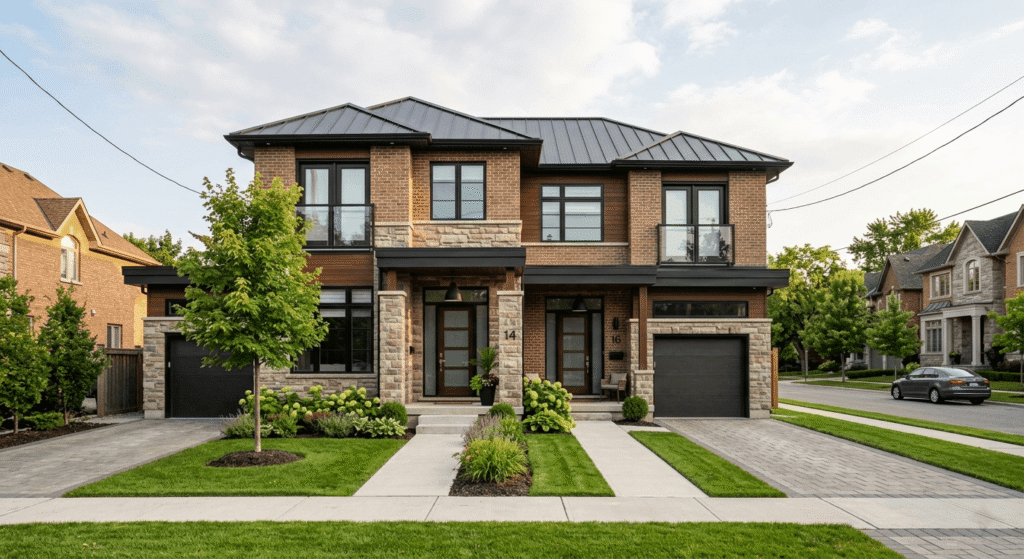
Quick Answer: A plex home is a real estate investment that works while you live in it. Splitting one property into two to four self-contained units lets owners collect rent from tenants, build home equity faster, and grow property value, all while offsetting mortgage costs in the GTA’s tight rental market.
A plex home, whether it’s a duplex, triplex, or fourplex, turns one residential lot into a real estate investment with several income streams instead of one. Across the GTA, more homeowners are converting single-family houses or building new multiplexes because the numbers no longer work as well for a single rental unit on its own. Rising land costs make a one-tenant property harder to justify, but spreading rent across two to four units changes that math.
Ontario’s zoning reforms have made this shift more practical than it was even three years ago. The province set a floor of three residential units as-of-right on most lots with municipal services, and several municipalities, including Toronto, now permit four. For homeowners exploring renovations, additions, and garden suites as a way to add units to an existing property, a plex home conversion or new build is often the fastest route to added income, equity growth, and a stronger resale position.
How Does a Plex Home Generate Rental Income and Cash Flow?
A plex home generates income from each self-contained unit, and that income covers most or all of the mortgage payment on the property. Cash flow is what remains after the mortgage, property taxes, insurance, utilities, and management costs are paid each month. In the GTA, a well-positioned duplex or triplex conversion can start adding real, collectible rent the day a tenant moves in.

Net Operating Income: The Number That Matters Most
Net operating income, or NOI, is gross rent minus operating expenses, calculated before any mortgage payment. Lenders and appraisers rely on NOI to value an income property, because it shows how the building performs on its own, separate from how it’s financed. For a plex home, NOI typically accounts for:
- Property taxes and insurance
- Utilities not covered by tenants
- Routine maintenance and repairs
- Management fees
- A vacancy allowance, even in a tight rental market
A higher NOI supports a higher appraised value down the road. Our guide to boosting income from multiplex rental units covers how owners structure unit mixes to grow that number from day one.
Property Management Costs and Mortgage Rates to Factor In
Self-managing a plex home with several tenants is realistic for some owners, but many hand day-to-day operations to a property management company instead. In Ontario, that service typically costs 6% to 12% of collected rent, plus a separate placement fee when a new tenant signs on. Financing terms matter just as much. As of June 2026, the Bank of Canada has held its policy rate at 2.25% for five consecutive announcements, keeping the prime rate at 4.45%. An owner-occupied plex home with up to four units can often qualify for CMHC-insured financing at 5% to 7.5% down, as long as the purchase price stays under $1 million. Larger rental buildings with five or more units fall under CMHC’s MLI Select program instead, which allows financing up to 95% of the property’s value but follows a different approval process built around affordability and energy scoring.
How Does a Plex Home Build Home Equity and Property Value?
Every mortgage payment funded by a tenant’s rent builds home equity for the owner, not the tenant. That equity compounds alongside whatever appreciation happens in the broader market. A plex home tends to hold its property value better than a comparable single-family home, because its income potential gives it a second source of worth beyond nearby comparable sales.
Capital Gains Tax When You Sell a Plex Home Investment
The portion of a plex home used as a rental does not qualify for the principal residence exemption, even when the owner lives in one of the units. The Canada Revenue Agency requires owners to split the sale price between the principal residence portion and the income-producing portion, using a reasonable measure such as square footage or number of rooms, then report the capital gain only on the rental share. As of 2026, the inclusion rate for individuals remains at 50%, after the federal government cancelled a proposed increase to 66.67% on larger gains in March 2025. Half of any taxable gain on the rental portion gets added to the owner’s income in the year of the sale.
Market Value Growth Driven by Ontario’s Zoning Reforms
A plex home’s market value increasingly depends on its zoning potential, not just its current layout. Ontario set a province-wide minimum of three residential units as-of-right on most serviced lots, and the City of Toronto extended that to four self-contained units across most of its Neighbourhood-designated residential zones starting in 2023, with Ontario Regulation 462/24 further easing lot coverage and setback rules for these units in late 2024. A lot that can legally support a fourplex is worth more than an otherwise identical lot that can’t, because that potential is already priced into the market value before a single wall goes up. Our breakdown of ways to maximize multiplex building value looks at how design choices affect that number further.
Frequently Asked Questions
1. Is a plex home a good real estate investment in the GTA?
Yes, for owners focused on cash flow over quick appreciation. A duplex or triplex spreads rent across multiple tenants, covering more of the mortgage than a single-family rental ever could. Combined with Ontario’s zoning reforms allowing up to three or four units as-of-right on most lots, a plex home offers both income and long-term value growth.
2. How much rental income can a plex home generate?
A converted second unit in the GTA typically adds $1,500 to $2,000 in monthly rental income while increasing the property’s value by an estimated $80,000 to $150,000. A triplex or fourplex compounds this across additional units, though actual rents depend on unit size, finishes, and location within the GTA.
3. What mortgage rate applies to a plex home purchase?
As of June 2026, Canada’s prime rate sits at 4.45%, following the Bank of Canada’s fifth consecutive hold of its policy rate at 2.25%. An owner-occupied plex home with up to four units can often qualify for CMHC-insured financing at 5% to 7.5% down, provided the purchase price stays under $1 million.
4. Do I pay capital gains tax when I sell a plex home?
Yes, on the rental portion. The Canada Revenue Agency requires the sale price to be split between the principal residence and income-producing portions, and only the rental share is taxed. As of 2026, the capital gains inclusion rate for individuals remains at 50%, after a proposed increase to 66.67% was cancelled in 2025.
5. How much does property management cost for a plex home?
Ontario property management companies typically charge:
- 6% to 12% of collected rent for ongoing management
- 50% to 100% of one month’s rent for tenant placement
- $99 to $200 per visit for periodic inspections
Self-managing avoids these costs but adds a real time commitment once a property has several tenants.
Conclusion
A plex home turns ordinary square footage into a real estate investment that works in two directions. A tenant’s rent chips away at the mortgage today, and the building’s value compounds for whoever owns it down the road. Converting an existing house or building new under Ontario’s expanded zoning rules can both pencil out when the design and financing are right from the start. Leedway Group’s design-build team can walk you through what a plex home could look like on your lot and what it could mean for your bottom line.