

Quick Answer Box Multigenerational home design Ontario projects typically take one of four forms: an interior in-law suite, a basement secondary suite, a detached garden suite or laneway house, or a second-storey addition. Since Ontario Regulation 462/24 took effect, most lots qualify for up to three units as-of-right, making these layouts easier to permit than they were before 2024.
What Is Multigenerational Home Design in Ontario?
Multigenerational home design Ontario refers to floor plans and additions that give grandparents, parents, and adult children separate living spaces under one roof or on one lot. It typically includes a private bedroom, bathroom, kitchenette, and entrance for each generation. Good design balances independence with proximity, while meeting Ontario Building Code and local zoning requirements.
TL;DR
- Ontario Regulation 462/24 (effective November 20, 2024) lets most residential lots host up to three units, covering in-law suites, garden suites, and laneway houses without rezoning.
- The federal Multigenerational Home Renovation Tax Credit refunds 14.5% of eligible costs, up to $7,250, for a self-contained secondary unit built for a senior or person with a disability.
- A separate entrance, fire-rated separation, and egress windows are non-negotiable under the OBC for any secondary suite.
- First-floor or detached suites usually outperform second-storey units for aging family members because of accessibility.
What Housing Options Work Best for Multigenerational Living in Ontario?
Four layouts dominate multigenerational house plans across the GTA: an interior in-law suite, a basement secondary suite, a detached garden suite or laneway house, and a second-storey addition built as an extra wing. Each puts a different generation in a different part of the property while keeping the family connected.
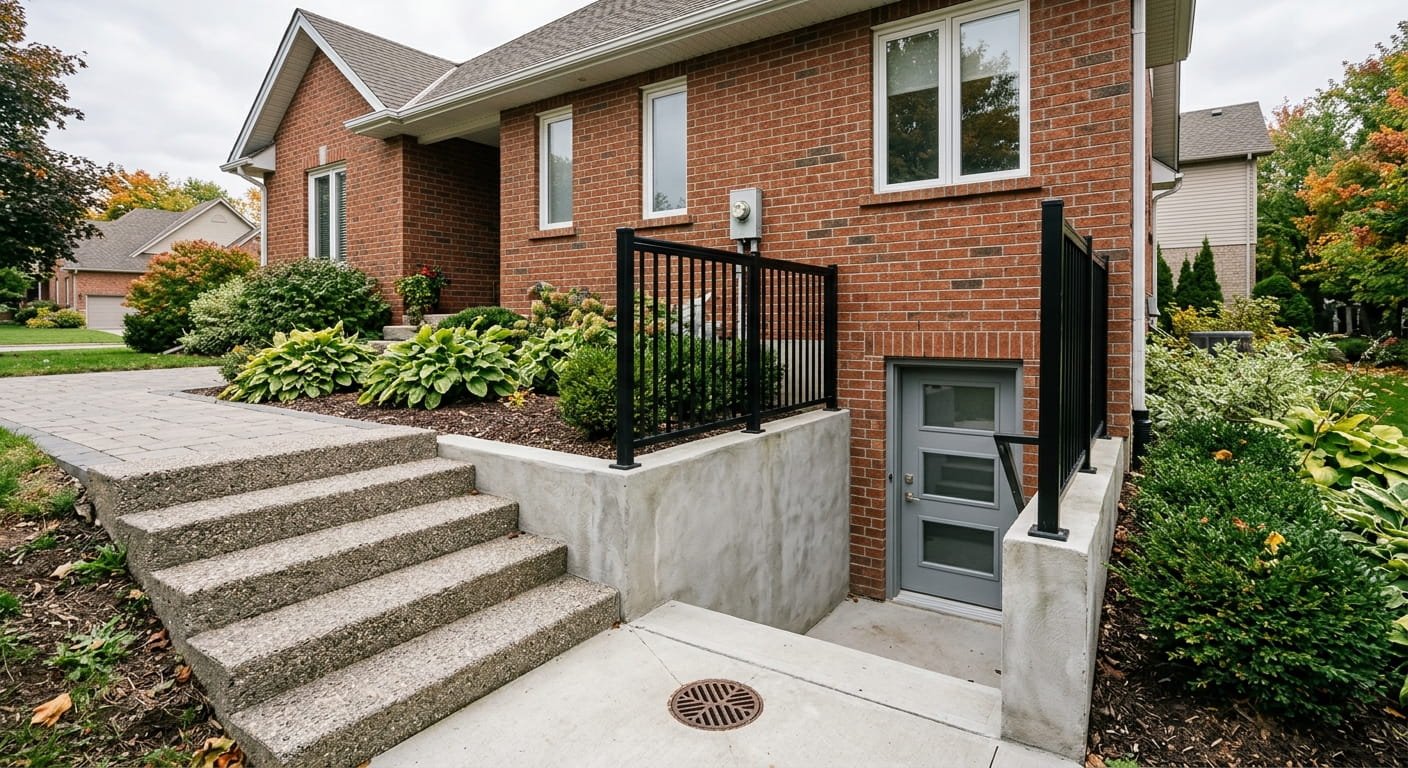
An in-law suite is usually carved out of existing main-floor space, such as a converted den, garage, or rear extension, and works best when an aging parent needs step-free access. A secondary suite in the basement is the most affordable route per square foot, since it reuses the existing foundation and roof, though it needs proper egress windows, soundproofing, and a fire separation from the rest of the house.
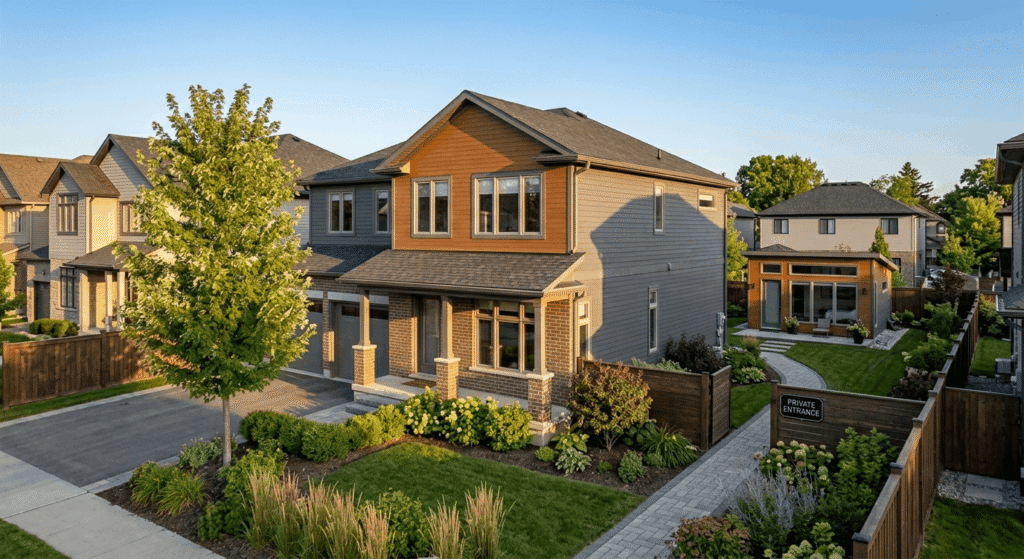
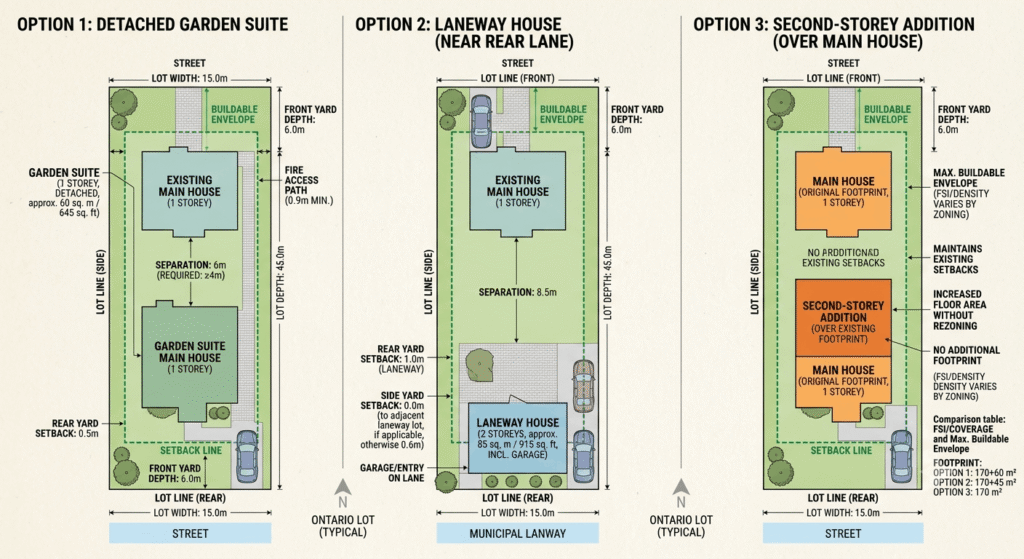
Garden suites and laneway houses sit at the back of the lot as fully detached structures with their own kitchen and bathroom. They suit adult children who want independence while staying close to aging parents, and they double as future rental income once the family’s needs change. Toronto’s zoning for laneway and garden suites was updated in 2025 through By-laws 847-2025 and 849-2025, making them as-of-right in most residential zones with height limits up to 6.3 metres and one parking space per unit. If you’re weighing whether a detached unit pencils out, our guide on garden suites as a housing density strategy breaks down the trade-offs in more detail.
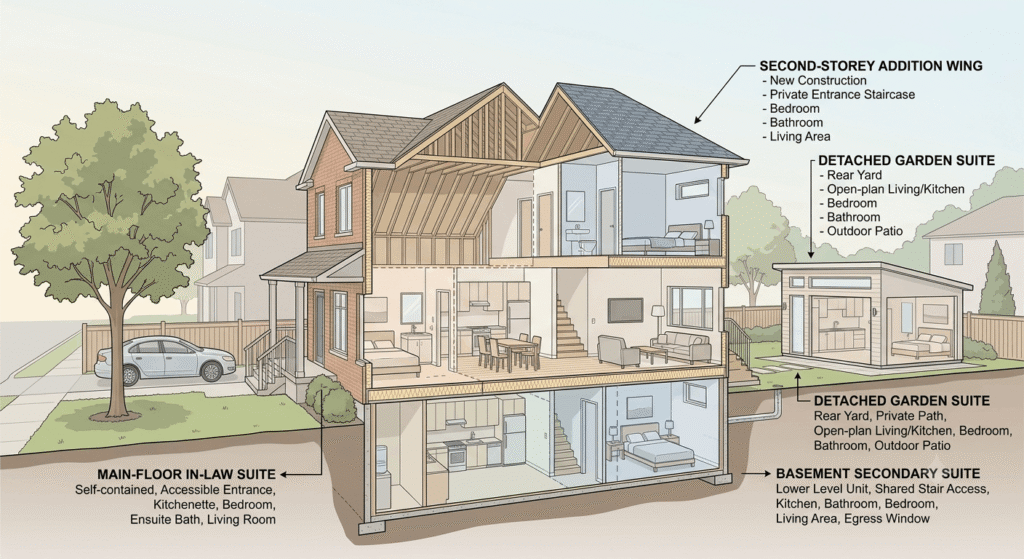
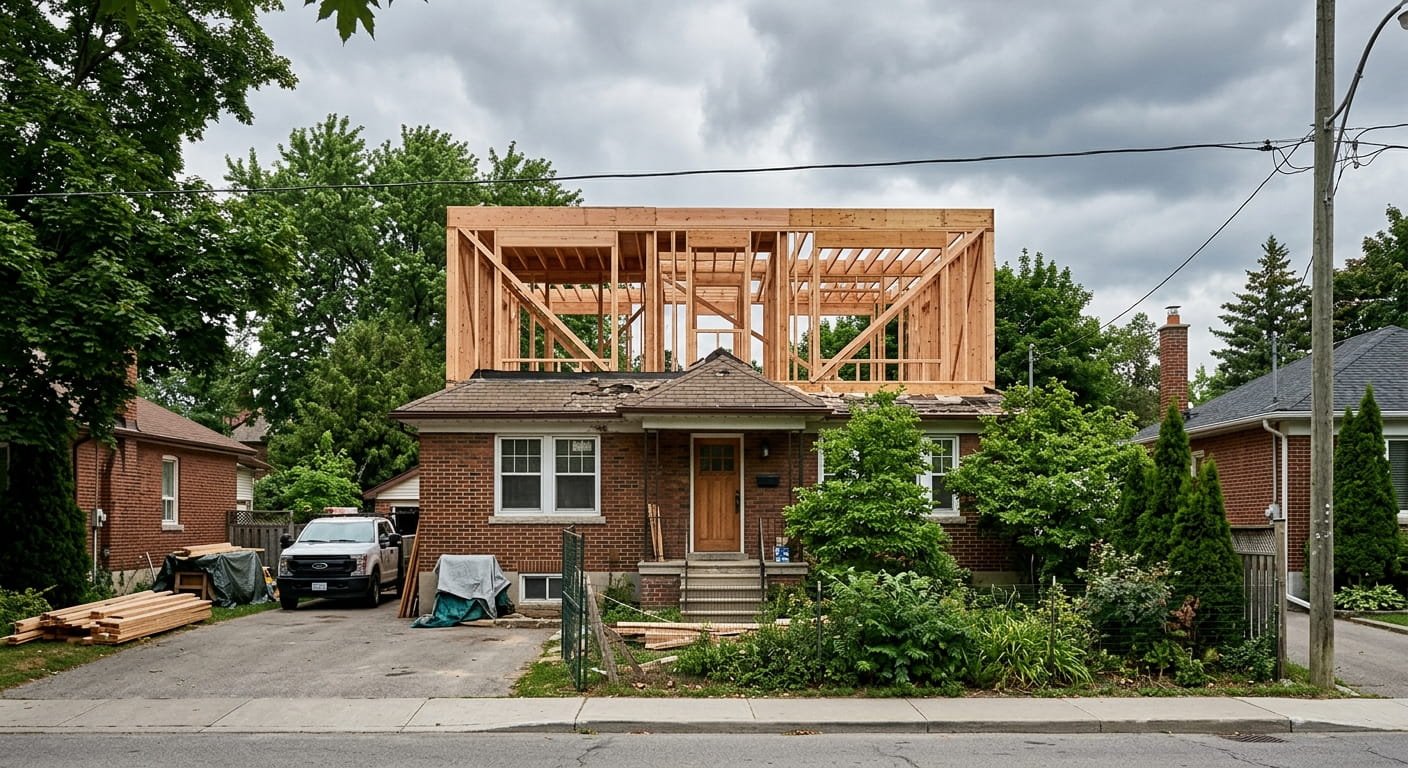
A second-storey addition adds an entire new wing, often used for a primary bedroom suite for parents while adult children take over the main floor, or vice versa. It’s the most disruptive option during construction but adds the most resale value per square foot in established neighbourhoods.
For families planning ahead, aging-in-place garden suites balance independence with accessibility.
How Do You Design an Accessible In-Law Suite for Aging Parents?
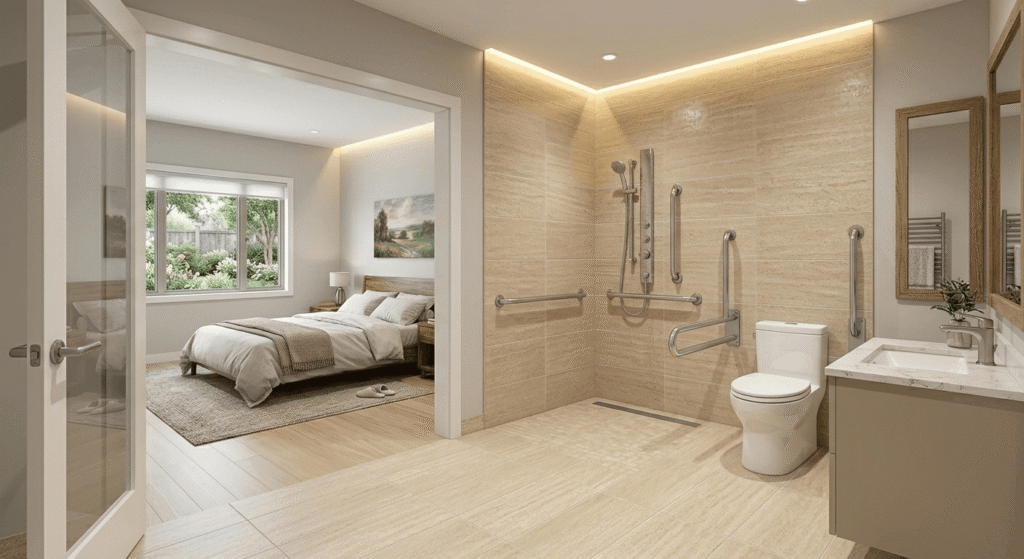
An accessible in-law suite puts the bedroom, bathroom, and kitchen on one level with no interior steps, wide doorways, and a separate entrance with a sloped, covered walkway. Many seniors live with mobility or vision impairment, so design teams often recommend a first-floor addition instead of a second-floor bump-out, because it’s easier to add a step-free entrance and the unit doesn’t require exterior stairs.
The bathroom deserves the most attention. A roll-in or curbless shower, grab bars rated to support body weight, a comfort-height toilet, and a lowered vanity all reduce fall risk without making the space feel clinical. Lever-style door handles, rocker light switches, and contrasting flooring colours at thresholds help residents with limited grip strength or low vision.
Don’t skip the entrance itself. A separate entrance with a sloped walkway rather than steps, weather coverage, comfortable non-slip materials, and good lighting along the path, porch, and doorway gives an aging parent privacy and dignity while also letting caregivers come and go without passing through the main household.
This is also where the federal tax credit becomes relevant. The Multigenerational Home Renovation Tax Credit is a refundable credit worth 14.5% of qualifying renovation costs, up to a maximum of $7,250 per qualifying renovation, for projects that create a self-contained secondary unit for an eligible senior or adult. A homeowner spending the full $50,000 maximum on eligible expenses would receive a $7,250 refundable credit, calculated separately for each qualifying renovation.
Planning space for a parent or adult child? Our guide to in-law suite additions in Ontario covers costs, permits and design.
What Permits Do You Need for a Garden Suite or Home Addition in Ontario?
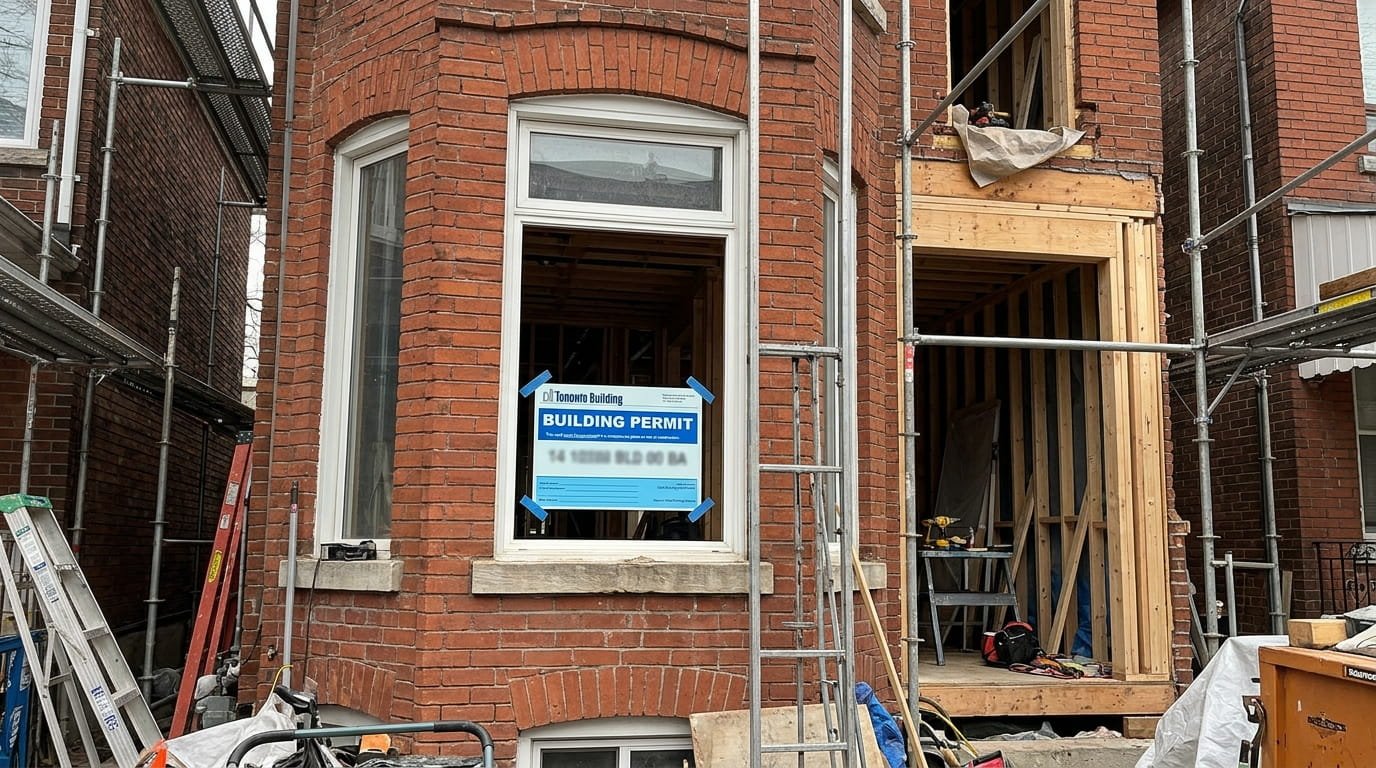
Every garden suite, laneway house, in-law suite, or addition in Ontario needs a building permit regardless of how the zoning rules apply, because the Ontario Building Code governs construction safety separately from municipal land-use planning. Zoning tells you what you’re allowed to build; the permit confirms how it gets built safely.
On November 20, 2024, Ontario Regulation 462/24 came into force under the Planning Act, setting new performance standards for additional residential units, including minimum separation distances, maximum lot coverage, floor space index, and minimum lot area. The regulation affects properties with up to three residential units, and the City of Toronto has been working to align its zoning by-laws with these provincial standards as part of its Expanding Housing Options in Neighbourhoods initiative.
For a secondary suite specifically, expect three Building Code checkpoints: egress windows in every bedroom for emergency exit, fire-rated separation between the suite and the rest of the house (typically a 45-minute or one-hour assembly depending on sprinklering), and adequate sound insulation between units. Electrical work also needs ESA inspection, and plumbing changes need to meet OBC Part 7. Builders registered with HCRA and working under a Tarion-enrolled warranty plan will already build these checks into their permit drawings, which is one reason it’s worth confirming registration before signing a contract with any multi generational home builders. For a fuller breakdown of how these rules interact with overall feasibility, see our guide to multigenerational homes in Ontario.
How to Plan a Multigenerational Home Addition
- Define each generation’s needs first. Map out mobility requirements, privacy expectations, and whether anyone needs to be on the ground floor before sketching layouts.
- Confirm zoning and unit count with your municipality. Even with O.Reg 462/24 in effect, lot coverage, frontage, and laneway access vary by city.
- Choose the suite type that fits your lot. A narrow urban lot might suit a basement secondary suite, while a deep rear yard suits a garden suite.
- Hire an HCRA-registered builder and request Tarion enrollment details upfront. This protects the addition under Ontario’s new home warranty program.
- Apply for the building permit with full architectural and structural drawings. Second-storey additions need a structural engineer’s load-path analysis for the existing foundation.
- Budget for separate metering if the suite might ever be rented. It’s not mandatory, but it simplifies utility billing later.
- Track renovation expenses for the Multigenerational Home Renovation Tax Credit. Keep invoices from contractors, electricians, and plumbers separated by qualifying renovation.
Weighing rental options? See our side-by-side on basement apartments vs garden suites.
Garden Suite vs Laneway House vs Home Addition: Which Fits Your Lot?
| Option | Best for | Typical footprint | Separate entrance | Resale impact |
|---|---|---|---|---|
| In-law suite (main floor) | Aging parents needing step-free access | Converted existing space | Usually added | Moderate |
| Basement secondary suite | Budget-conscious families, rental flexibility | Existing footprint | Required for legality | Moderate |
| Garden suite | Adult children wanting independence | Up to 60 m² (about 645 sq ft) on most lots | Built-in | High |
| Laneway house | Lots backing onto a public laneway | Minimum 3.5 m frontage required | Built-in | High |
| Second-storey addition | Families needing a full extra wing | New upper floor over existing footprint | Optional, via new stairwell | Highest |
Common Mistakes to Avoid With Multigenerational Home Design
The most frequent error is treating a basement renovation as a secondary suite without confirming egress windows and fire separation, which can turn a finished project into a non-compliant one during final inspection. A close second is skipping the accessibility conversation entirely. Families often design for today’s needs and ignore that a parent’s mobility will likely decline within a few years, leaving them stuck with a second-floor in-law suite that becomes unusable.
Another common misstep involves underestimating soundproofing. Shared walls between generations need more than standard drywall to keep early risers from waking everyone else. Finally, some homeowners assume a detached garden suite can be built without a permit because it’s “just a backyard structure.” It can’t. Garden suites and laneway houses require a full building permit from the City of Toronto Building Division and must meet OBC occupancy, fire separation, and egress requirements before occupancy is granted.
Which Multigenerational House Plan Is Right for Your Family?
If an aging parent needs daily support and step-free living, prioritize a main-floor in-law suite or a garden suite with a covered, sloped entrance. If your priority is rental flexibility down the road, a basement secondary suite or laneway house gives you the most resale options. Families adding space for adult children who are still mobile and want privacy from the rest of the household often do best with a second-storey addition, since it keeps the main floor shared while giving everyone their own retreat. Whatever you choose, talk to a renovations and additions specialist early, since lot constraints often narrow the choice before design even starts.
Frequently Asked Questions
1. Is a garden suite the same as a laneway house in Ontario?
No. A garden suite requires a minimum 1.5 m setback from the rear lot line, while a laneway suite abuts the laneway directly with no rear setback, and both are capped at 45% total lot coverage under Ontario Regulation 462/24.
2. Do I need a separate entrance for an in-law suite to be legal?
A separate entrance is not always mandated by code for legality, since a lockable internal door can suffice, but a basement walkout or side door is highly desirable for privacy and property value.
3. Can I claim the Multigenerational Home Renovation Tax Credit for a garage conversion?
Yes, the credit applies to renovations that create a self-contained unit with its own entrance, kitchen, bathroom, and sleeping area, which can include a garage conversion or a separate laneway house on the same property.
4. What’s the maximum size for an ADU in Toronto?
Most lots cap a garden suite or laneway house footprint at 60 m², about 645 sq ft, though lots larger than 370 m² may qualify for a slightly larger footprint.
5. How do I choose between a basement secondary suite and a detached garden suite?
Consider:
- Budget: basement suites typically cost less since they reuse the existing foundation
- Privacy: detached suites separate noise and daily routines completely
- Lot size: garden suites need rear-yard space; laneway houses need lane access
- Future use: detached units are easier to rent out independently later
Conclusion
Multigenerational home design Ontario comes down to matching the right suite type, in-law suite, garden suite, laneway house, or addition, to your family’s mobility needs, lot constraints, and budget, while staying inside the Ontario Building Code and the updated zoning standards under O.Reg 462/24. Get the accessibility details and permit sequencing right early, and the rest of the project tends to fall into place.
For the bigger picture, see our complete Ontario home addition cost guide. For the full picture, read our complete guide to garden suites in Ontario. Thinking about building? Contact Leedway for a consultation.