
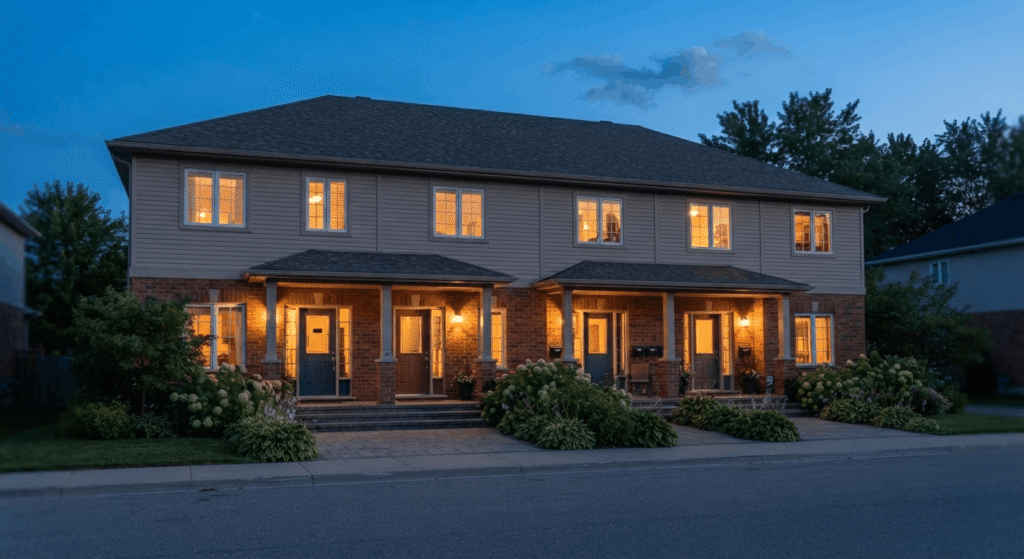
Quick Answer Box: A duplex, triplex or fourplex is one building holding two, three or four self-contained homes. In Canada, duplex triplex fourplex properties are financed as residential real estate, not commercial, because CMHC mortgage insurance covers buildings with one to four units when the owner lives in one of them.
What is a duplex, triplex or fourplex?
Duplex, triplex and fourplex buildings hold two, three and four separate homes under one roof. Each unit has its own kitchen, bathroom, entrance and, usually, its own hydro meter. Canadians often call the whole category a plex or a small multiplex. That legal separation is what divides them from a house with a rented spare bedroom.
What is a duplex?
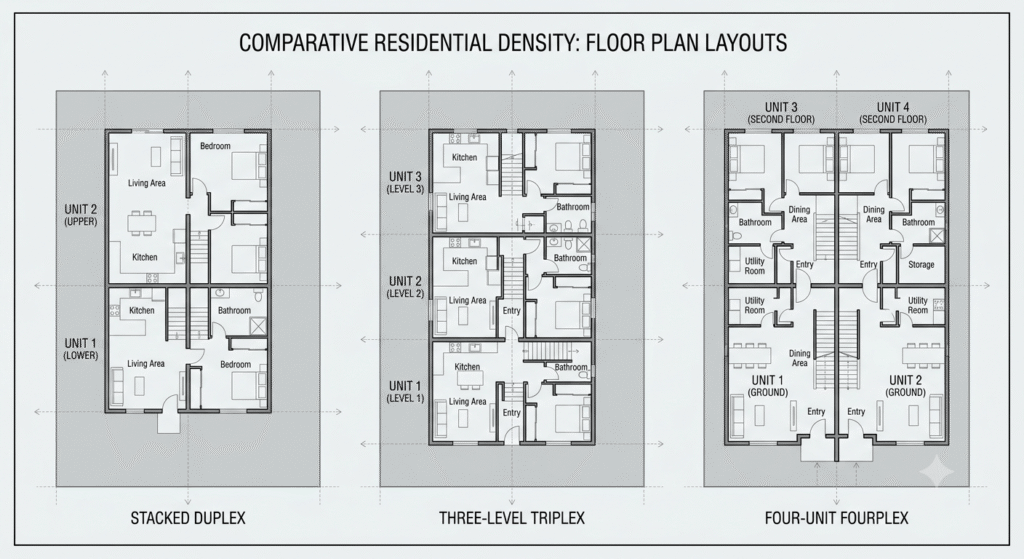
A duplex is two homes in one building. Here’s where Canada gets specific: Statistics Canada’s census defines an apartment or flat in a duplex as one of two dwellings located one above the other. Two units side by side, with open space on all sides, get counted as a semi-detached house instead. Realtors and municipalities are looser with the word, so read the zoning file, not the listing.
What is a triplex?
Three units, one building, one title. Most triplexes in older Ontario and Quebec neighbourhoods stack one unit per floor, with the ground-floor suite the largest. Newer ones split front-to-back. The triplex is where financing changes: CMHC caps homeowner loans at 90% of value for three- and four-unit properties, versus 95% for one or two.
What is a fourplex?
Four self-contained units, and the last stop before commercial lending. CMHC’s homeowner mortgage insurance covers properties with one to four units; at five, you move into multi-unit programs with different underwriting entirely. The fourth unit also matters for tax. Ottawa’s enhanced GST rental rebate requires at least four private apartment units, and the Department of Finance backgrounder rules out duplexes and triplexes by name.
That tax line is worth real money. The enhanced rebate lifts the GST rental rebate from 36% to 100%, which Finance Canada valued at roughly $25,000 on a two-bedroom unit worth $500,000. The conditions are tight: construction started after September 13, 2023, 90% of units held for long-term rental, and no condo registration. An owner-occupied fourplex generally won’t clear that 90% test.
Multiplex vs single family home: which one should you build?
A single family home is simpler, cheaper to build and easier to sell. A multiplex costs more up front and brings tenants, paperwork and a stricter building code, but it produces monthly rent. The multiplex vs single family home decision usually comes down to whether you want lower risk or lower net housing cost.
Zoning used to settle this argument before you could start it. Not anymore. Ontario’s Bill 23 has allowed up to three residential units on most serviced urban lots since November 2022, with no development charges on the second and third unit. British Columbia went further: small-scale multi-unit housing rules require three or four units on lots in municipalities over 5,000 people, and six near frequent transit on lots above 280 square metres.
As-of-right means no rezoning application and no council vote, as long as the design meets the objective standards in the bylaw. BC’s latest bylaw-update deadline was June 30, 2026, so local rules may be newer than whatever you last read.
Build cost per square foot is similar. What climbs is everything that has to be repeated four times: kitchens, bathrooms, furnaces, meters, and the fire separations between units. Whether converting an existing house or starting from a clean slate makes more sense on your lot is worth settling before drawings begin.
Resale is the trade-off people underestimate. A detached house sells to any buyer in the neighbourhood. A triplex sells to investors and to owner-occupants who want the rent, which is a smaller pool and a slower sale in a soft market.
| Building type | Minimum down payment, owner-occupied insured | Enhanced GST rental rebate |
|---|---|---|
| Duplex (2 units) | 5% of the first $500,000, 10% above | Not eligible |
| Triplex (3 units) | 10% of the full value | Not eligible |
| Fourplex (4 units) | 10% of the full value | Can qualify at 4+ private apartment units |
CMHC’s price ceiling applies either way: the purchase price has to sit below $1.5 million, and debt service ratios cap out at 39% gross and 44% total.
Do these buildings actually work as an income property?
Often, yes. A plex spreads vacancy risk across several rental units instead of one, and lenders will count part of the projected rent toward qualifying. The catch is that an income property is a small business: you handle repairs, tenant law, insurance and taxes, and the numbers only work if the rents are real.
Living in one unit changes the math the most. Owner-occupied insured financing needs 5% or 10% down depending on unit count, while a rental property you don’t live in falls under CMHC’s small rental stream at 20%. Every application is still stress tested at the greater of your contract rate plus two points or 5.25%.
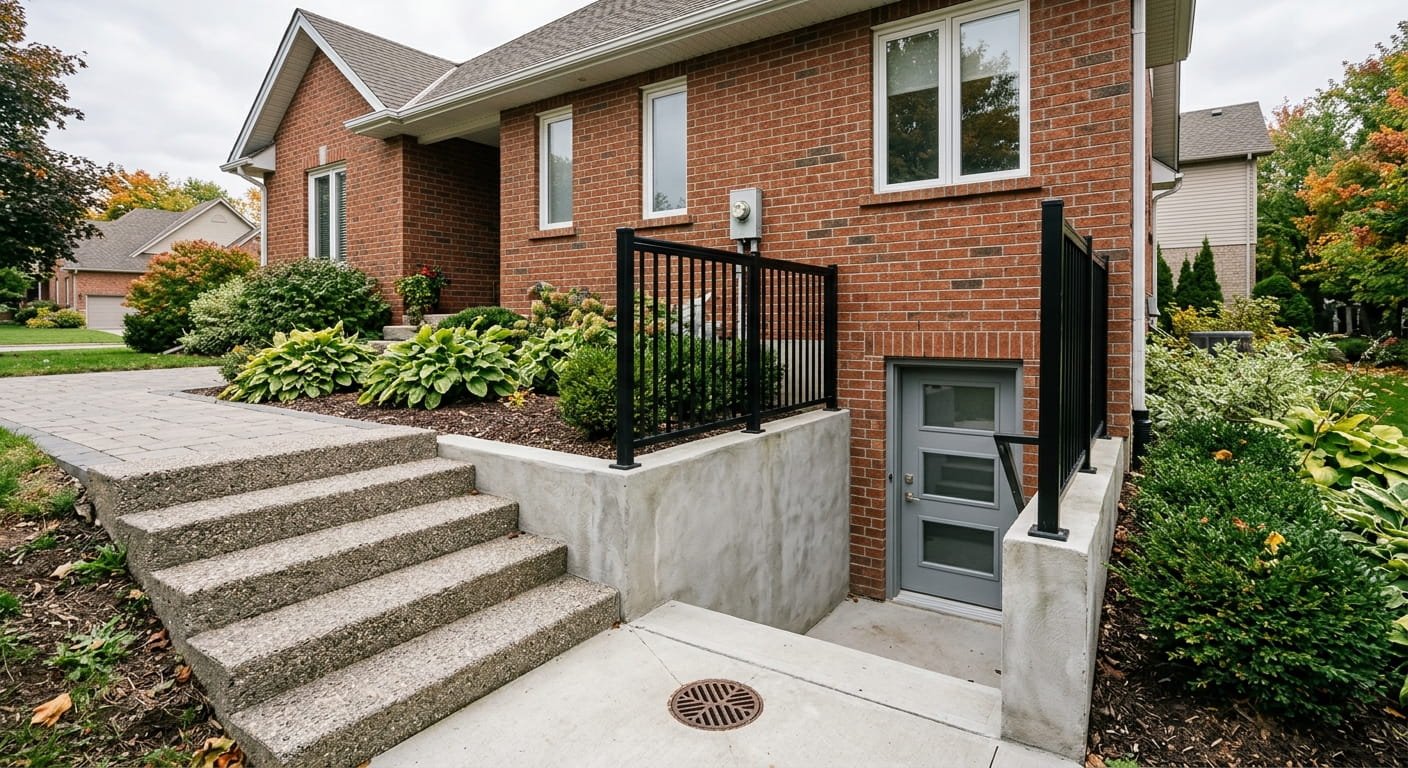
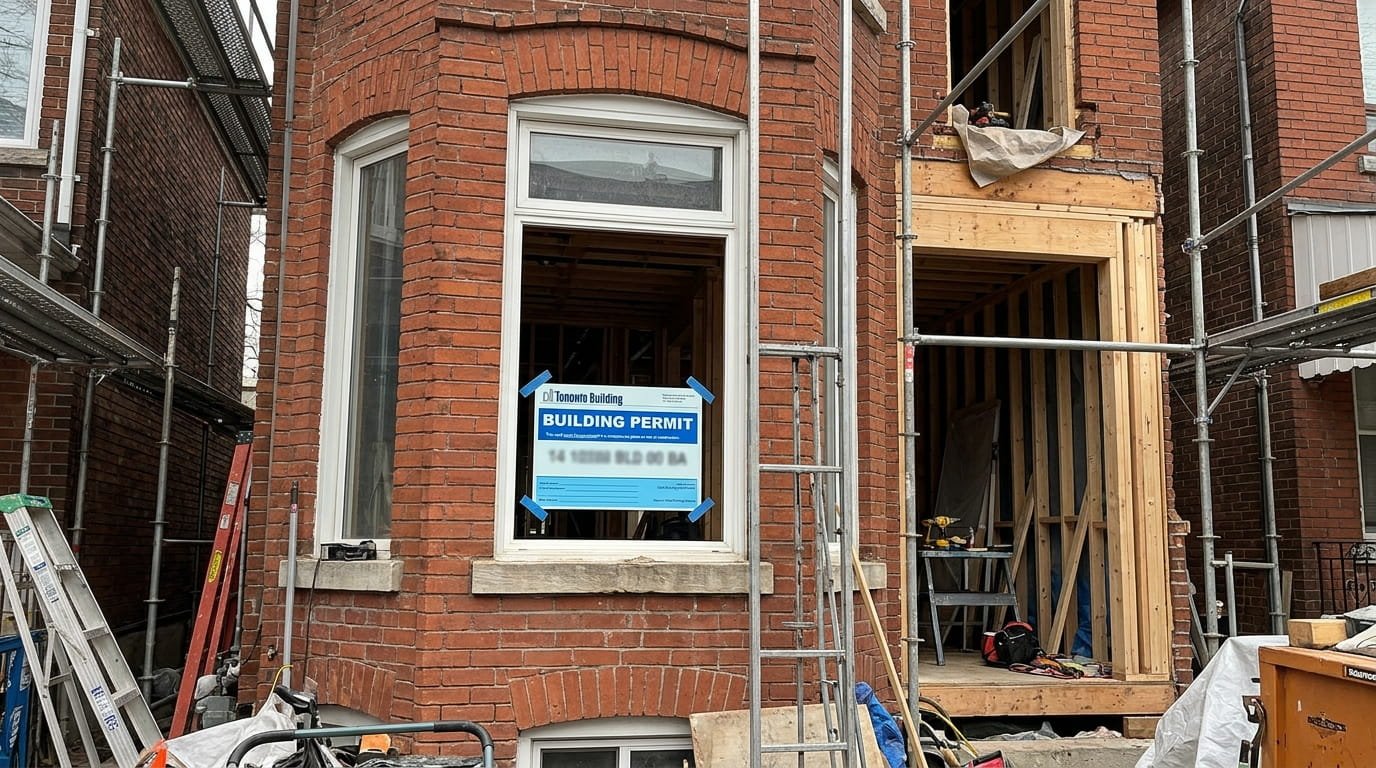
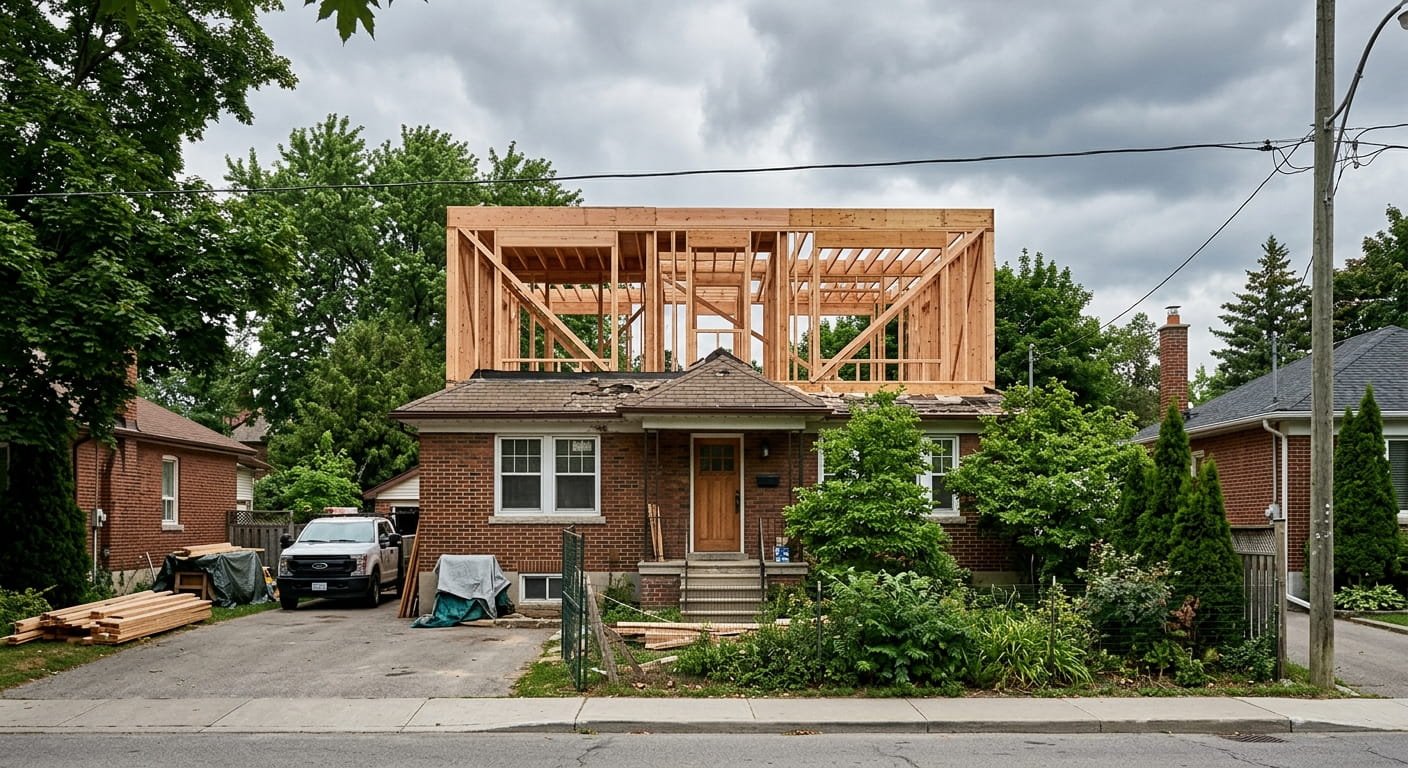
Legality isn’t a formality. A suite the municipality doesn’t recognize won’t count toward mortgage qualification, and your insurer may decline the claim that proves it. Second-storey additions, rear extensions and garden suites each carry their own zoning review before a unit count changes.
Adding units to a house you already own is the cheaper path in most GTA neighbourhoods. CMHC Refinance lets owner-occupants borrow against the as-improved value to build self-contained suites, provided the finished property values under $2 million and no unit gets rented for stays shorter than 90 days. Get that budget and financing picture settled early.
Run the numbers on real rents, not hopeful ones. Vacancy, property management, repairs, higher multi-unit insurance premiums and provincial rent increase caps all sit between gross rent and what lands in your account. One extended vacancy in a duplex wipes out half your income for that month; in a fourplex, a quarter.
Frequently Asked Questions
1. Is a duplex better than a triplex for a first-time buyer?
For most first-time buyers, yes. A duplex needs 5% down on the first $500,000 under CMHC’s homeowner insurance, while a triplex jumps to a flat 10% of the whole value. On a $900,000 property that gap is about $25,000 in extra cash at closing.
2. What is the difference between a fourplex and a small apartment building?
Unit count, and it decides the lending category. Four units or fewer qualify for CMHC homeowner and small rental insurance and standard residential mortgages. At five units the property shifts to multi-unit insurance such as MLI Select, where underwriting leans on the building’s income rather than yours.
3. Can I build a fourplex on a single family lot in Canada?
It depends on the province and the municipality. Current rules:
- British Columbia requires three or four units on most serviced lots in municipalities over 5,000 people
- Ontario guarantees three units province-wide on serviced urban lots, and some municipalities allow four
- Everywhere else, check the municipal zoning bylaw before you buy
4. How much rental income can I use to qualify for the mortgage?
Lenders commonly apply up to 50% of gross rental income toward debt service, or use a net rental approach that subtracts operating costs. CMHC publishes both options. Your gross debt service ratio still has to land at or under 39%, and total debt service at 44%.
5. Does a basement apartment make my house a duplex?
Not automatically. Lenders and municipalities look for a legally recognized, self-contained second unit with its own kitchen, bathroom and entrance, plus code-compliant fire separation and egress. An unpermitted basement suite may still generate rent, but it usually won’t be counted in an appraisal or a mortgage application.
Conclusion
Duplex, triplex and fourplex buildings sit in the same lending category and the same corner of the housing market, but they are not interchangeable. The third unit changes your down payment. The fourth changes your tax position. Before you commit, confirm two things: what your lot permits and what the finished units will actually rent for. Your lender will care about both.