

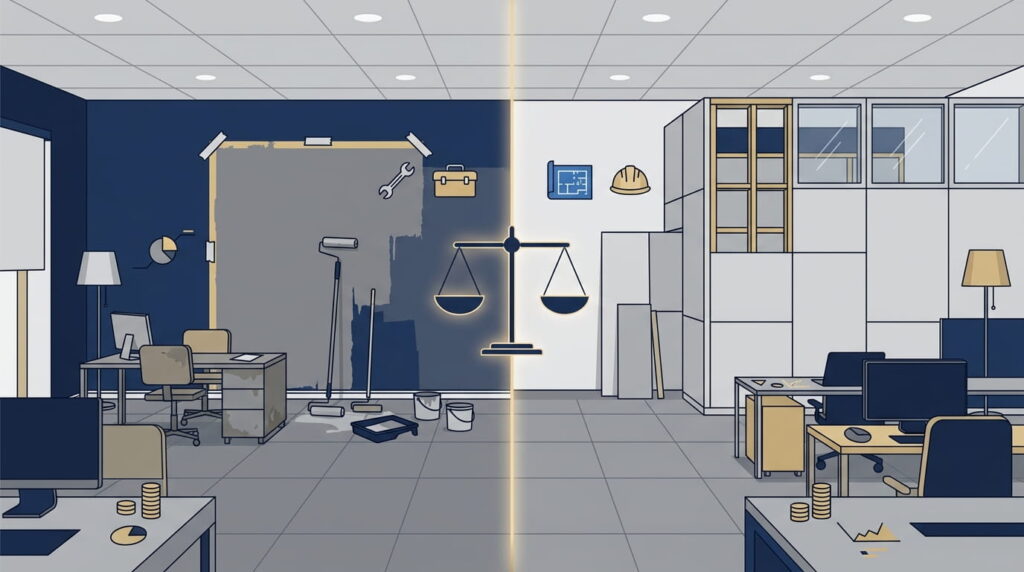
Quick Answer Box: Some office renovation costs are expensable and some are not. The Canada Revenue Agency treats work that restores a space to its original condition as a current expense you deduct in the year you pay it. Work that improves the space beyond that condition is capital, and you recover it slowly through capital cost allowance.
What are office renovation costs under CRA rules?
Office renovation costs are the amounts a business pays to alter, repair, or improve a workspace it owns or leases. The CRA sorts them into two buckets: current expenses, deducted in full the year you pay them, and capital expenditures, added to an asset’s cost and written off over many years.
That split changes your cash position, not just your bookkeeping. Say you spend $60,000 on a fit-out. Deducting it now beats spreading it across two decades of 4% write-offs, which is why the classification question gets argued so often at audit.
Which office renovation costs are repair expenses and which are capital improvements?
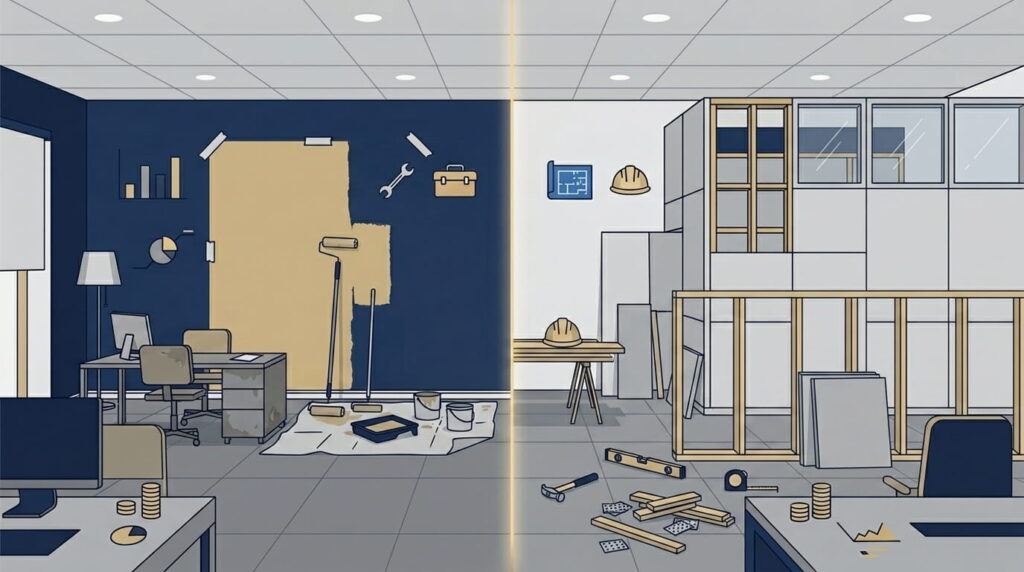
Repair expenses restore something that broke or wore out. Capital improvements make the space better than it was before. The CRA applies four tests in a set order: does the spending give a lasting benefit, does it maintain or improve the property, is it a separate asset or part of the building, and how large is it relative to the property.
The CRA’s current or capital expense criteria give a useful pair of examples. Repairing wooden steps is current. Replacing those steps with concrete is capital. The agency also states plainly that a rise in market value caused by the work is not a major factor either way, which surprises people who assume any value-adding project must be capitalized.
The value test is a tiebreaker, not a dollar threshold
Here’s the part most guides get wrong. CRA instructs you to use the size-of-expense comparison only if the first three tests haven’t settled the question. A single large invoice for maintenance you postponed for years is still a maintenance cost, and it stays in operating expenses. Size alone doesn’t convert a repair into a capital improvement.
| Office work | Usual CRA treatment | Reason |
|---|---|---|
| Repainting existing walls | Current expense | Restores original condition |
| Replacing worn carpet with equivalent carpet | Current expense | Replaces a part of the building |
| Swapping that carpet for hardwood | Capital improvement | Improves beyond original condition |
| Rewiring to the existing standard | Current expense | Wiring is part of the building |
| Adding partition walls to create offices | Capital improvement | Lasting benefit and a betterment |
Two situations flip ordinary repairs into capital regardless of how minor they look. Fixing up a used or vacant office you just bought, to get it into suitable condition for your business, is capital. So are repairs done in anticipation of a sale or as a condition of one. If you’re already weighing a renovation against a full rebuild, the timing of the purchase matters as much as the scope
How do you deduct capital improvements you can’t expense?
Capital improvements become fixed assets and get deducted through capital cost allowance. Which class applies depends on whether you own the building or lease it, and the difference in write-off speed between the two is large.
Fixed assets, CCA classes, and owned office space
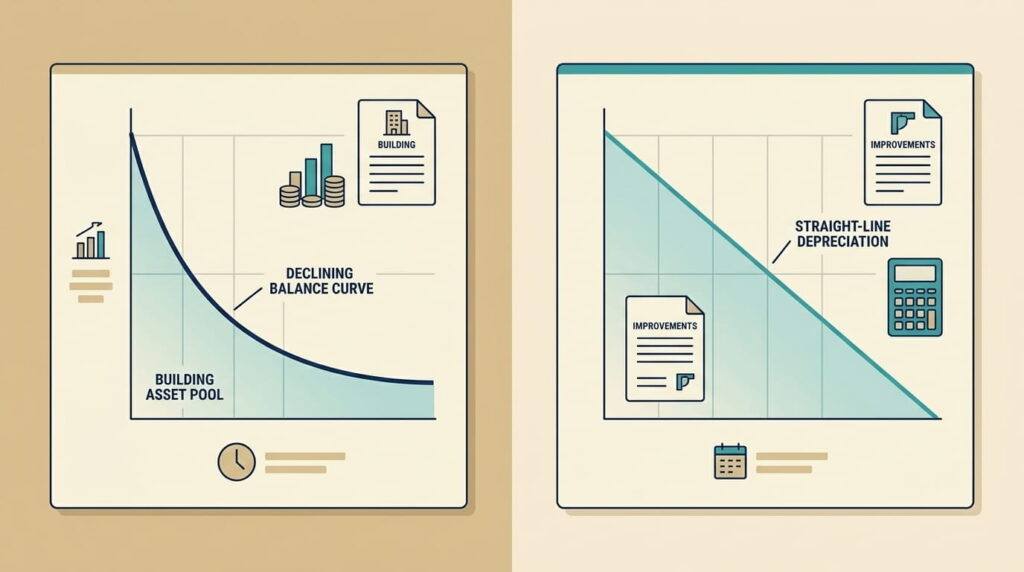
Class 1 covers most buildings acquired after 1987 and runs at 4% on a declining balance. Building components go in with the building, including electrical wiring, plumbing, sprinkler systems, HVAC, and elevators. Under the CRA’s classes of depreciable property, eligible non-residential buildings acquired after March 18, 2007 can pick up an extra 2%, for 6% total, but only if you elect to put the building in a separate class by attaching a letter to your return. Skip the election and you’re back at 4% permanently.
Tenant improvements on leased office space
Tenant improvements you pay for on someone else’s building go to Class 13 and depreciate straight-line over the lease term plus the first renewal period, with a five-year floor and a forty-year ceiling. Only the first renewal counts. A short base lease therefore accelerates the deduction rather than slowing it.
The accelerated investment incentive reaches straight-line classes too, and CRA names leasehold improvements specifically. The half-year-rule equivalent for Class 13 is suspended for eligible property, so a first-year claim can be materially larger than the schedule suggests.
One trap worth flagging on commercial design-build projects: a landlord’s improvement allowance is generally business income to the tenant in the year received. You can file an election under subsection 13(7.4) to reduce the Class 13 capital cost instead, but there’s no prescribed form and the deadline is your return’s due date.
What can you claim for home office expenses under CRA rules?
Home office expenses under CRA rules split by employment status, and neither group gets to expense a renovation. Employees deduct a share of utilities, heat, water, rent, and minor repairs using the detailed method. The temporary flat rate method ended after the 2022 tax year, so a signed Form T2200 is now mandatory.
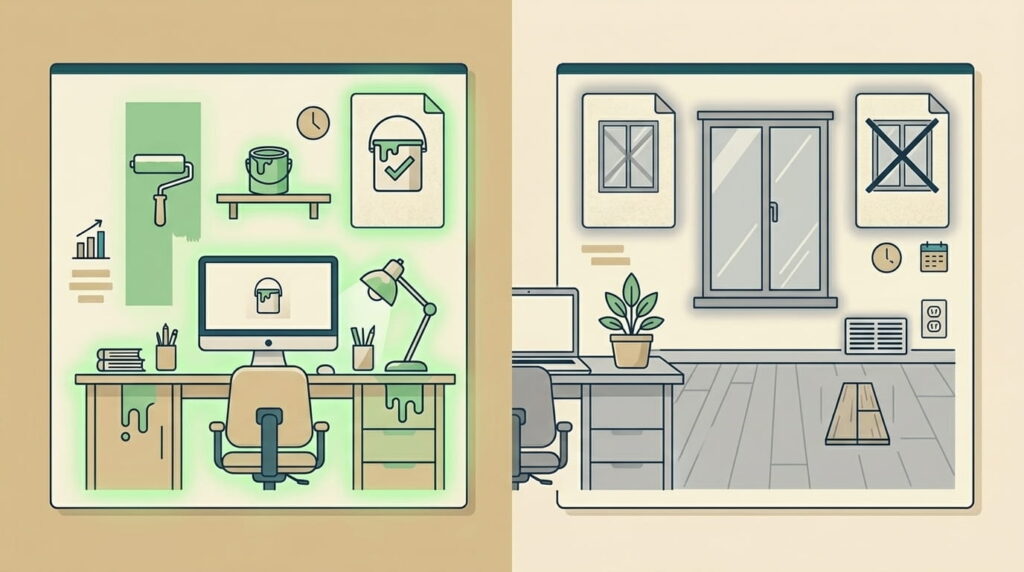
CRA’s list of expenses employees can claim, updated January 2026, draws an unusually sharp line. Repainting the work space or patching walls after installing office equipment is claimable at 100%, not prorated, provided the amount is reasonable. Changing a window, a furnace, or the flooring is claimable at zero. Furniture and wall decorations are out as well.
Self-employed filers get more room. Business-use-of-home expenses on Form T2125 include mortgage interest and property tax, though the claim can’t create or increase a business loss and any excess carries forward. Claiming CCA on the business portion of a principal residence is technically allowed and almost always a poor trade, since it puts part of your principal residence exemption at risk. Worth reviewing alongside your broader project planning and financial guidance before the work starts.
Frequently Asked Questions
1. Can I write off a full office renovation in the year I pay for it?
Rarely. A renovation that only restores the space to its previous condition is a current expense and comes off this year’s income. Anything that improves the space, extends its useful life, or adds a separate asset gets capitalized and deducted through CCA over multiple years.
2. Are office renovation costs deductible if I lease the space instead of owning it?
Yes, but through Class 13 rather than as an immediate write-off. Capital work a tenant funds on leased premises is depreciated straight-line across the remaining lease term plus one renewal period, bounded by a five-year minimum and a forty-year maximum.
3. What office repairs count as operating expenses I can deduct right away?
Work that puts a worn item back to its original state usually qualifies. Common examples include:
- Repainting walls and touching up trim
- Fixing a leak or servicing existing HVAC equipment
- Replacing a broken window pane with the same type
- Patching drywall and repairing damaged flooring
- Rewiring to the existing electrical standard
4. Does a large renovation bill automatically make it a capital expense?
No. CRA applies the size comparison only when the lasting-benefit, betterment, and separate-asset tests leave the answer unclear. A single big invoice covering maintenance you deferred for years remains a current expense, since the work restored rather than improved the property.
5. Can employees claim home office renovation costs on their tax return?
No. Salaried and commission employees cannot deduct capital expenses such as replacing windows, flooring, or a furnace, and cannot claim capital cost allowance. Minor maintenance and repairs to the work space itself do qualify, along with utilities, internet, and a share of rent.
Conclusion
Whether office renovation costs are expensable comes down to one question the CRA asks first: did the work restore the space or make it better? Restoration is deductible now. Betterment gets capitalized, sorted into Class 1 or Class 13, and released over years. Document the scope and the condition before work begins, because that record is what an auditor will want to see.