


Quick Answer Box: Building permits Ontario are required before starting almost any construction or major renovation project over 10 square meters. These permits prove compliance with the Ontario Building Code and municipal zoning bylaws, ensuring safe, legal, and high-quality building work. Complete documentation streamlines approval and avoids project delays or costly penalties.
What is a Building Permit in Ontario?
A building permit in Ontario is a legal document issued by your local municipality authorizing you to construct, renovate, modify, or demolish a structure. Building permits Ontario are required for nearly all construction or renovation projects over 10 square meters and certify that your work meets the Ontario Building Code, applicable municipal zoning bylaws, and land use policies.
Definition of Building Permits Ontario
A building permit in Ontario is an official approval granted by a municipal authority, allowing you to proceed with building, renovating, or demolishing a structure. It demonstrates code compliance and ensures public safety for projects exceeding 10 square meters, as required by the Ontario Building Code Act.
Why Do You Need a Building Permit in Ontario?
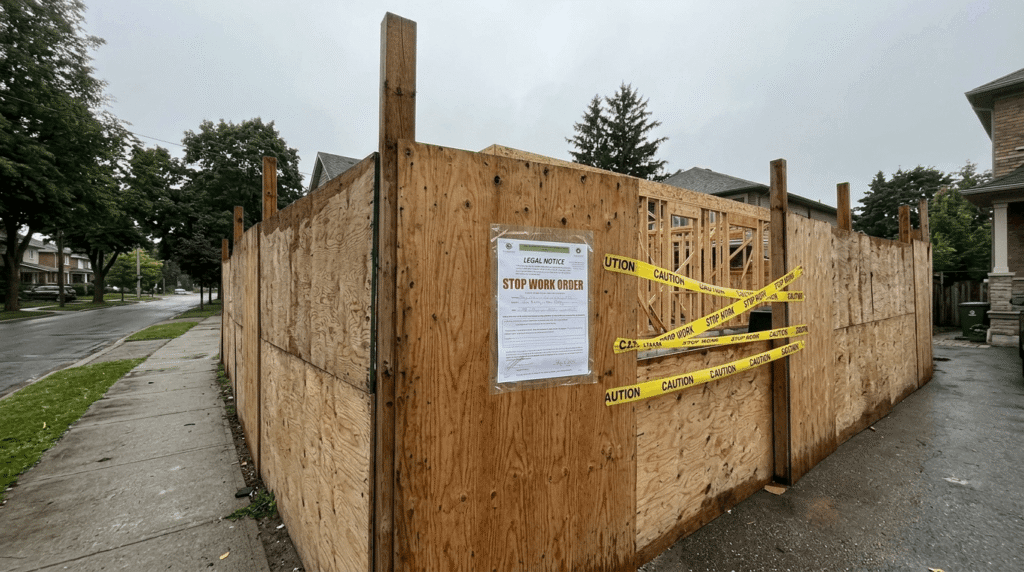
Building permits Ontario are legally mandated by the Ontario Building Code Act for projects such as new builds, additions, and most structural changes. These permits help guarantee safety, protect property value, and ensure all construction meets technical and fire standards. Without a permit, you may face fines, stop-work orders, denied insurance claims, or forced demolition of unapproved work. Building inspectors, activated by a permit, enforce health, safety, and accessibility standards during and after construction. Ontario’s Citizens’ Guide: Building Permits details these essential legal requirements.
Role of Zoning Bylaws in Permit Approval
Zoning bylaws are critical to the building permits Ontario process, determining what types of projects are permitted on a property, including setbacks, building heights, and permitted uses. Failure to comply with zoning regulations is a leading cause for denied permits or costly redesigns. Always review your local zoning bylaws before planning your project or submitting your application.
Understanding Building Permit Requirements
Permit requirements differ by municipality, but several universal standards apply throughout Ontario. Building permits Ontario are required for:
- New buildings, additions, or structural changes
- Decks over 24 inches high or greater than 108 square feet
- Detached garages or large sheds exceeding 108 square feet
- Significant utility changes (plumbing, electrical, HVAC)
- Demolitions and some solar panel installations
Cosmetic repairs like interior painting or small sheds under 108 square feet without utilities do not require permits.
The typical application package includes:
- Completed “Application to Construct or Demolish” (new 2026 template)
- A scaled site plan with property lines, setbacks, and lot coverage
- Permit-ready architectural, structural, and mechanical drawings
- Proof of property ownership or written authorization from the owner
- Full municipal permit fees and plan review fees
- Confirmation of compliance with current zoning bylaws and the building code
- Grading and landscaping plans for additions or new dwellings
- Special certifications—such as BCIN-registered designers or engineer stamps if required
Municipalities may request further documents such as heritage assessments or site-specific declarations based on local zoning overlays.
Navigating Additional Permit Requirements
Certain permit requirements apply if your property is within a designated heritage area or subject to unique local controls. In these cases, securing a specialized heritage permit and supplemental design reports is mandatory. Consulting the Ontario Building Officials Association or your local building department before applying can help you identify and prepare for any extra requirements.
Permit Test Requirements: Myths and Realities
Permit test requirements often generate confusion among Ontario homeowners and builders. For most applicants, there is no written or practical test involved in building permit approvals. Instead, municipal staff assess the accuracy and code compliance of submitted documents.
However, for major or complicated projects, specialized professionals who design and take responsibility for plans—such as BCIN-registered designers and architects—must meet permit test requirements by passing Ontario building code exams and holding a valid Building Code Identification Number (BCIN). These provincially administered exams certify technical knowledge, a requirement before such professionals can submit applications. For standard residential work, careful attention to plan details, code citations, and complete documentation replaces any formal “test.”
Applications are carefully reviewed, and any errors, omissions, or compliance issues will trigger deficiency notices or denials, which require corrections before proceeding.
Ontario Building Code and Zoning Bylaws
The Ontario Building Code prescribes minimum requirements for structural safety, energy efficiency, fire protection, and accessibility across the province. Demonstrating full compliance is a non-negotiable part of the building permits Ontario process. Alongside the code, municipal zoning bylaws regulate use, setbacks, height, and density on each property.
Significant updates to the Ontario Building Code and municipal zoning bylaws in 2025 and 2026 have provided more flexibility for garden and laneway suites, introduced stricter energy-efficiency standards, and clarified requirements for secondary dwellings. Toronto’s updated 2025 zoning bylaw, for example, enables more minor secondary units and lane homes, while other cities tailor their rules. You can review zoning details through your city’s website or tools provided by platforms like Symbium.
Noncompliance with the building code or zoning bylaws is the main reason permits are delayed or refused. Engage with municipal staff or qualified designers early in the planning stages to confirm your design meets all relevant requirements.
Heritage Designation and Approval
If your project affects a heritage-designated property, you must obtain both standard building permits Ontario and a specialized heritage permit. This process usually involves a municipal heritage planner, committee review, and often additional conditions to ensure heritage features are preserved.
How to Get a Building Permit in Ontario: Step-by-Step Process
The construction approval process in Ontario involves several well-defined steps. Following this process helps ensure that your application is accepted and your project stays on schedule.
1. Preliminary Design and Zoning Review
Start by researching your city’s zoning bylaws for specific restrictions on setbacks, permitted heights, and building uses. For infill, custom homes, or land development, consult municipal planning offices. Evaluate whether minor variances are required for your proposed project, and confirm that your planned construction fits within all regulations.
2. Preparing Submission Documents
Develop detailed, permit-ready construction drawings, including dimensions, elevations, cross-sections, and building systems. Secure a professional’s stamp such as a BCIN-certified designer or engineer’s approval for complex structural changes or custom home design permit applications. Assemble a site plan highlighting the placement of structures relative to property boundaries. Collect proof of ownership or authorization, and complete the 2026 “Application to Construct or Demolish” form.

3. Submitting Your Application
File your application package, including all drawings, site plans, forms, and fees, with your municipal building department. Many cities, including Toronto, now use online submission platforms for their toronto building permit process, allowing for electronic file uploads, fee payments, and status tracking. Smaller towns may still require in-person paperwork. Always verify your municipality’s policy before submission.
4. Application Review and Checking Permit Status
Once submitted, the building department reviews your materials for completeness and compliance with the Ontario Building Code and local zoning bylaws. Most standard residential permits are legally required to be issued within 10 business days, while commercial or complex permits can take up to 30 days. If your submission is incomplete or noncompliant, expect a deficiency notice that pauses the timeline until corrections are made. Monitor your permit status online (where available) or by contacting your building department directly for regular updates.
5. Inspections, Approvals, and Temporary Occupation Permit
With your permit approved, construction can begin according to the stamped plans. Mandatory municipal inspections are required at key stages, such as foundations, framing, insulation, and before occupancy. Notify the city as each stage reaches completion to book an inspection, and keep in mind that municipalities generally must perform these within two business days.
After a successful final inspection, a certificate of occupancy or compliance is issued. If your project requires early partial use, request a temporary occupation permit, which gives limited or phased occupancy under specific safety conditions while construction is finalized.
Ontario Building Permit Fees and Cost Breakdown
Permit fees are determined by each municipality, typically calculated based on floor area (per square foot or square meter) or total construction value. In 2026, the base fee in Toronto starts at $198 for small projects, with residential permit fees set at $18.16 per square meter, or approximately $1.69 per square foot. Plan review fees (often 80% of the base permit cost) may apply separately for larger or complicated projects. Other cities such as Mississauga and Ottawa set minimum fees from $150 to $185 and may structure cost schedules differently.
Remember to account for additional charges:
- Site plan review fees
- Parkland or development levies
- Revision or resubmission charges
- Special fees for heritage, laneway, or garden suite projects
The best practice is to check your city’s current fee schedule before starting your project and to review sample cost breakdowns from reliable sources. Don’t forget to factor permit fees into your initial project budget.

Cost Factors When Calculating Permit Fees
Multiple variables affect your final permit fees, including project scope, design complexity, location, and required inspections. Larger projects such as custom home design permit applications or commercial builds face higher charges due to extended review times and additional documentation requirements. Consult the Toronto Permit Fee Schedule or equivalent for your municipality to ensure budget accuracy.
Construction Approval Process: Timeline & Tips
The legally mandated timeline for issuing complete residential building permits in Ontario is 10 business days from receipt of a complete, code-compliant package. For commercial or more complicated building types, this extends to 30 days. Nevertheless, in practice, deficiencies, missing documentation, or zoning complications commonly cause delays.
To maximize your chances of a quick approval:
- Work with a BCIN-certified designer or experienced architect, especially for custom home design permit projects or complex renovations
- Carefully check that all plans are to scale, dimensioned, and code-compliant
- Verify that your design complies with both current zoning bylaws and the Ontario Building Code
- Respond promptly to city requests for new information or corrected drawings
- Track your permit status regularly to avoid missing key communications
Digital application portals available in larger cities have improved transparency in the construction approval process. However, successful approval still depends on your documentation being accurate, thorough, and up to code.
Common Causes of Approval Delays
Deficient or missing application documents, inconsistent or unsealed drawings, incomplete or unpaid permit fees, and unresolved zoning conflicts are the main culprits behind delays in the construction approval process. Ensuring your submission is checked by a professional and cross-referencing with current permit requirements mitigates risk.
Custom Home Design Permit and Specialized Permits
Applying for a custom home design permit in Ontario brings extra complexity. Custom homes require architecturally stamped, fully code-compliant plans reviewed for unique lot conditions. Properties with heritage status or special overlays will also need heritage permits and municipal committee review.
Toronto’s recent bylaw changes, for example, enable more laneway and garden suites, but also introduce additional documentation and design requirements. Some municipalities require a separate permit and report for each accessory dwelling or suite. If pursuing a commercial or multi-unit building, you must work with professionals who understand both the Ontario Building Code and intricate local permit requirements.
For green builds, Net Zero Energy Homes are increasingly popular, involving further checks and certifications to meet advanced efficiency standards.
Expertise Matters in Specialized Applications
Whether your project involves land development, commercial structures, or advanced sustainable construction practices, working with recognized professionals—such as BCIN-certified designers, architects, or engineers familiar with local zoning bylaws—dramatically improves your chance of securing a permit quickly.
Toronto Building Permit vs. Other Ontario Municipalities
| Requirement/Stage | Toronto | Mississauga/Ottawa/Others |
|---|---|---|
| Online application | Yes (Digital/Symbium platform) | Yes (varies by city, some paper) |
| Residential permit fee (2026) | $17–$18/sq.m. ($1.69/sq.ft.), min $198 | $14–$16/sq.m., min $150 |
| Plan review fee | Included (most small projects) | Charged separately in many cases |
| Approval timeline (law) | 10 days for standard res. | 10 days (if complete) |
| Real-world approval time | 2–4 weeks typical (multi-stage review) | 2–6 weeks, varies with backlog |
| Public tracking of permit status | Yes (city web portal) | Email/phone, some cities have portals |
| Zoning bylaws | Updated 2025 (laneway suites, etc.) | Zone changes city by city |
| Temporary occupancy permits | Common for major projects/phased use | Typically by request/large projects |
| Heritage review requirements | Yes, for listed/designated properties | As required by local bylaw |
Common Mistakes When Applying for Building Permits in Ontario
Despite clear guidelines, many applicants encounter avoidable setbacks in the building permits Ontario process. Frequent mistakes include:
- Incomplete or outdated application forms and insufficient construction drawings
- Failing to check current zoning bylaws or presuming prior approvals remain valid
- Missing permits for garages, decks, laneway or garden suites, and outbuildings over 108 square feet
- Incorrect permit fee calculations or incomplete payments
- Ignoring latest Ontario Building Code updates or municipal policy
- Starting construction before permit issuance, risking serious legal and financial consequences
- Submitting unscaled or unstamped plans when a BCIN or engineer’s stamp is required
Avoid these errors by consulting with professionals, referencing guides like BuildersOntario.com’s application checklist, and thoroughly reviewing all submission materials before filing with your local building department.
Using Internal and External Resources
In addition to municipal staff support, Ontario builders and homeowners should utilize resources such as:
- Planning & Financial Guidance for budgeting and feasibility
- Sustainable Construction Practices for eco-friendly projects
- Community Data Program building permit stats for market research and trends
Frequently Asked Questions
1. Do I need a permit for all types of renovations?
Not all renovations need building permits Ontario. Structural work, plumbing, new partitions, large decks above 24 inches or 108 square feet, new garages, and finished basements generally do. Simple cosmetic updates like painting, tile replacement, or cabinet swaps rarely require a permit but always check with your local building department in case scope changes trigger compliance requirements.
2. How long does it typically take to get a building permit approved?
Legally, standard residential building permits Ontario must be decided within 10 business days of a complete, compliant application. Larger or more complex projects have a limit of 30 business days. Delays can occur due to incomplete submissions or peak application periods, making two to four weeks a typical actual turnaround for simpler projects.
3. What happens if I build without a permit in Ontario?
Constructing or altering a building without the proper permit is unlawful. Offenders may face fines, stop-work orders, removal of unapproved work, or retroactive inspections requiring costly changes. Mortgage lenders and insurers may refuse coverage for properties with unpermitted work, and unresolved permits can complicate resale.
4. Can I appeal if my permit application is denied?
Yes. If your building permit is denied, technical refusals can be appealed to the Building Code Board of Appeal. Zoning disputes may require hearings at the municipal committee of adjustment or even at Ontario’s Superior Court. Consult your city’s process and consider professional help for complex appeals.
5. Are there special permits required for temporary or partial occupancy?
Temporary occupation permits are available when you need to occupy all or a section of a property before full completion and final inspection. This is common for phased or urgent move-ins. The building department will set safety and compliance conditions. To apply, provide a written request and supply documentation as required for that phase. Approval of a temporary occupation permit depends on passing interim safety inspections.
Conclusion
Building permits Ontario are the cornerstone of safe, legal, and sustainable construction across the province. By understanding evolving permit requirements, leveraging digital construction approval process platforms, and collaborating with experienced professionals, you can achieve compliant results and avoid costly errors. Meticulous planning, careful zoning bylaw research, diligent permit status tracking, and upfront payment of permit fees all support an efficient approval. For project-specific assistance on custom home design permit applications or industry-best building code advice, consult the experts and resources highlighted here to ensure your experience with building permits Ontario is smooth from start to finish.