

Quick Answer: The best sunroom heaters for Ontario homes are cold climate ductless heat pumps, which Natural Resources Canada rates as up to twice as efficient as electric baseboards. Baseboards still make sense in small three-season rooms, radiant floors suit tiled four-season builds, and portable plug-in units should stay a short-term fix.
What to Look For in the Best Sunroom Heaters
A sunroom sheds heat faster than any other room in the house, so the best sunroom heaters get chosen by glass area and air leakage, not floor space. Natural Resources Canada reports that windows, doors and skylights account for up to 35 percent of total house heat loss. A sunroom is mostly window.
Start with three numbers before you shop: the room’s square footage, the total glazed area, and the spare amperage on the circuit you plan to use. A 12 by 12 room wrapped in glass can need close to double the output of a bedroom the same size. Certification matters just as much. Buy only units carrying a CSA or cUL mark, with a tip-over cutoff and overheat protection built in.
Across Mississauga, the GTA and the wider Greater Golden Horseshoe, one mistake shows up again and again. A homeowner buys a 1,500 W plug-in heater for a room that needed a permanent system.
Heating efficiency, sizing and output
Heating efficiency separates the best sunroom heaters more sharply than price does. Every electric resistance heater turns nearly all its electricity into heat, so a basic baseboard and an expensive designer panel deliver the same warmth per kilowatt-hour. A ductless mini-split breaks that ceiling by moving heat rather than generating it.
| Heater type | Best fit | Efficiency notes | Install scope |
|---|---|---|---|
| Ductless mini-split | Four-season rooms used daily | Highest, and it cools in summer | Licensed HVAC plus dedicated circuit |
| Electric baseboard | Small or lightly used rooms | Resistance heat, cheap to install | Electrician plus dedicated circuit |
| Radiant floor | Tile or vinyl plank floors | Even, silent, slow to respond | Built in during construction |
| Infrared panel | Spot warmth for a seating area | Warms people, not air volume | Wall or ceiling mount, hardwired |
| Portable plug-in | Occasional shoulder-season use | Same output, highest fire risk | None, but watch circuit load |
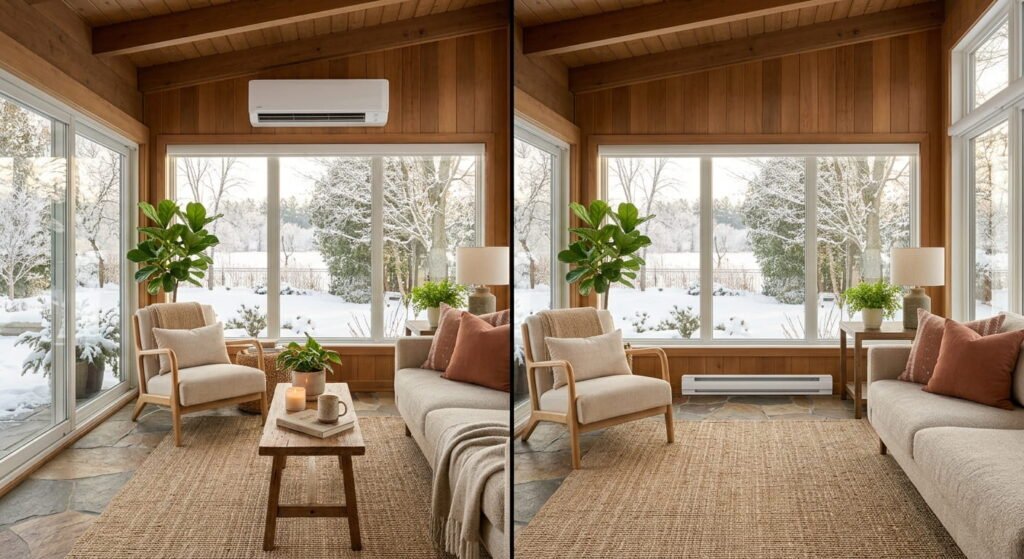
Which Sunroom Heating System Works Best in Ontario Winters?
Among the best sunroom heaters for daily year-round use, a cold climate ductless heat pump beats every alternative on this list. Natural Resources Canada confirms these systems run at outdoor temperatures as cold as -30°C, with the strongest models reaching seasonal ratings approaching HSPF 13. Below -30°C, supplemental heat may be needed.
Where a ductless heat pump earns its price
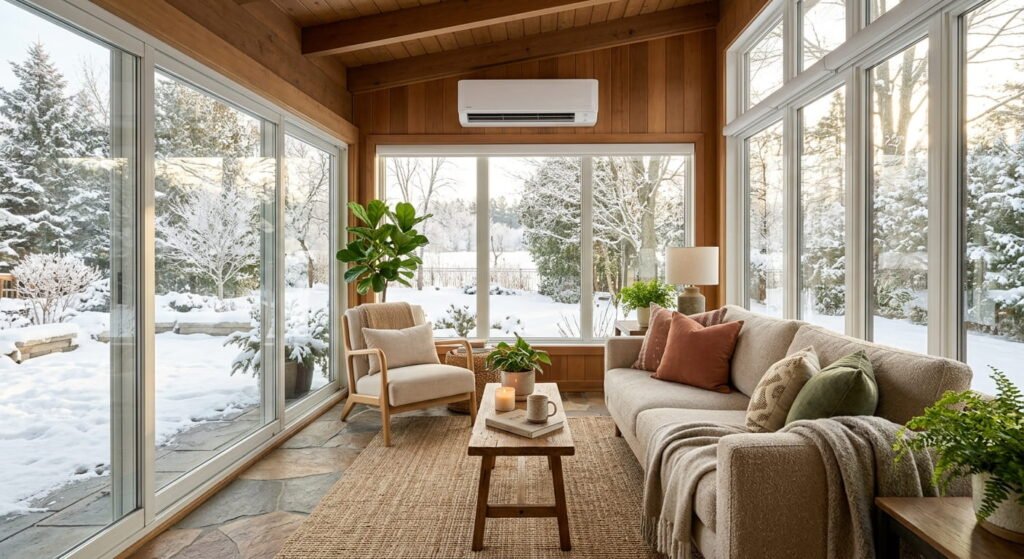
One wall-mounted head handles both February heating and July cooling, which matters in a glass room that bakes by mid-afternoon. NRCan rates air-source models as heating space up to two times more efficiently than electric furnaces or baseboards, and cold climate units reach up to three times the efficiency of an oil furnace. That gap is the whole argument.
HVAC installation and electrical capacity
Two jobs get quoted here, not one. The HVAC installation covers the indoor head, the outdoor condenser, the line set and commissioning, while an electrician runs a dedicated circuit back to your panel. Older GTA homes on 100-amp service sometimes need a panel upgrade first. Our Ontario sunroom and addition cost breakdown puts mechanical tie-in work at $3,000 to $8,000.
One more thing people miss. Adding permanent heat to a three-season room can reclassify it as conditioned living space, which pulls insulation and energy requirements into play. Your municipality reviews and issues building permits for that work, and a complete application for a house carries a 10-day review window. Our sunroom permit and budget guide covers the sequence.
How Much Does It Cost to Heat a Sunroom in Ontario?
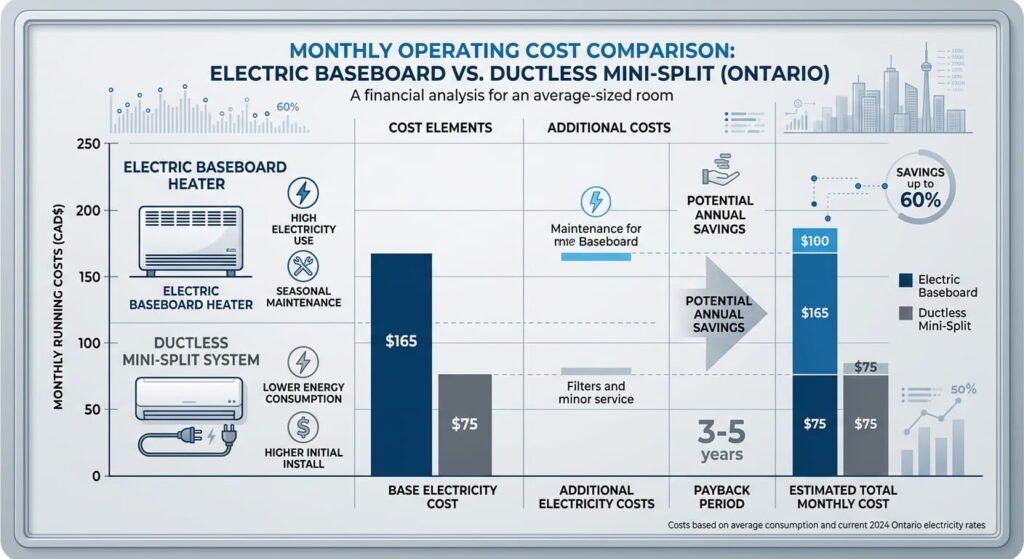
Run the arithmetic before you choose between the best sunroom heaters. A 1,500 W unit running eight hours a day burns 12 kWh. At the Ontario Energy Board’s Tier 1 winter price of 12.0 cents per kWh, that works out to about $1.44 daily, or roughly $43 a month for one room.
What energy costs look like month to month
Energy costs swing hard depending on your rate plan. On Ultra-Low Overnight pricing, weekday power between 4 p.m. and 9 p.m. costs 39.1 cents per kWh. Heat that room with resistance heat through a single winter evening and you have spent close to $3 before dinner is done. A mini-split doing identical work draws roughly a third of the electricity, which is where the monthly difference stops being a rounding error. Pricing also shifts by municipality, and our Milton sunroom price guide shows how the same footprint quotes differently town to town.
Thermal insulation comes before hardware
Thermal insulation decides whether even the best sunroom heaters succeed. Low-E argon glazing, an insulated roof assembly, sealed sill plates and a frost-protected floor are what let a modestly sized unit hold 20°C in February. Skip that work and you will oversize the equipment, then pay for the oversizing every single month. Insulation and heat pumps both qualify for rebates under Ontario’s Home Renovation Savings Program.
Thermostat scheduling on time-of-use rates
A programmable thermostat is the cheapest upgrade on this list. Set the room to 16°C overnight and 21°C for the hours you actually use it, then push the heavy lifting into off-peak windows priced at 9.8 cents per kWh instead of 20.3. Winter Tier 1 allows 1,000 kWh per month before the higher rate kicks in.
Frequently Asked Questions
1. Can you heat a sunroom through the winter in Ontario?
Yes, provided the room was built as a four-season space with insulated walls, an insulated roof and double or triple glazing. A three-season sunroom with single-pane glass will never hold temperature through a January cold snap, no matter how much capacity you throw at it.
2. Can I extend my home’s furnace ductwork into a sunroom?
Usually a bad idea. Your existing furnace and duct layout were sized for the original house, so tapping into them starves other rooms and unbalances the system. A dedicated heat source for the sunroom performs better and keeps the rest of the house comfortable all winter.
3. What size heater does a sunroom need?
Sizing depends on far more than square footage. Account for these factors:
- Total glazed area and the number of panes
- Insulation levels in the roof, walls and floor
- How many exterior walls the room has
- Ceiling height, and whether the roof is glass
- The lowest indoor temperature you will accept
4. Are portable heaters safe to use in a sunroom?
Only with care. Health Canada cites Ontario Fire Marshal data showing an average of 510 structural fires a year from heating equipment in Ontario between 2017 and 2021. Keep a metre of clearance, plug directly into a wall outlet, never use an extension cord, and switch the unit off when you leave.
5. Do sunroom heaters qualify for Ontario rebates?
Heat pumps, insulation and smart thermostats are all eligible categories under the Home Renovation Savings Program, delivered by Save on Energy and Enbridge Gas with Ontario government support. Portable plug-in heaters are not. Confirm current amounts and participating-contractor rules on the official program site before you sign anything.
Conclusion
Choosing among the best sunroom heaters comes down to how often you will use the room and how well it was built. Daily year-round comfort in Ontario points to a cold climate ductless heat pump. Occasional autumn evenings point to a baseboard and careful scheduling. Either way, the envelope decides the outcome.