

Quick Answer Box: Yes, you can rezone your property in Ontario by filing a Zoning By-law Amendment (ZBA) with your local municipality. Can you rezone your property in Ontario successfully? That depends on whether your proposal aligns with the municipal Official Plan. Straightforward applications resolve in 3 to 6 months; complex urban files average roughly 25 months province-wide.
Developing a property? Leedway Group handles multiplexes, severances, rezoning and small developments across the GTA. See our multiplex and land development service.
What Is Rezoning a Property in Ontario?
Rezoning, formally called a Zoning By-law Amendment or ZBA, is the legal process for changing the permitted uses or development standards on a property under Ontario’s Planning Act. Every property in Ontario operates under a municipal zoning bylaw that specifies permitted uses, building heights, setbacks, lot coverage, and density. When a proposed project exceeds those rules in a significant way, a ZBA is the mechanism to change them.
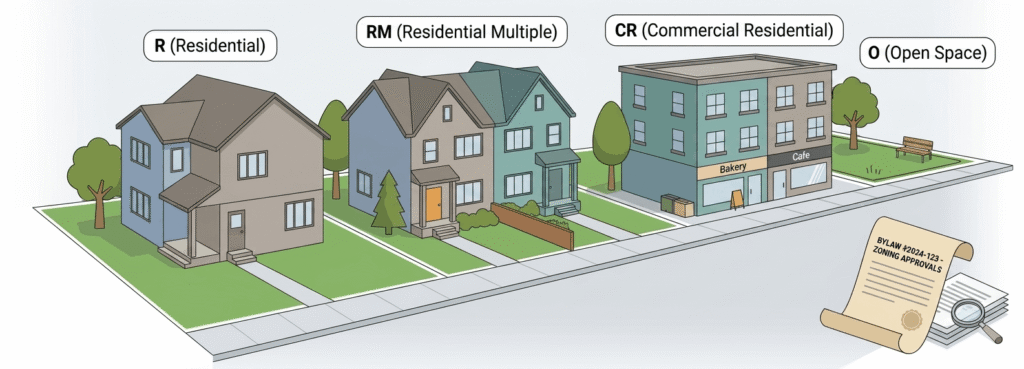
Zoning regulations in Ontario operate at the municipal level, each tied to the municipality’s Official Plan. The zoning codes list Ontario municipalities use follows broad provincial categories: Residential (R), Commercial (C), Industrial (I or M), Institutional (IN), Mixed-Use (MU), Agricultural (A), and Open Space (OS). Within those, cities add dozens of sub-designations. Toronto alone carries dozens of residential and mixed-use variants. Before doing anything else, confirm your property’s current designation using your municipality’s online zoning map. That zoning information tells you exactly what’s permitted today and what kind of application, if any, you’ll need.
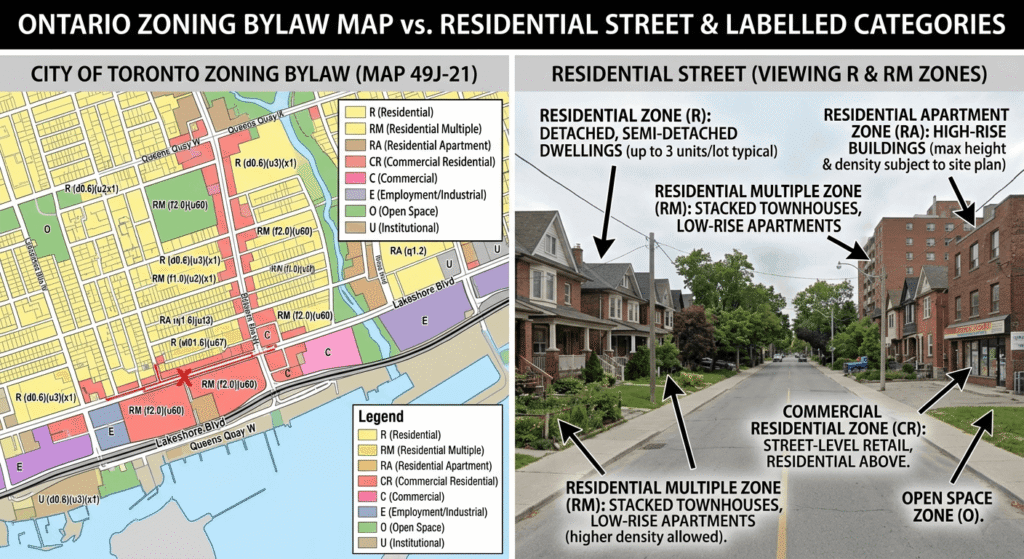
Zoning decides what you can build — our guide explains Ontario zoning laws and what they mean for your project.
How Do You Apply to Rezone Your Property in Ontario?
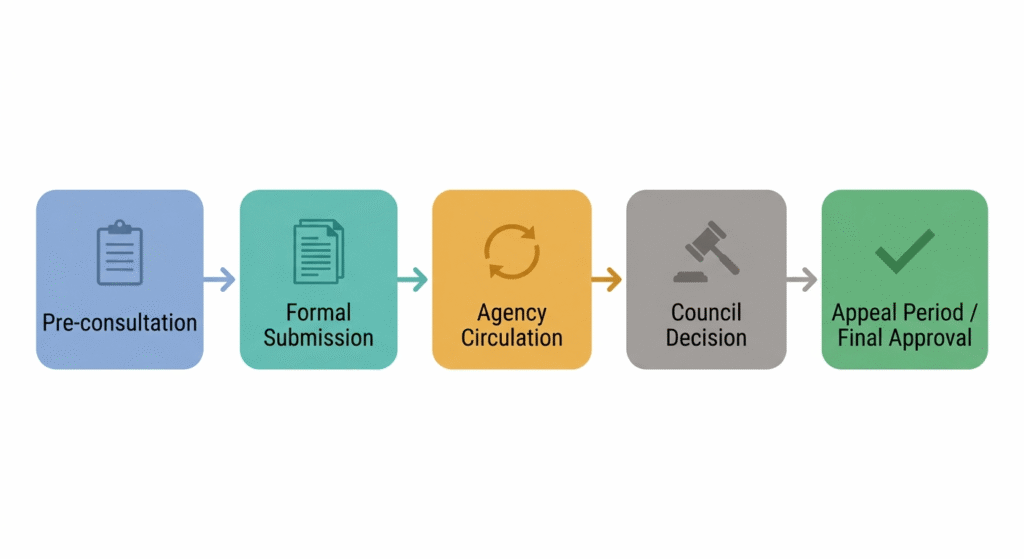
Filing a rezoning application Ontario municipalities will accept starts with pre-application consultation, a step that most large cities, including Toronto, Ottawa, and Hamilton, require before you can submit anything formally. Planners review your concept against the Official Plan, flag which technical studies you’ll need, and confirm whether a full ZBA is the right tool for what you’re trying to do.
Once pre-consultation is complete, you assemble a formal submission. Most municipalities require:
- A completed application form
- Site plan drawings and a current property survey
- A planning justification report demonstrating the rezoning aligns with policy
- Technical studies, which may include traffic impact, environmental, or heritage assessments depending on the site
- The applicable municipal application fee
Planning staff then circulate the application to internal departments and external agencies such as school boards and conservation authorities. Under the Ontario Planning Act, council has 90 days to make a decision on a ZBA (120 days when a related Official Plan Amendment is filed at the same time). If council refuses or doesn’t act within that window, you can file an appeal with the Ontario Land Tribunal (OLT), the independent provincial body that handles planning disputes.
After council approves a rezoning, a 20-day appeal period begins. Qualified parties who took part in the public process can challenge the decision with the OLT during that window. If none land, the new zoning is final. Applications that align cleanly with planning policy and face minimal opposition typically wrap up in 3 to 6 months. Complex or contested proposals in major cities average around 25 months from first submission to final approval.
How Much Does Rezoning Property in Ontario Cost?
The cost of rezoning property Ontario homeowners actually face is almost always higher than the application fee alone suggests. For residential ZBA cases, total costs typically land between $10,000 and $50,000 when you factor in professional fees, technical studies, and the municipal application charge. Projects that reach the OLT can push well past that.
Municipal application fees for residential applications generally run $500 to $5,000 or more depending on the municipality and project scope. Toronto raised planning fees by 4.82% effective January 2026, and the City publishes a current breakdown in its 2026 planning fee schedule. These fees are non-refundable and payable at submission.
Professional costs are often the larger line item. A planning consultant preparing a justification report and managing the file typically charges $5,000 to $20,000 or more. Technical studies add another $2,000 to $15,000 each. If community opposition results in an OLT hearing, legal representation can reach $30,000 or beyond on complex files.
Rezoning vs. Minor Variance: Which Route Is Right for You?
Not every project requires a full ZBA. Ontario’s Planning Act distinguishes between a rezoning, which changes the actual permitted uses or density on a property, and a minor variance, which covers small deviations from existing zoning regulations. Think a setback one metre shorter than permitted, or a building height slightly over the bylaw limit. Minor variances go through the Committee of Adjustment and resolve far faster.
| Factor | Minor Variance | Full Rezoning (ZBA) |
|---|---|---|
| Scope | Small deviation from existing bylaw | New use, density, or major bylaw revision |
| Decision body | Committee of Adjustment | Municipal Council |
| Typical timeline | 6 to 12 weeks | 3 months to 25+ months |
| Municipal fee range | $1,000 to $3,000 | $500 to $5,000+ |
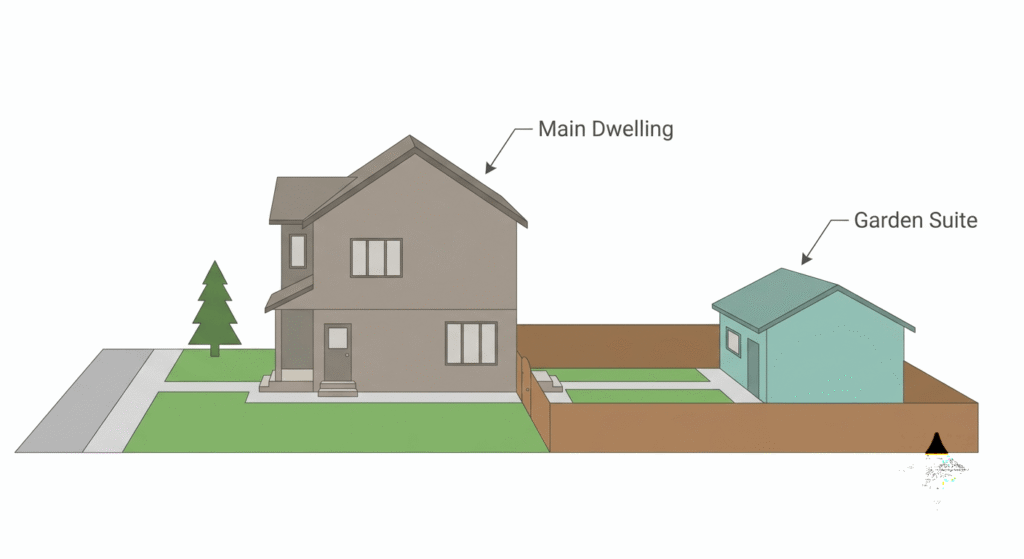
Ontario’s Additional Residential Unit (ARU) framework offers a third path worth checking first. It gives most urban Ontario homeowners as-of-right permission to add up to three residential units, such as a basement suite or garden suite, without filing a rezoning application at all. Check whether the ARU rules already cover your lot before spending money on a planner. Our planning and financial guidance resource explains how the framework applies across different lot types, and our land development services page covers where a full ZBA or development application may be warranted.
Frequently Asked Questions
What happens if the municipality refuses my rezoning application in Ontario?
If council refuses a ZBA, or fails to decide within 90 days of a complete submission, you can appeal to the Ontario Land Tribunal (OLT). The OLT is an independent adjudicative body that can approve or reject the rezoning, or approve it with conditions. Its decisions are legally binding on all parties. Contested OLT hearings for complex rezoning files can take months to schedule and conclude.
3. Do I need a rezoning to add a garden suite in Ontario?
Usually not. The ARU framework permits most urban Ontario homeowners to add a garden suite as one of up to three permitted residential units without filing a ZBA. A minor variance may still be needed for specific height or setback deviations. Before assuming a full rezoning is required, review our garden suite guide for a breakdown of what approval typically involves.
3. How do I find my property’s current zoning in Ontario?
Most Ontario municipalities offer free, public-facing zoning lookup tools online. To find your zone:
- Go to your city or town’s official planning or GIS website
- Search your property address in the interactive zoning map
- Read the zone designation (such as R for residential or C for commercial) and review the bylaw provisions tied to it
- Contact your municipal planning counter directly if the result is unclear or you need help interpreting the rules
Toronto, Ottawa, Hamilton, and virtually every Ontario municipality maintain these portals at no cost to the public.
4. Can agricultural land be rezoned to residential in Ontario?
Agricultural rezoning is one of the harder changes to achieve in Ontario. The Provincial Planning Statement protects prime farmland from conversion, and most Official Plans follow that lead. If your land carries an Agricultural designation, a ZBA alone won’t be enough; you’ll also need an Official Plan Amendment. The province and conservation authorities scrutinize these applications closely, and success typically requires strong policy justification and professional planning support.
5. Do I need a planning consultant or lawyer to file a rezoning application in Ontario?
You don’t legally need one, but most successful applications involve one. Municipalities expect a planning justification report written by a qualified professional, and without it your submission is likely returned as incomplete. For straightforward residential rezonings, a registered professional planner (RPP) typically manages the file. Contested applications or those heading toward an OLT appeal commonly require a land use lawyer as well.
Conclusion
You can rezone your property in Ontario, and homeowners do it successfully every year. Knowing whether you actually need a full Zoning By-law Amendment, or whether a minor variance or the ARU framework already covers your project, is where the real work starts. Begin with a pre-application consultation at your local planning department before committing time or money. For design-build projects and land development across Ontario, reach out to Leedway Group for expert guidance on approvals from concept to completion.
For everything on approvals, see our complete Ontario building permits guide. Planning a project? Get in touch with the Leedway team.