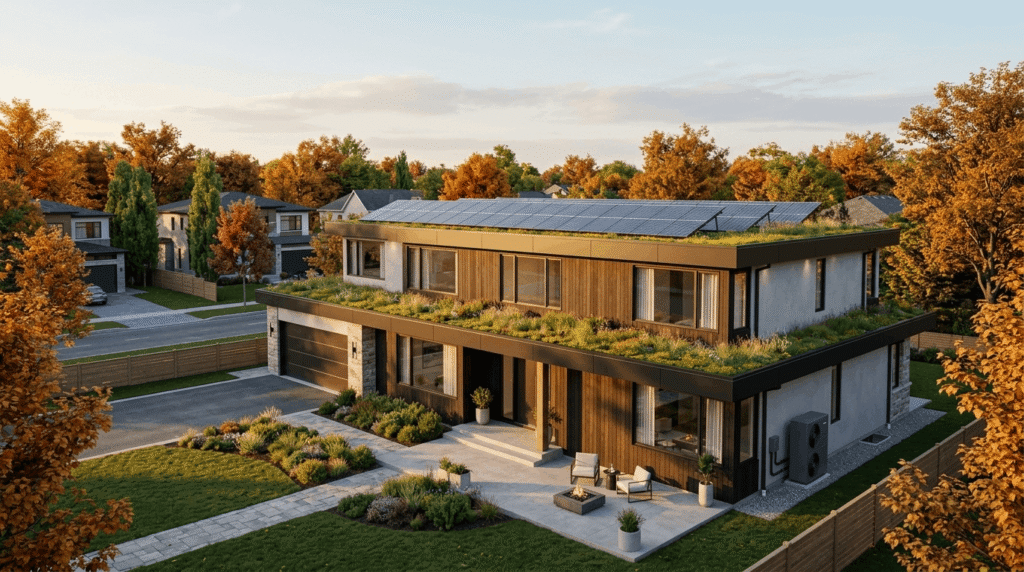
Quick Answer Box: Compare LEED, R-2000, and Zero Carbon Building certifications in Ontario. Understand costs, timelines, and incentives for your 2026 project. R-2000, a federal NRCan standard, delivers homes that average 50% better energy efficiency than code. ZCB certification targets net-zero carbon in building operations.
What Are Green Building Certifications in Ontario?
Green building certifications in Ontario are voluntary third-party programs that verify a building meets defined standards for energy efficiency, carbon reduction, water performance, and indoor air quality. Three programs matter most in 2026: LEED, the Zero Carbon Building (ZCB) standard, and R-2000. Each targets a different building type and performance priority. Picking the right one from the start avoids costly redesigns and documentation gaps mid-project.
These rules tie back to the 2026 Ontario Building Code changes, which are worth reviewing before you design.
What Is LEED Certification Ontario and How Does It Work?
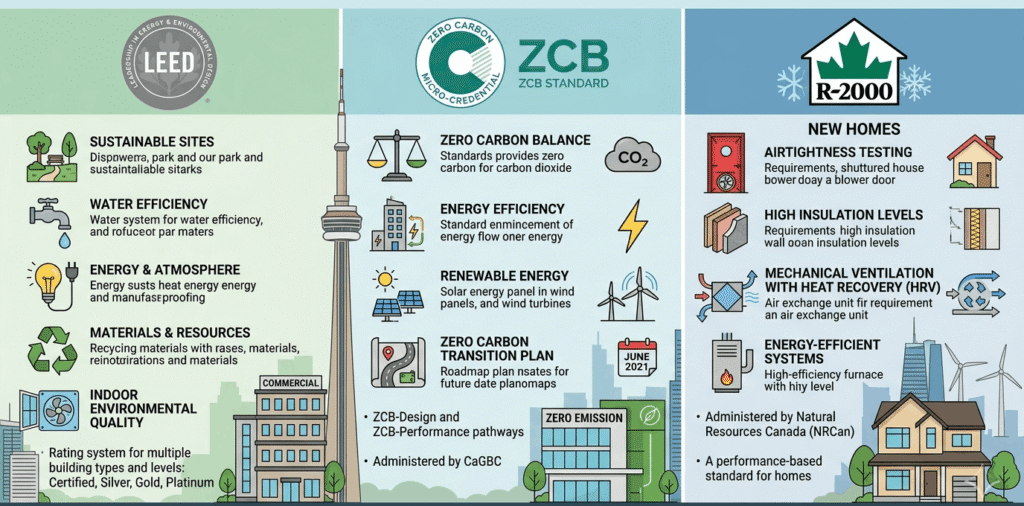
LEED, short for Leadership in Energy and Environmental Design, is the most widely recognized green building certification in Canada. The Canada Green Building Council (CAGBC) administers all LEED projects in Canada through a 110-point rating system that spans eight sustainability categories: location and transportation, sustainable sites, water efficiency, energy and atmosphere, materials and resources, indoor environmental quality, innovation, and regional priority.
Ontario projects earn one of four rating levels: Certified (40 to 49 points), Silver (50 to 59), Gold (60 to 79), or Platinum (80 and above). Canada ranked third globally in LEED-certified space in 2022, with 248 projects totalling more than 5.3 million square metres certified that year. Ontario drives a significant share of that volume. Prominent recent examples include 100 Yonge Street in Toronto’s financial district, which completed LEED certification in late 2025.
LEED applies to all building types: new construction, existing buildings, commercial interiors, homes, and whole communities. CAGBC certification fees for a new commercial building up to 2,500 m² start at $7,250 CAD. Larger or more complex projects can run from $15,000 to well over $100,000 once consulting and documentation are included. On the construction side, achieving basic LEED Certified adds around 2% to total build costs, a premium that typically pays back through lower operating costs and access to municipal incentives across Ontario.
In April 2026, CAGBC launched LEED v5, refocusing the rating system around three core impact areas with stronger embodied carbon requirements than previous versions. Project teams registering now should confirm whether v4 or v5 best fits their submission timeline, since different closing deadlines apply to each.
Multiple Ontario municipalities already mandate LEED standards for publicly funded buildings, and the Toronto Green Standard layers additional requirements for energy, water, waste, and transportation on new developments across the city. Understanding how sustainable construction practices in Ontario interact with LEED targets is a practical first step before registration. Achieving LEED certification can also unlock financial incentives including reduced property taxes and grants, making the investment case stronger than most builders initially expect.
How Do Net Zero Building Certification and R-2000 Compare for Ontario Homeowners?
Both programs focus on residential buildings, but they measure performance differently. Confusing one for the other leads to wrong budget estimates and the wrong builder conversation.
R-2000 is a pass-or-fail federal standard created by Natural Resources Canada (NRCan) in 1982, developed in partnership with the Canadian Home Builders’ Association. It evaluates whole-house energy efficiency, airtightness, ventilation quality, and environmental responsibility. Certified R-2000 homes in Ontario average 50% better energy performance than homes built to code minimums. The builder must hold a current NRCan license, and a third-party energy advisor inspects and certifies every home individually. To stay licensed, builders must certify at least one R-2000 home every three years and attend update workshops every two years, which keeps the quality bar consistent.
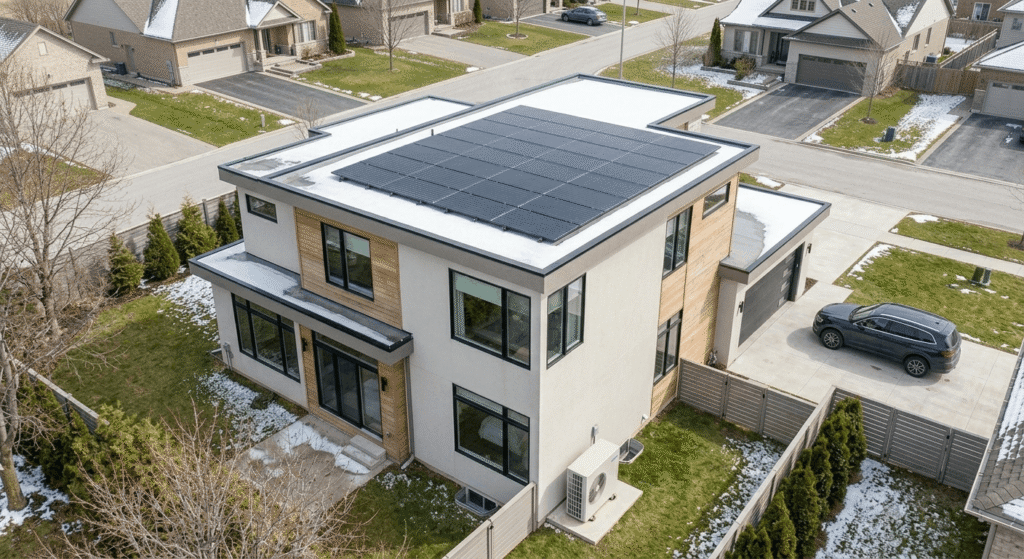
Net Zero Building Certification under the CAGBC’s Zero Carbon Building (ZCB) Standard targets carbon balance rather than energy use alone. The ZCB-Design Standard, at v4 as of June 2024, certifies that a building is designed so annual energy generation from on-site renewables equals or exceeds consumption while also accounting for embodied carbon in materials. The ZCB-Performance Standard then verifies zero-carbon operations each year, making it a renewable credential rather than a one-time stamp. Homes pursuing ZCB certification typically pair solar photovoltaics, heat pumps, and airtight thermal envelopes to meet the green energy output thresholds the standard requires.
| Feature | R-2000 | ZCB-Design v4 |
|---|---|---|
| Administered by | Natural Resources Canada | CAGBC |
| Building type | Residential only | All building types |
| Pass/fail vs. levels | Pass/fail | Certified |
| Energy metric | EnerGuide rating (energy use) | Carbon balance (operational + embodied) |
| Annual renewal required | No | Yes (ZCB-Performance track) |
| Licensed builder required | Yes (NRCan-licensed) | No (project team self-registers) |
For energy-efficient homes Ontario builders want to deliver today, R-2000 remains the more accessible residential path. ZCB certification suits projects targeting full carbon neutrality with integrated renewables. Ontario’s Building Code tightened energy standards further in 2026, narrowing the gap between code-minimum and certified performance, but certified homes still hold clear advantages in utility costs, resale value, and buyer appeal.
Reviewing current Ontario green building standards and policies before selecting a certification path helps teams avoid project delays. For the full federal regulatory picture, NRCan’s green building policies page covers ENERGY STAR for New Homes, EnerGuide ratings, and the National Energy Code for Buildings (NECB), all of which interact with Ontario’s certification landscape.
For the cost-and-incentive side, see our full guide to Net Zero homes in Ontario.
Frequently Asked Questions
1. Does green home certification Canada increase property value?
Yes, and the numbers are measurable. A Toronto appraisal analysis found that roughly $22,800 in annual energy savings from a LEED-certified commercial building translated to approximately $285,000 in added appraised value using local capitalization rates. For residential builds, R-2000 and ZCB-certified homes attract buyers and lenders who factor long-term energy costs into purchase offers, a trend accelerating as Ontario buyers grow more energy cost-conscious.
2. What is the difference between LEED Certification Ontario and R-2000?
LEED applies to all building types and uses a tiered rating system from Certified to Platinum, administered by CAGBC with fees from $7,250 for smaller commercial projects. R-2000 is residential-only and pass/fail, managed by NRCan. Key R-2000 distinctions:
- Covers energy efficiency, airtightness, and indoor air quality together
- Requires an NRCan-licensed builder on every project
- Includes third-party energy advisor inspection before certification
- Delivers homes averaging 50% better energy performance than code minimums
3. How long does LEED certification take in Ontario?
For new construction, LEED documentation runs alongside the design and build process, with the final CAGBC review typically taking three to six months after project completion. Existing buildings pursuing LEED O+M (Operations and Maintenance) recertify every three years, requiring continuous performance tracking through LEED Online. Registering at the start of design, rather than mid-construction, cuts both timeline and documentation costs significantly.
4. Are there grants or rebates available for green building certifications in Ontario?
Yes. LEED certification can unlock financial incentives such as reduced municipal property taxes and development charge rebates in several Ontario cities. R-2000 and ZCB-certified homes may qualify for federal programs tied to EnerGuide evaluations. Incentive availability varies by municipality and program year, so confirming eligibility with your local authority before breaking ground is the most reliable approach.
5. Is green building certification required under the Ontario Building Code?
No. LEED, R-2000, and ZCB certification are all voluntary programs in Ontario. The Ontario Building Code sets the mandatory minimum floor for energy efficiency, and that floor has risen with 2026 updates. Certification programs sit above code and are pursued for competitive, financial, or environmental reasons rather than legal compliance. Some publicly funded projects in Ontario municipalities do require LEED as a procurement condition.
Conclusion
Green building certifications in Ontario have moved from niche credentials to mainstream project requirements. Tightening Ontario building codes in 2026, rising energy costs, and expanding federal incentive programs make LEED Certification Ontario, R-2000, and Zero Carbon Building certification practical business decisions for builders and developers, not just environmental statements. LEED suits commercial and multi-use projects aiming for internationally recognized green home certification Canada-wide. R-2000 delivers proven performance for custom residential builds. ZCB targets full carbon neutrality for projects ready to invest in net zero infrastructure. Selecting the right certification early keeps your Ontario project on schedule and positions it for long-term value. Leedway Group’s net zero energy homes resource explores how these standards translate into real custom home builds across Ontario.
For the complete overview, read our guide to Net Zero homes in Ontario. Ready to start? Talk to the Leedway team about your build.