

Quick Answer Box: The cost of building a house in Canada in 2026 runs roughly $150 to $300 per square foot for a production build and $200 to $400+ for a custom home. An 1,800 sq ft house therefore lands near $270,000 to $720,000 in construction alone, before land, permits and design fees.
What Is the Cost of Building a House in Canada in 2026?
The cost of building a house in Canada covers hard construction plus soft costs like design, permits and financing. A practical 2026 baseline is $150 to $300 per square foot for production-style builds and $200 to $400+ for custom builds, before land and soft costs. Site conditions and province move that number the most.
How Expensive Is It to Build a House of 1,800 Square Feet?
At national averages, an 1,800 sq ft home costs between $270,000 and $540,000 to build in Canada in 2026 using production pricing. Push into custom territory in Vancouver or Toronto and the same footprint can pass $1 million in construction alone. The gap comes down to city, finish level and who builds it.
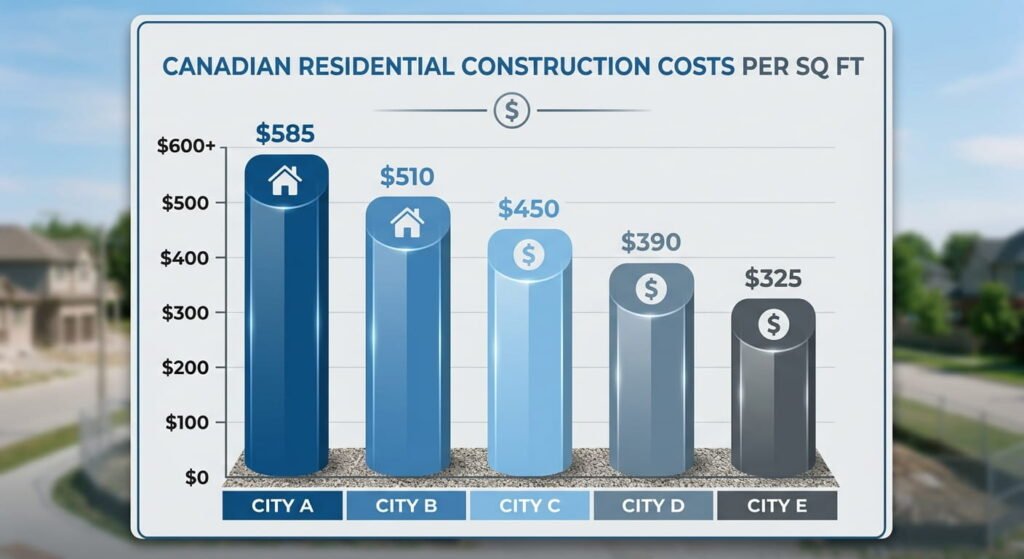
Regional spreads are wide. Altus Group’s cost guide put production builds as low as $140 per square foot in Halifax and Ottawa and as high as $320 in Vancouver, while custom homes ran $345 to $695 per square foot in Halifax versus $495 to $1,250 in Vancouver. Quebec typically sits higher than many markets, often $260 to $350 per square foot.
Here’s what those ranges look like applied to 1,800 square feet.
| Build type | Cost per square foot | 1,800 sq ft construction cost | Typical buyer |
|---|---|---|---|
| Economy production | $150 to $215 | $270,000 to $387,000 | Halifax, Ottawa, prairie markets |
| Mid production | $215 to $320 | $387,000 to $576,000 | Suburban GTA, Calgary, Vancouver |
| Standard custom home | $345 to $500 | $621,000 to $900,000 | Design-build, owner-selected finishes |
| High-end custom | $500 to $1,250 | $900,000 to $2,250,000 | Prime Toronto and Vancouver lots |
Cost pressure has cooled but hasn’t stopped. Statistics Canada reported residential building construction costs up 0.5% in Q2 2026 after a 0.7% rise the previous quarter, with the 15-city composite up 2.3% year over year. The regional split matters more than the national figure. Québec led quarterly increases at 2.6%, followed by Montréal at 2.5%, Halifax at 2.1% and both Saskatoon and Regina at 2.0%, while Toronto actually fell 0.8%, Vancouver 0.2% and Calgary 0.1%. Statistics Canada
Why builder quotes never match the index
One trap catches almost every first-time builder. The Building Construction Price Index reflects materials, labour, equipment, overhead and profit, but it excludes taxes, land, land assembly, building design, land development and real estate fees. So the government number tracks house construction, not your project total. Two quotes at the same dollar figure can differ by six figures in scope. Always demand a line-item exclusion list before you compare. Statistics Canada
What Does Land Cost Add Before You Build a House?
Land cost is usually the single largest variable in the whole budget and the one national averages hide. In Alberta, land acquisition commonly absorbs 20% to 40% of total home building expenses. A lot can run anywhere from $50,000 to more than $500,000 depending on location.
Serviced urban lots carry the highest sticker price but the fewest surprises. Rural land is cheaper per acre and then charges you back. Rural parcels outside the city may add well, septic, or long driveway construction that a serviced lot does not require. Budget those as separate line items, not as a rounding error.
If you already own the lot and plan to tear down and rebuild, you skip the acquisition entirely, which changes the arithmetic more than any finish selection ever will. Our financial planning guide for Ontario builds walks through how lenders treat owned land as equity in a construction draw.
Development charges sit next to land in the budget and behave like a second purchase price in some municipalities.
Architectural Fees, Engineering Fees and the Soft Costs Nobody Quotes
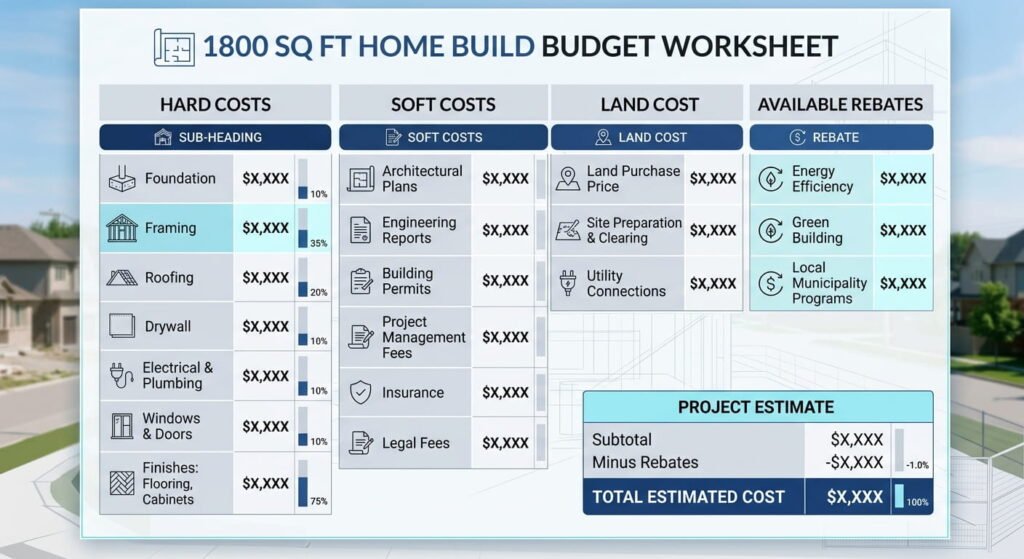
Soft costs add 15% to 25% on top of hard construction on most Canadian projects. Architectural and engineering fees typically run 5% to 10% of hard build costs, legal, survey and planning work adds $5,000 to $20,000, and project management can add another 2% to 5%. These land early, before a shovel moves. Leedway Group
Break the design side down further. Structural engineering usually adds 1% to 3% of construction cost on top of the base architectural fee, and a new-build land survey runs about $1,000 to $3,000 depending on lot complexity. On an 1,800 sq ft build costing $450,000 to construct, that’s $22,500 to $45,000 in architectural fees and engineering fees combined, plus permits.
Ask whether subconsultants are bundled or billed separately. It changes the total by thousands.
The $50,000 rebate most cost guides still miss
Here’s the 2026 change that actually moves a budget. The first-time home buyers’ GST/HST rebate now refunds 100% of the GST, or the federal part of the HST, on a new home valued up to $1 million, phasing out between $1 million and $1.5 million. Eligible individuals can recover up to $50,000, and the CRA opened applications in 2026. Canada.ca
Owner-builders qualify too. If you built your own home and started construction on or after March 20, 2025, you apply directly to the CRA using Form GST191, and you generally have two years from taking ownership or finishing construction to file. In Ontario there’s a second layer. The Ontario first-time home buyers’ rebate provides up to $80,000 of the provincial part of the HST for individuals buying, building or substantially renovating a first home. Canada.ca
That is real money against the cost of building a house in Canada, and it is claimed, not automatic.
Frequently Asked Questions
1. How much does it cost to build an 1,800 sq ft house in Canada in 2026?
Expect $270,000 to $540,000 for construction at production pricing of $150 to $300 per square foot. Custom builds in Toronto or Vancouver can exceed $900,000 for the same footprint. Land, development charges and design fees sit on top of every one of those figures.
2. Is it cheaper to build a house or buy an existing one in Canada?
Buying usually wins on speed and certainty. A purchase closes in 30 to 90 days versus 8 to 14 months for a build, and avoids change-order costs. Building wins when you want a specific layout, energy performance, or a lot you already own.
3. What percentage of my budget should go to land cost?
Plan on these shares:
- Land: 20% to 40% of total project cost in most markets
- Hard construction: 50% to 65%
- Soft costs including architectural fees and engineering fees: 15% to 25%
- Contingency: 10% to 15% on top
4. Do architectural fees and engineering fees get included in a per-square-foot quote?
Usually not. Standard builder quotes cover hard costs only. Design, structural engineering, surveys and permits are billed separately and commonly total 5% to 10% of construction value. Confirm in writing what each quoted figure includes before comparing two builders.
5. Can I claim the GST rebate if I build the house myself?
Yes, if you’re a first-time buyer and construction started on or after March 20, 2025. You file Form GST191 with the CRA rather than receiving a builder credit, and the rebate reaches $50,000 federally on homes up to $1 million.
Conclusion
The cost of building a house in Canada for an 1,800 sq ft home realistically spans $270,000 to well past $1 million once land, soft costs and region are counted. Get three line-itemed quotes, confirm what each excludes, and check your rebate eligibility early. For provincial detail, see our full Ontario custom home price guide, the Ontario cost per square foot breakdown, or compare against modular construction pricing.