

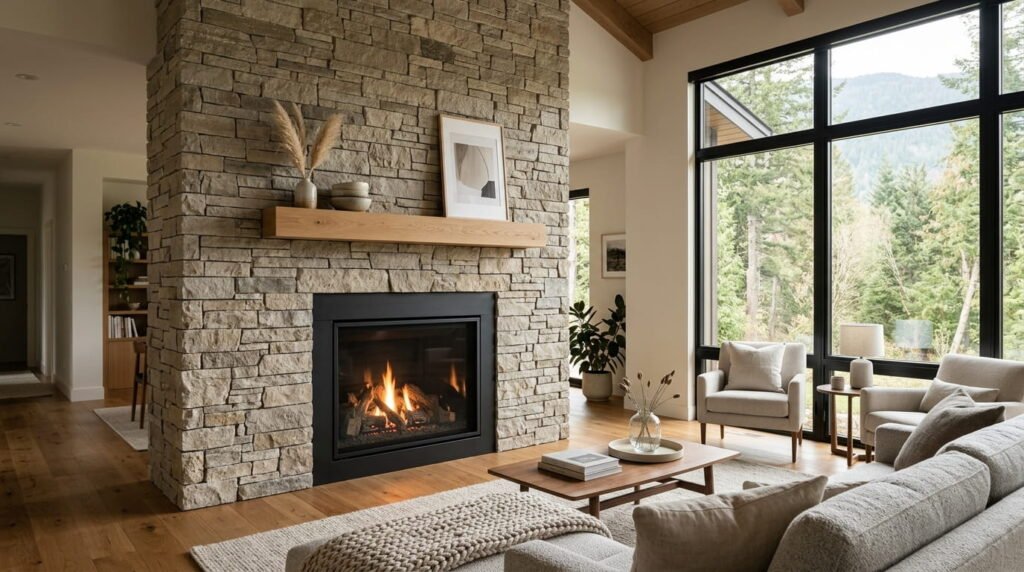
Quick Answer: A modern fireplace renovation updates the surround, hearth and firebox so the fireplace suits current design and Canadian safety rules. Most homeowners reface with stone, tile or plaster for $1,500 to $5,000. A gas insert conversion runs closer to $4,000 to $8,000 installed, permits and licensed gas work included.
What is a modern fireplace renovation?
A modern fireplace renovation is a scope-limited rebuild of the fireplace and the wall around it: new surround material, a reworked hearth, an updated mantel, and often a new insert. In Canada it also means bringing venting and clearances back in line with current code, plus carbon monoxide protection.
About a quarter of Canadian homes already have a gas fireplace, and most run it as supplementary heat rather than a main heat source, according to the Canada Energy Regulator. So most projects here aren’t about adding heat. They’re about fixing a wall that dates the whole room.
That distinction sets your budget. A cosmetic fireplace makeover leaves the firebox alone and changes only what you see. A full fireplace remodel touches the appliance and the venting, which pulls permits and licensed trades in and starts to resemble any other structural renovation project.
How much does a fireplace remodel cost in Canada?
Fireplace remodel cost in Canada usually lands between $1,500 and $8,000. Refacing a surround with manufactured stone or tile sits at the low end. A direct-vent gas insert with a new chimney liner, a permit and a licensed gas connection sits at the top, before finishing work.
Material rate is the number most people fixate on. In the GTA, installed stone veneer runs roughly $9 to $18 per square foot for polymer panels, $18 to $36 for manufactured veneer, and $45 to $75 for natural quarried stone. Labour is the quiet variable: it’s about 26% of a polymer install and climbs to roughly 60% of a natural stone install, because real stone needs a mason, mortar, lath and cure time.
| Scope | Typical installed cost (CAD) | Main cost driver |
|---|---|---|
| Manufactured stone or tile reface | $1,500 to $5,000 | Surround area and corner count |
| Full-height natural stone surround | $8,000 to $20,000+ | Mason labour and cutting |
| Gas insert, supplied and installed (Ottawa) | $2,500 to $6,000+ | Unit tier and venting route |
| Gas insert conversion with liner and permit (Vancouver) | $4,000 to $8,000 | Chimney condition, gas fitter time |
| New gas line run to the fireplace | $400 to $1,200 | Distance from meter, wall access |
One line item catches people out.
Corners get billed by the linear foot, not the square foot, so a corner-heavy fireplace can add 15% to 25% to a stone takeoff that looked settled. Build contingency into your renovation budget planning, especially in a pre-1980 house where the firebox can hide surprises.
Which fireplace finishes work best in a modern makeover?
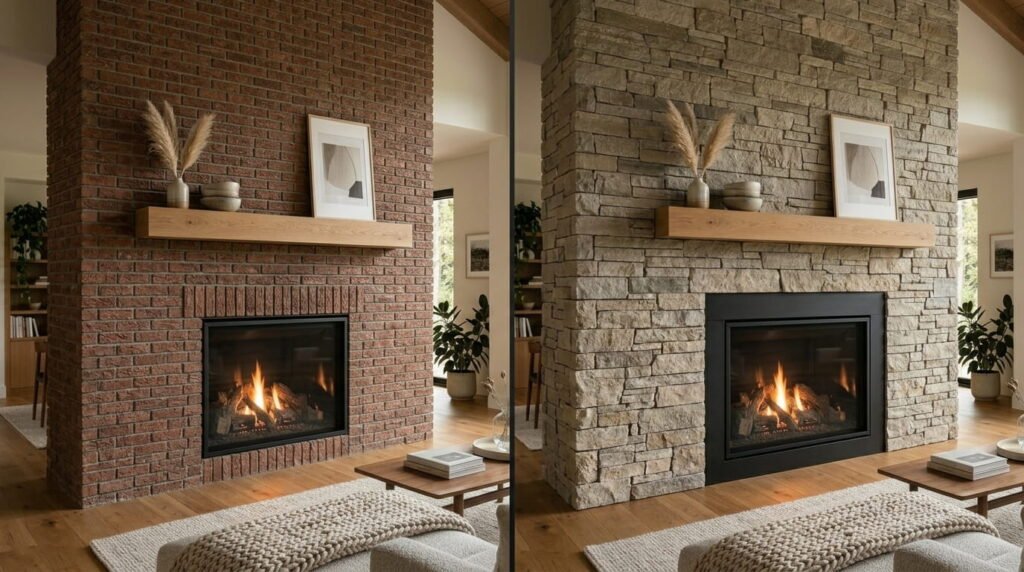
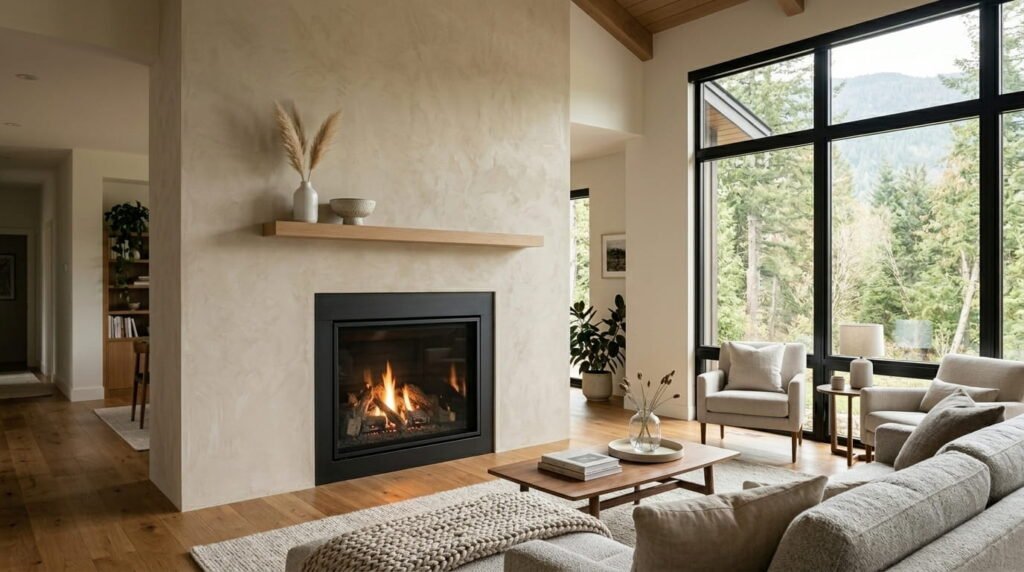
The fireplace finishes carrying a modern fireplace renovation in 2026 are quiet and continuous: limewash over sound brick, lime or Venetian plaster, microcement, large-format porcelain, and stone run floor to ceiling. Texture now does the work that ornament and heavy mantels used to do. Warm, earthy tones have displaced cool grey.
Limewash is the cheapest honest upgrade for a brick fireplace. It softens the colour without hiding the texture, though the product must suit masonry and needs cure time. Porcelain slab sits at the other end: fewer grout lines, more height, higher fabrication cost.
Fireplace stone makeover ideas that still look current
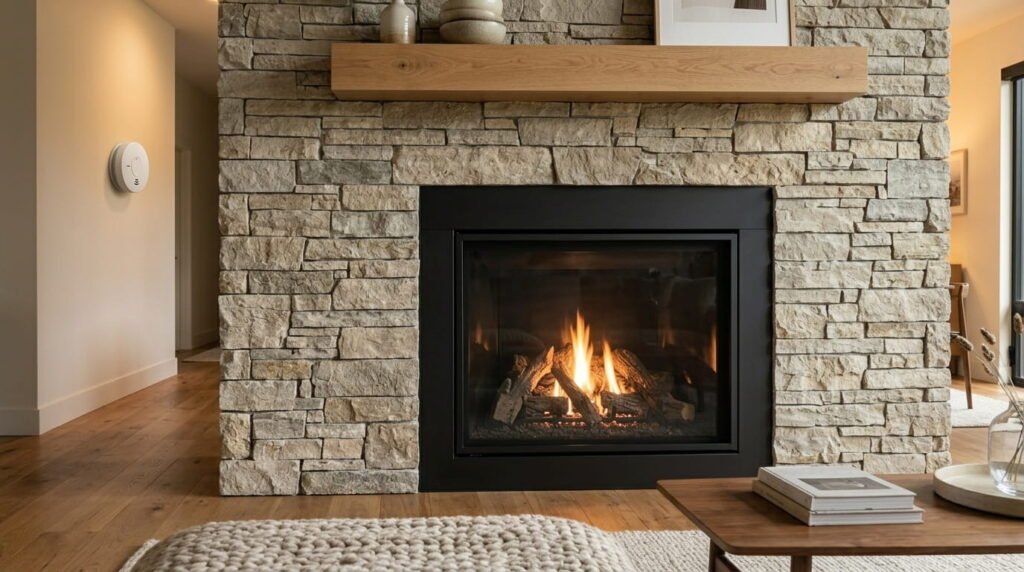
A fireplace stone makeover works best when the stone does one thing well. Vertical dry-stack ledgestone, honed limestone, fluted travertine, or a bookmatched slab with veining that carries from hearth to ceiling all read as deliberate. Busy multi-tone blends read as 2012.
Manufactured veneer weighs less and installs faster than quarried stone, which is why it dominates stone veneer work in Canadian renovations. Natural stone holds colour better over decades. Both go over sound brick without demolition in most cases.
Planning a fireplace accent wall
A fireplace accent wall typically covers 75 to 150 square feet. Multiply that area by your material rate for a working budget, plus 10% to 15% for waste on most veneer products.
Two details decide whether the wall looks custom or awkward. Clearance to combustibles around the opening comes from the manufacturer’s instructions, not from taste, and it governs mantel depth. Cable routing for a mounted TV gets roughed in before the finish goes on, because nobody wants to cut a channel through fresh plaster.
Is a gas fireplace conversion worth it in Canada?
A gas fireplace conversion buys convenience and cleaner combustion. It doesn’t automatically buy lower bills. A CMHC study cited by the Canada Energy Regulator found that homes running a gas fireplace alongside a high-efficiency furnace used about 10% more total energy than the furnace alone.
The safety case is stronger than the savings case. Natural Resources Canada separates decorative gas fireplaces from heating models and rates the latter on fireplace efficiency, or FE. Sealed direct-vent appliances pull combustion air from outside instead of from your living room, and they let an old masonry chimney stay in service once it’s relined.
Who does the work isn’t optional. In Ontario a TSSA-certified gas technician has to make the connection; in British Columbia it’s a licensed gas fitter under Technical Safety BC. An Ottawa insert swap with a new liner is typically a four to eight hour job. If you’re weighing what to hand off to a licensed pro, gas is never the DIY line item.
Permits are where Canadian rules split apart, and this is the stage of a modern fireplace renovation people underestimate. Toronto doesn’t require a building permit to install a gas fireplace in a house, while Ottawa requires one for an insert or chimney liner. Several Montréal boroughs require a permit before you install, replace or remove a fuel-burning appliance, plus a declaration within 120 days.
Wood is regulated harder. Montréal prohibits using a solid fuel appliance unless it emits under 2.5 grams of fine particles per hour, and bans all wood burning during smog warnings. One code change reaches every fireplace owner in Ontario: since January 1, 2026, homes with a fireplace, fuel-burning appliance or attached garage need a carbon monoxide alarm on every storey and next to each sleeping area.
Frequently Asked Questions
1. What is the cheapest way to modernize an old brick fireplace?
Limewash or masonry paint is the lowest-cost route, and it keeps the brick texture visible. Other budget moves that hold up:
- Swap a bulky mantel for a slim floating shelf
- Replace dated brass doors with a matte black screen
- Extend the existing finish upward with shiplap
- Repoint crumbling mortar before finishing anything
2. Do I need a building permit for a fireplace renovation in Canada?
A modern fireplace renovation may or may not trigger one. Toronto requires a permit to install or reconstruct a chimney or fireplace, but exempts gas fireplace installs in houses. Ottawa requires permits for woodstoves, inserts, chimney liners and pre-manufactured fireplaces. Cosmetic refacing usually needs none. Confirm with your municipality first.
3. Can you put stone veneer over existing brick?
Yes, in most cases, provided the brick is structurally sound and clean. Installers typically apply lath and a scratch coat over the masonry, then set the veneer. This avoids demolition and keeps the firebox untouched. Have a mason check for spalling, moisture, crumbling mortar or old paint first.
4. Can I still use my wood-burning fireplace in Canadian cities?
Often yes, but rules tightened. Montréal bans solid fuel appliances emitting more than 2.5 grams of fine particles hourly, with an exception for power outages lasting over three hours. Several Québec municipalities have set their own deadlines. Check your city’s bylaw before spending money renovating a wood firebox.
5. Does a gas fireplace actually save money on heating?
Not reliably. A gas fireplace heats the room it’s in, so the rest of the house can drift cooler while that room overheats. Natural Resources Canada rates heating gas fireplaces by fireplace efficiency, which measures seasonal performance. Compare FE figures rather than trusting a brochure percentage.
Conclusion
A modern fireplace renovation pays off when the design decision and the code decision get made together, not six weeks apart. Price the finish by square foot, confirm your Canadian municipality’s permit rules early, and hire licensed trades for anything touching gas or venting. The rest is choosing a material you’ll still like in ten years.