

Quick answer: HATC Ontario 2026 lets a senior or a person with a disability claim up to $20,000 of permanent accessibility work on line 31285 of the federal return. The credit rate dropped to 14 per cent this year, so a full claim cuts federal tax by $2,800. Most guides still say $3,000.
What is the Home Accessibility Tax Credit?
The Home Accessibility Tax Credit is a non-refundable federal credit for permanent renovations that let a senior or a person with a disability get into a home, move around inside it, or avoid injury there. Ontario homeowners claim it on their own tax return, backed by contractor invoices and proof of payment.
Ontario has no provincial twin for it. The Seniors’ Home Safety Tax Credit covered 2021 and 2022 only and never returned, so provincial help now arrives as application-based funding with deadlines and approval steps. The federal credit has neither.
Who qualifies, and which accessibility renovations count?
Two roles create eligibility. A qualifying individual is 65 or older at the end of the year, or eligible for the disability tax credit at any time in the year. An eligible individual, usually a spouse or a caregiving relative, can claim on that person’s behalf.
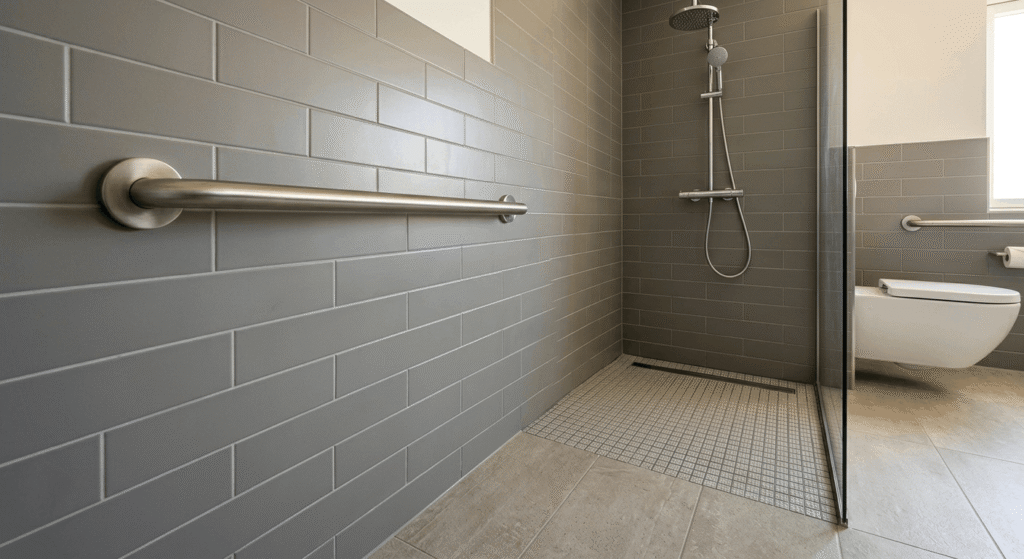
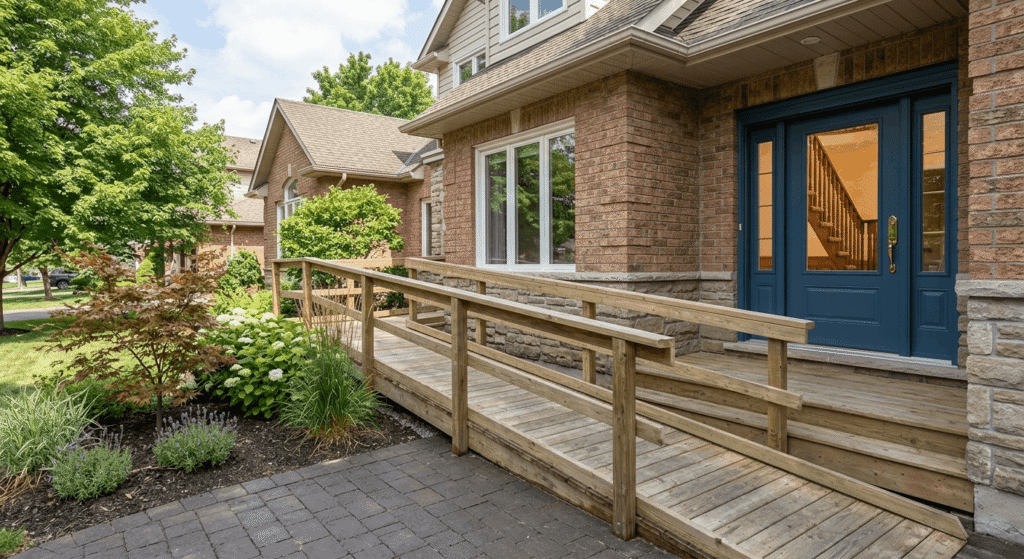
The work has to be of an enduring nature and integral to the dwelling. Grab bars, walk-in tubs, ramps, widened doorways, lowered counters, non-slip flooring and a main-floor bathroom all pass. Portable equipment generally fails, and CRA’s rules for line 31285 also exclude routine maintenance, appliances, financing costs and work done mainly to raise the home’s value.
Doing it yourself? Materials, fixtures, permits, plans and equipment rentals count. Your own labour and tools do not. Work by a relative qualifies only if that relative is registered for GST/HST. Condo owners can claim their share of common-area accessibility work, which almost nobody asks about.
How much is HATC Ontario 2026 actually worth?
Fourteen per cent. Bill C-4 received Royal Assent on March 12, 2026 and set the lowest federal tax rate, which is also the rate applied to most non-refundable credits, at 14 per cent for 2026 and later years. So $20,000 of eligible work returns $2,800 in federal tax relief.
The same claim was worth $2,900 for 2025 at the blended 14.5 per cent rate and $3,000 through 2024. A temporary Top-Up Tax Credit runs from 2025 to 2030 and holds the old 15 per cent rate for credit amounts above the first bracket threshold of $58,523, though Finance Canada’s June 2026 report puts the share of filers who need it under 0.3 per cent.
Since the credit is non-refundable, it does nothing for someone with no federal tax owing. A parent on modest retirement income often sits in that group. The adult daughter who paid the contractor usually does not. Settle whose name goes on the invoice before work starts.
One overlap gets missed constantly. An expense that also qualifies as a medical expense can be claimed on line 31285 and again on lines 33099 or 33199. A few 2026 articles wrongly report that door as closed. Only 39,000 Canadians claimed the credit in 2023.
Home Accessibility Tax Credit vs Ontario Renovates program: which one fits?
The Home Accessibility Tax Credit vs Ontario Renovates program decision turns on income and timing. The credit has no income test and no application, and it pays when you file. Ontario Renovates is income-tested, first come first served, and needs written approval before anyone cuts a board.
Amounts move by region, since the province funds the program through the Ontario Priorities Housing Initiative and local service managers deliver it. London’s 2026 program offers a ten-year forgivable loan up to $25,000, with the first $5,000 of approved accessibility work paid as an outright grant. Haldimand and Norfolk cap repairs at $15,000 plus a $5,000 grant, with income and asset tests attached. Toronto homeowners have no local equivalent now, after the City discontinued its program.
Use both where you can. CRA states the credit is not reduced by government assistance, including grants, forgivable loans and provincial tax credits, so program money does not shrink your claim. Ontario’s Home and Vehicle Modification Program adds up to $15,000 in lifetime funding for ramps, stairway lifts, wheel-in showers and wider doors.
What do stair lift installation and wheelchair accessibility upgrades cost?
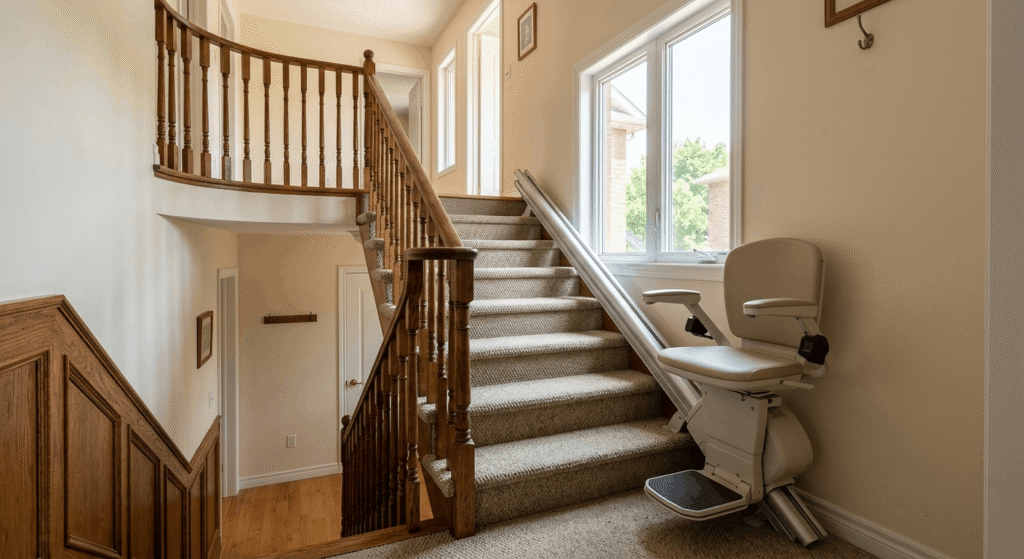
Ontario pricing stayed in a tight band through 2026. A straight-rail stair lift installation runs roughly $3,000 to $5,500 installed, refurbished units land nearer $2,200 to $3,500, and a custom curved rail for stairs with a turn starts around $10,000 and can pass $15,000.
Wheelchair accessibility costs more because it moves walls. Doorways widened toward the 800 to 900 millimetre clear width a chair needs, a solid exterior ramp, and a bathroom rebuilt with a curbless shower and roughly 1,500 millimetres of turning space can absorb the whole limit. Mobility access solutions that stop at the front step leave the real barrier in place, so scope the entry, the bathroom and a main-floor bedroom together. For anything larger, compare in-law suite addition costs in Ontario first.
One scheduling trick pays for itself. The limit resets every calendar year, so a big project split across December and January earns two limits, provided the work and the payments genuinely fall in each year.
Do universal design homes make aging in place easier?
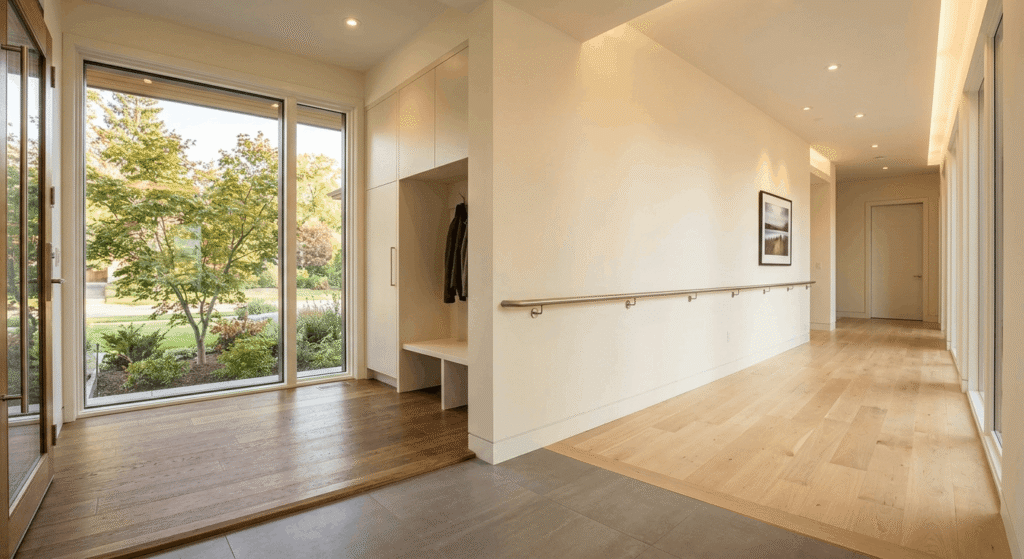
Universal design homes take the retrofit out of the equation. Level entries, wider halls, blocking behind bathroom walls for grab bars later, and a main-floor bathroom and bedroom cost very little during construction and a fortune after a fall.
Statistics Canada found home adaptations such as grab bars, handrails and adapted bathing facilities already in use by 25 per cent of people aged 65 to 79 and 51.9 per cent of those 80 and older. Aging in place is the default plan for most Ontario families, which is why our guide to aging-in-place garden suites in Toronto comes up so often when a parent moves closer.
Where the plan involves a self-contained unit for that parent, the separate multigenerational home renovation tax credit covers up to $50,000 of qualifying work and is refundable. Our multigenerational home design guide shows where the two overlap.
Frequently asked questions
1. Who can claim the Home Accessibility Tax Credit in Ontario?
Anyone 65 or older by December 31, or eligible for the disability tax credit at any point in the year, qualifies as the person the work is for. A spouse, or a relative claiming a caregiver amount for them, can claim instead and often should, since the credit only offsets tax owing.
2. Does a stair lift installation qualify for HATC Ontario 2026?
Yes. A stair lift fastens to the structure, so it meets the enduring and integral test on line 31285. A straight-rail installation usually runs $3,000 to $5,500 in Ontario, which at the 2026 rate of 14 per cent returns $420 to $770 in federal tax relief.
3. Can I claim the same accessibility renovations as a medical expense too?
Yes. CRA allows an expense that qualifies as both to be claimed on line 31285 and again as a medical expense on lines 33099 or 33199. Bathroom modifications for someone with a mobility impairment commonly qualify twice. Keep one invoice set and report the amount in both places.
4. Will an Ontario Renovates grant reduce my Home Accessibility Tax Credit claim?
No. CRA states the credit is not reduced by government assistance, including grants, forgivable loans and provincial tax credits. A $5,000 accessibility grant and a $20,000 claim can coexist. The claimant still has to have incurred the expense, so keep records of who paid what.
5. What documents does CRA want if my claim gets reviewed?
Invoices naming the contractor, their business address, their GST/HST number where it applies, a description of the work, the address, the dates, the amount, and proof of payment. Do not send them with your return. Keep them in case CRA asks later.
Conclusion
HATC Ontario 2026 is worth less than it was and still worth planning around properly. Confirm who in the household has tax owing, put the invoices in that name, check whether your service manager still runs Ontario Renovates, and time larger work across two annual limits. Accessibility renovations never get cheaper by waiting.